
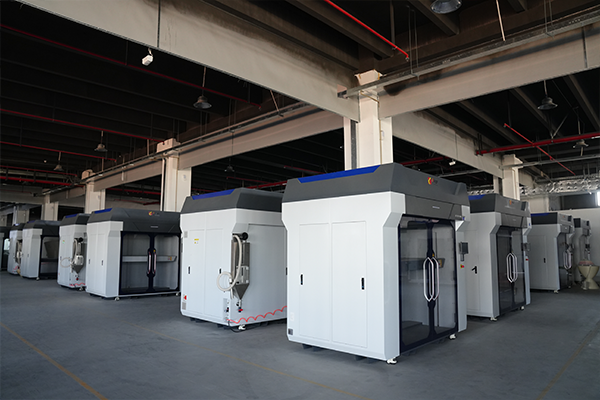
This hall is built around scale. Fused granulate fabrication (FGF) feeds plastic pellets straight into a heated screw extruder instead of drawing filament off a spool, which lets these machines lay down material an order of magnitude faster than a desktop printer and build objects measured in meters rather than centimeters. Sculptures and mall displays, furniture, architectural mock-ups, automotive bucks, foundry patterns and large jigs all come out of this room — parts that would otherwise be carved from foam or split into dozens of glued segments.
Inside the Workshop
The large-format machines run nozzles up to 9 mm and deposit up to 15 kg of material per hour, so a body-sized object is a job measured in hours rather than weeks. Pellet feedstock also changes the economics: raw granulate costs a fraction of spooled filament, and the machines accept engineering grades including glass- and carbon-fiber-reinforced compounds that stay dimensionally stable at that size. Because the extruded bead is deliberately coarse, most parts leave this room for the finishing department, where they are filled, sanded, primed and painted — or laid up with fiberglass for outdoor installations.
Quality & Process Control
Large-format printing calls for a different quality conversation than precision processes, and we would rather set the expectation than surprise you with it. At a 9 mm bead and meter-scale geometry, accuracy is measured in millimeters rather than hundredths, because thermal contraction across a large part is simply bigger than the extrusion tolerance. So parts are checked against the model once they have cooled fully rather than straight off the bed, and where a face has to mate with something we print near-net and machine that specific feature afterwards. If your part genuinely needs tight tolerances we will say so at quote time and propose CNC machining or a finer printing process instead. The plant operates under ISO 9001:2015, ISO 14001, ISO 13485 and IATF 16949.
Related Services
This workshop produces our FGF large-format 3D printing service and our FDM printing. Fine detail on a large object is usually printed separately in SLA and bonded on. Filling, sanding, painting and fiberglass lay-up are handled by surface finishing.
Start Your Project
Send us a STEP or IGES file and we will come back within 1–3 hours with a quote and free design-for-manufacturing feedback. Your files stay confidential, there is no minimum order quantity, and every process on this page runs under one roof with one project manager. Get a free quote.