
The SLA workshop is where most Jingrui Proto projects start. A UV laser traces each 25–100 micron layer across a vat of liquid photopolymer, so the parts that come off the platform hold sharp edges, thin ribs and engraved text that extrusion processes soften or lose. In our one-stop workflow this room feeds three routes downstream: appearance models go straight to the finishing area for painting and plating, master patterns move to the vacuum casting room to be copied in polyurethane, and fit-check parts ship as printed for design review.
SLA resin 3D printing delivers high‑resolution, smooth‑surface plastic prototypes.
Perfect for appearance models, assembly verification, concept mock‑ups, complex artistic structures. Widely used in consumer goods, figurines, housing prototypes.
Inside the Workshop
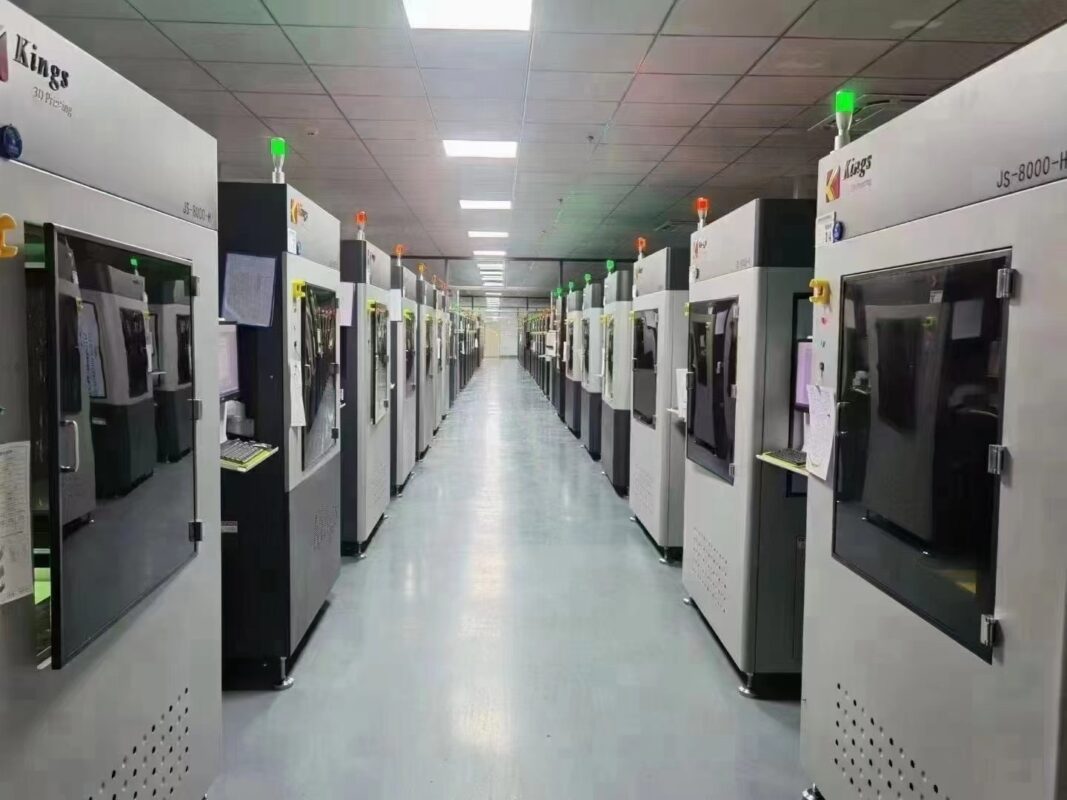
More than 100 resin printing systems run in this building, including ZRapid and UnionTech SLA880 and SLA1700 machines. The largest of them build single pieces up to 1700 × 800 × 600 mm, which means full-size housings, bumper sections and display models are printed whole instead of bonded together from segments — no glue lines to sand out, no assembly tolerance stacking up. Machines are grouped in long aisles so one operator can supervise several builds at once, and printers run unattended overnight. Standard, tough, high-temperature, transparent and castable resins are stocked on site, so a material change does not turn into a procurement delay.
Available Materials
‑ Standard resin: High detail, good surface finish for appearance prototypes
‑ Tough resin: Impact‑resistant for simple functional testing
‑ High‑temperature resistant resin
‑ Transparent clear resin
‑ Flexible rubber‑like resin
Key Specifications
‑ Layer thickness: 0.05 mm / 0.10 mm optional
‑ As‑printed tolerance: ±0.05‑0.15 mm
‑ Minimum wall thickness: ≥0.8 mm
Post‑processing Services
✅ Support removal
✅ UV post‑curing
✅ Sanding & polishing
✅ Painting, texture spraying
✅ Transparent polishing for clear parts
Quality & Process Control
Control starts before the build. An engineer reviews wall thickness, orientation and support placement against your data, and if the part has critical tolerances or specific datums we ask for a 2D drawing alongside the 3D model — without one we quote and build to our standard tolerances. Parts are checked after cleaning and post-curing, before they move to finishing, because a defect caught at that point costs a reprint rather than a repainted assembly. Resin lots are recorded against the job so a batch can be traced back if a question comes up later. The plant operates under ISO 9001:2015, ISO 14001, ISO 13485 and IATF 16949, so medical and automotive programs can use this workshop without running a separate supplier qualification exercise.
Typical Lead Time
‑ Prototypes: 2‑5 working days
‑ Batch order: 4‑8 working days
Deliverable Documents
‑ Build report
‑ Visual inspection report
‑ NDA agreement available
Related Services
This workshop produces our SLA 3D printing service. Parts that need to survive functional testing rather than a photo shoot are usually better in SLS nylon; runs above roughly twenty identical units are usually cheaper through vacuum casting using an SLA master. Painting, plating and dyeing are handled in our surface finishing department.
FAQ
Q1: Are SLA resin parts strong enough for functional load‑bearing testing?
A: Standard resin is mainly for appearance & assembly check. Choose tough resin for limited functional tests. For heavy‑load parts, select SLS or CNC.
Q2: Can clear resin achieve full transparent effect?
A: As‑printed clear resin is translucent. Multi‑step manual polishing is required for high transparency.
Start Your Project
Send us a STEP or IGES file and we will come back within 1–3 hours with a quote and free design-for-manufacturing feedback. Your files stay confidential, there is no minimum order quantity, and every process on this page runs under one roof with one project manager. Get a free quote.