
The SLS workshop makes the parts customers actually test. Selective laser sintering fuses nylon powder layer by layer inside a heated chamber, and because the surrounding loose powder supports the part as it grows, there are no support structures to design around and no witness marks to sand off. Snap fits, living hinges, internal channels and thin clip arms all print in one piece and survive being assembled, dropped and cycled. That is why this room handles most of our functional prototypes and short production runs.
SLS selective laser sintering uses nylon powder to produce functional plastic parts without support structures.
Great for complex interlocking structures, living hinges, snap‑fit functional prototypes and small‑batch production. No need for support, highly suitable for internal intricate geometry.
Inside the Workshop
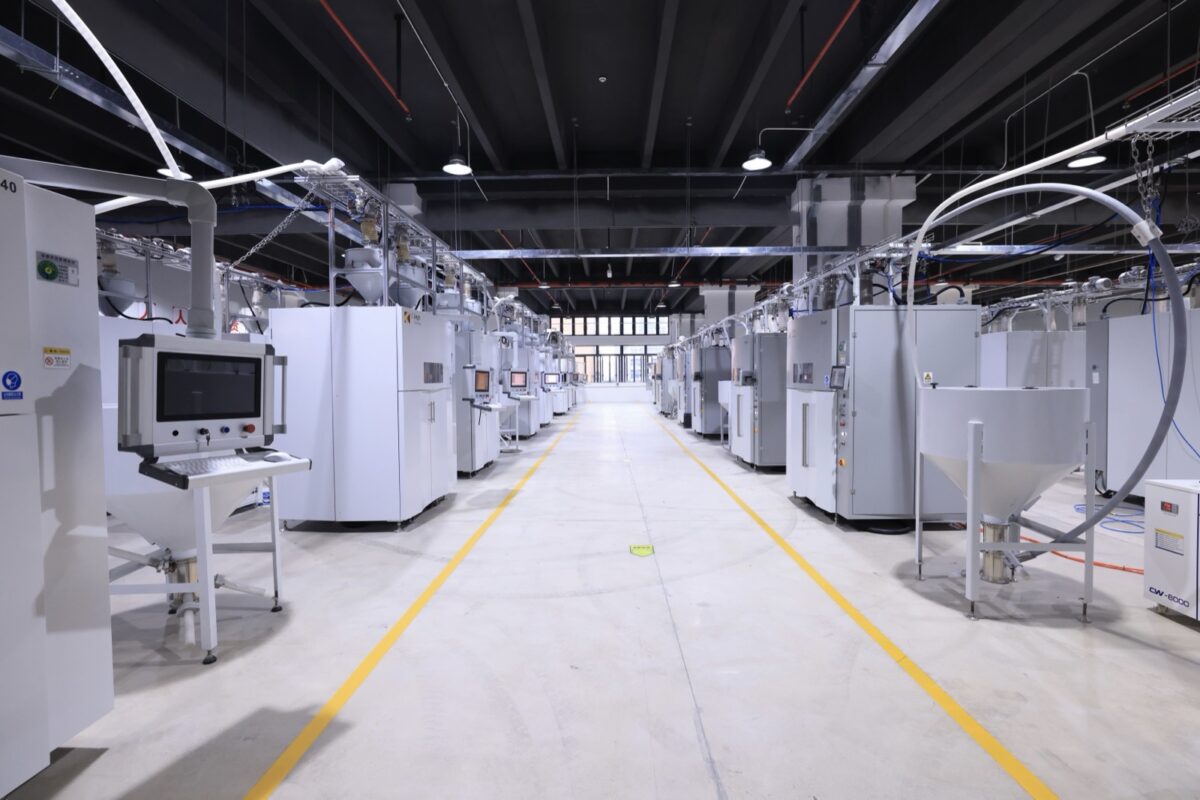
Over 100 powder bed systems run here, built around Farsoon Technologies and Formnext systems, with a working envelope of 320 × 320 × 590 mm per build. Because parts can be nested in three dimensions rather than laid out on a flat plate, a single build can carry dozens of components at once — the reason SLS pricing scales so well from one prototype to a few hundred units. Overhead conveying lines move powder between the machines and the sieving stations, and used powder is blended with virgin material to a fixed refresh ratio so that mechanical properties stay consistent from build to build. PA12 nylon, glass-filled and mineral-filled grades are stocked on site.
Available Materials
‑ PA12 Black Nylon (Standard, most widely used)
‑ PA12 White Nylon (Standard, most widely used)
‑ PA12 + Glass‑filled
‑ PA12 + Carbon‑filled for higher stiffness
‑ TPU flexible powder for elastic rubber‑like parts
‑ PA6+ Glass‑filled
‑ PA6 + Carbon‑filled for higher stiffness
‑ PA11 Black Nylon (Standard, most widely used)
‑ PA11 + Glass‑filled
‑ PA11 + Carbon‑filled for higher stiffness
Key Specifications
‑ As‑printed tolerance: ±0.10‑0.20 mm
‑ Minimum wall thickness: ≥1.2 mm
‑ No support required for most geometries
Post‑processing Services
✅ Ball blasting
✅ Impregnation for better sealing performance
✅ Painting & dyeing
✅ Sanding
Typical Lead Time
‑ Prototype samples: 3‑6 working days
‑ Low‑volume batches: 5‑10 working days
Deliverable Documents
‑ Sintering build report
‑ Material specification sheet
‑ NDA available
Quality & Process Control
Powder is the variable that decides whether an SLS part is good. Used powder is sieved and blended with virgin material to a fixed refresh ratio, and chamber temperature is held through the build, because drift in either shows up later as a warped or brittle part rather than as an obvious failure on the platform. PA12 from these machines reaches roughly 45–50 MPa tensile strength, in the same range as molded nylon, which is the property customers are actually relying on when they load a bracket or cycle a snap fit. Parts are inspected after depowdering and bead blasting, before finishing. The plant operates under ISO 9001:2015, ISO 14001, ISO 13485 and IATF 16949.
Related Services
This workshop produces our SLS 3D printing service and our MJF work. When a part needs a cosmetic, paint-ready surface instead of the matte grain of sintered nylon, we quote SLA; when it needs metal strength, SLM metal printing or CNC machining. Dyeing, vapor smoothing and painting are handled in surface finishing.
FAQ
Q1: Why SLS parts have grainy surface?
A: Powder sintering creates matte grain surface. Painting or impregnation can improve surface quality.
Q2: Can SLS make moving interlocking assemblies in one print?
A: Yes, no support needed, we can print assembled moving structures as‑one piece.
Start Your Project
Send us a STEP or IGES file and we will come back within 1–3 hours with a quote and free design-for-manufacturing feedback. Your files stay confidential, there is no minimum order quantity, and every process on this page runs under one roof with one project manager. Get a free quote.