
Vacuum casting is how we bridge the gap between one prototype and an injection tool. A 3D printed master is finished to the exact surface the customer wants, suspended in a frame and cast in liquid silicone; once the silicone cures it is cut open along a parting line and becomes a mold. Polyurethane resin is then poured into that mold under vacuum, which pulls the air out of the cavity and gives clean, bubble-free copies with the same texture, lettering and gloss level as the master. For a pilot run, a trade show batch or a market test of 2 to 200 units, it is the fastest route to parts that look and feel like production.
Vacuum Casting (Silicon molding) is a cost‑effective solution for low‑volume plastic copies from one master prototype.
Perfect for 2‑200 pieces small‑batch runs, before expensive hard‑tool injection molding. Great for appearance verification, market test samples.
Inside the Workshop
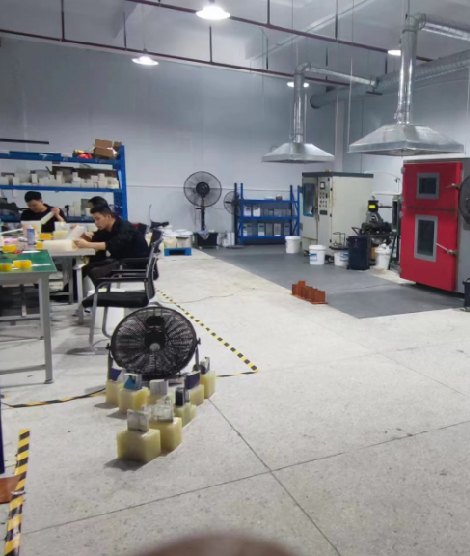
The room holds complete vacuum casting equipment: mixing and degassing chambers, casting stations and curing ovens, with extraction hoods over the working area. Each silicone mold yields roughly 15–20 parts before the cavity softens and detail begins to drop off, so quantity is planned as a number of molds rather than a single tool — and multiple molds can run in parallel when a deadline is tight. Polyurethanes are selected to imitate the target production material: ABS-like and PP-like rigid grades, clear resins for lenses and light pipes, and rubber-like grades spanning Shore A 20 to Shore D 85 for gaskets and grips. Molds are ready in 1–3 days and first parts in 3–7. Color is mixed into the resin before casting rather than sprayed on afterwards, so a scratch does not expose a different color underneath.
Available Casting Materials
‑ PU resin: simulate ABS, PP, PC, PMMA, rubber‑like soft material
‑ Transparent PU resin
‑ Flame‑retardant PU material
‑ Glass‑filled reinforced PU
Key Specifications
‑ Typical copy quantity per silicone mold: 10‑25 shots
‑ Tolerance: ±0.15‑0.25 mm
‑ Max part size: 1200 mm
Post‑processing Services
✅ Gate trimming
✅ Sanding
✅ Painting, matte / glossy finish
✅ Texture spraying
✅ UV coating
Typical Lead Time
‑ Master prototype + silicone mold + 10‑20 pcs samples: 5‑8 working days
‑ Larger quantity: 8‑12 working days
Deliverable Documents
‑ Visual inspection report
‑ Material datasheet
‑ NDA supported
Quality & Process Control
Casting runs about one tolerance band looser than injection molding: roughly ±0.15 mm up to 100 mm and ±0.3% of nominal beyond that, against ±0.05–0.1 mm for a well-tooled injection part. For fit, form and function testing that is almost never the limiting factor, but it is the number to plan around — and where one interface has to be tight, the usual answer is to cast the part and machine that single feature. The master sets everything downstream, so it is finished and signed off before the silicone goes on, since every flaw in the master is reproduced in every copy. Mold life is treated as a consumable rather than pushed: after roughly 15–20 usable parts, dimensional drift and surface degradation set in and a fresh mold is cast from the same master. The plant operates under ISO 9001:2015, ISO 14001, ISO 13485 and IATF 16949.
Related Services
This workshop produces our vacuum casting service. Masters come from the SLA or CNC departments, and finished castings go to surface finishing for painting, texturing or pad printing. Above a few hundred parts, ask us to compare casting against low-volume injection molding.
FAQ
Q1: How many parts can one silicone mold produce?**
A: Normally 10‑25 copies. Complex thin‑wall parts will reduce mold service life.
Q2: Can vacuum casting get transparent parts?**
A: Yes with transparent PU resin, secondary polishing required for high clarity.
Q3: Difference between vacuum casting and injection molding?**
A: Vacuum casting for small batches 10‑50pcs, low tooling cost. Injection molding is for mass‑production with expensive steel mold.
Start Your Project
Send us a STEP or IGES file and we will come back within 1–3 hours with a quote and free design-for-manufacturing feedback. Your files stay confidential, there is no minimum order quantity, and every process on this page runs under one roof with one project manager. Get a free quote.