
Outdoor Digital Signage Enclosure Manufacturing: Fabrication, Testing and System Integration
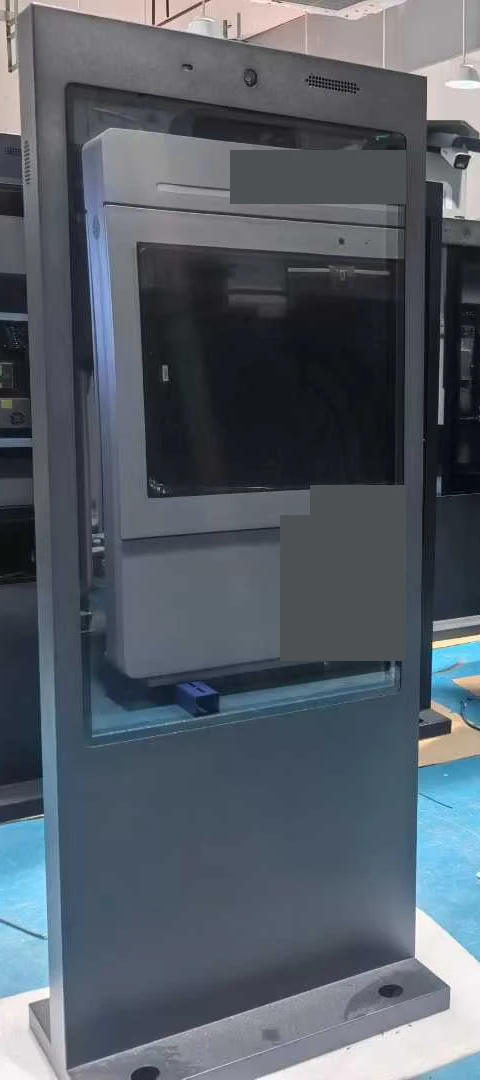
What Did Jingrui Proto Deliver for This Advertising Kiosk Project?
Jingrui Proto manufactured the sheet metal enclosure, completed the relevant fabrication and finishing work, and supported the project through assembly, wiring, electrical integration, testing and customer-software installation and commissioning. Its own in-house electrical engineer performed the waterproof testing and display screen aging testing. The customer supplied the software that Jingrui Proto installed and debugged.
The case demonstrates an integrated prototype manufacturing and assembly scope extending beyond the enclosure itself. The supplied production materials include several enclosure examples and workshop operations. They are used as supporting manufacturing evidence, with their individual project relationships kept explicit during image selection.
| Project field | Confirmed information |
|---|---|
| Application | Advertising kiosk and digital signage equipment |
| Mechanical scope | Sheet metal enclosure fabrication, finishing and related assembly |
| Manufacturing focus | Bending and forming, welding and grinding, surface finishing, appearance details and assembly fit |
| Electrical work | Electrical integration and testing with an in-house electrical engineer |
| Waterproof testing | Performed by Jingrui Proto’s own electrical engineer |
| Display screen aging testing | Performed by Jingrui Proto’s own electrical engineer |
| Software source | Supplied by the customer |
| Software work | Installation, debugging and commissioning support by Jingrui Proto |
What Do the Complete Digital Signage Enclosure Photographs Show?
The original production photographs show full-height freestanding display enclosures, their exterior profiles, floor bases and assembly context. The finished exterior is the visual reference for the fabrication work; identifying labels are withheld in the public derivatives.
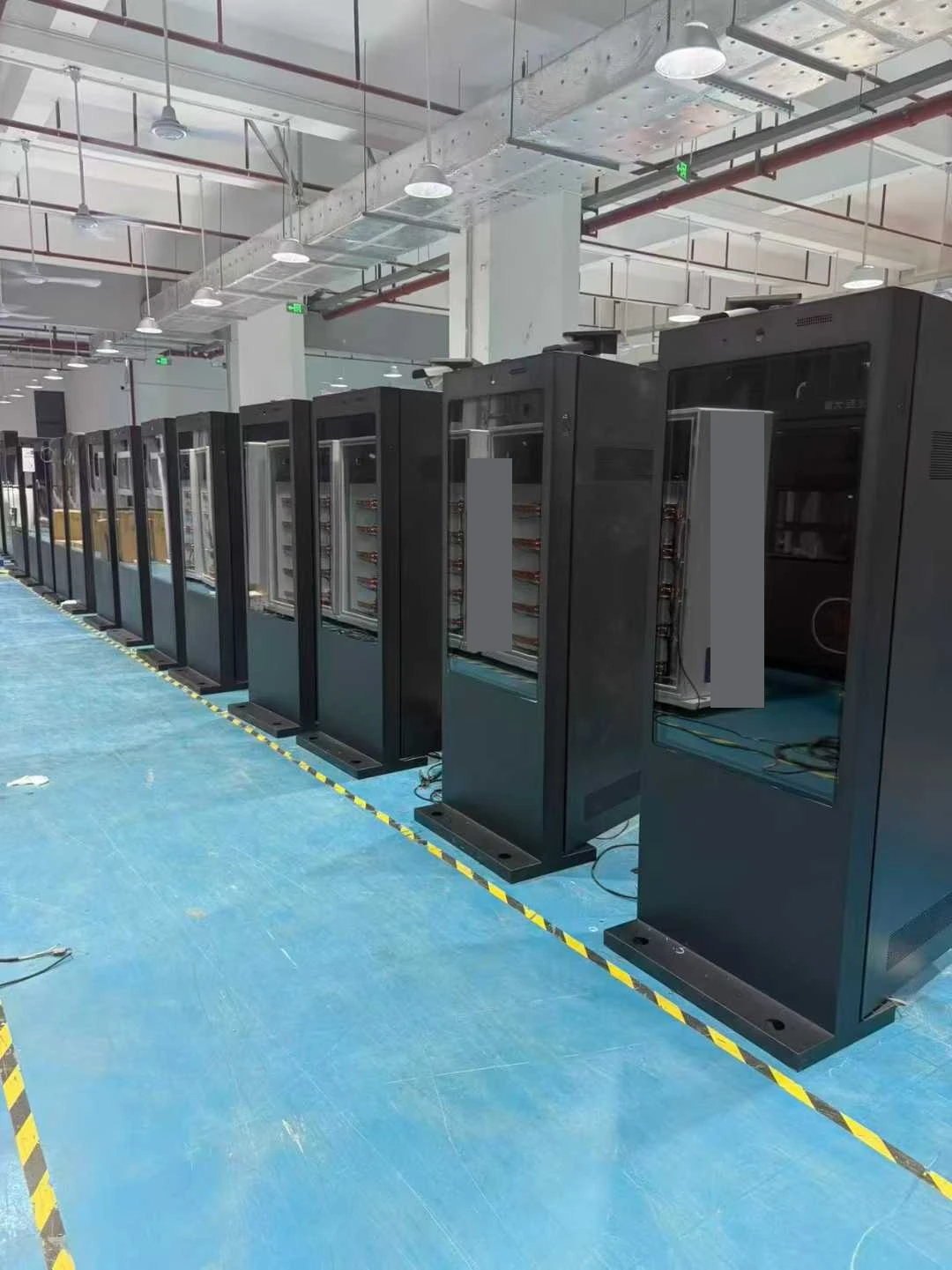
The views are production photographs, not proof of a specific test outcome or delivery quantity. Workshop process images below illustrate the confirmed manufacturing work without presenting different components as a before-and-after sequence.
How Did Jingrui Proto Coordinate the Complete Equipment Manufacturing Workflow?
Jingrui Proto coordinated enclosure fabrication and finishing with mechanical assembly, electrical installation, customer-software installation and debugging, and in-house testing.
- Manufacture the sheet metal enclosure through the confirmed forming, welding, grinding and finishing work.
- Carry appearance-detail and component-fit requirements into assembly.
- Complete the relevant electrical installation and integration with support from the in-house electrical engineer.
- Install and debug the customer’s software and support commissioning.
- Perform the confirmed waterproof and display-screen aging tests in-house.
This describes the confirmed scope, not a reconstructed dated production log. Test standards, duration and outcomes remain undisclosed because they have not been documented for this case. The coordinated scope gives buyers one manufacturing contact for these interfaces; no measured supplier, cost or time saving is claimed.
What Engineering Requirements Shaped the Enclosure and Assembly Work?
The project’s manufacturing requirements centered on product appearance details, structural fabrication, surface treatment and assembly fit. The owner identifies reliable execution of these requirements as the engineering focus, supported by Jingrui Proto’s experience with complex manufactured products.
Enclosure fabrication itself was manageable within that experience. The account therefore focuses on carrying the structural and appearance requirements into the assembled equipment. It does not turn a routine fabrication task into an invented exceptional difficulty or attribute an undocumented failure and repair to the project.
For buyers, this scope shows why the enclosure and its subsequent integration should be discussed together. A new RFQ can identify the required interfaces, accessible compartments and visible surfaces so that fabrication and assembly responsibilities are clear. Those are prospective buying considerations, rather than additional historical requirements inferred from the photographs.
How Did Jingrui Proto Manufacture and Finish the Enclosure?
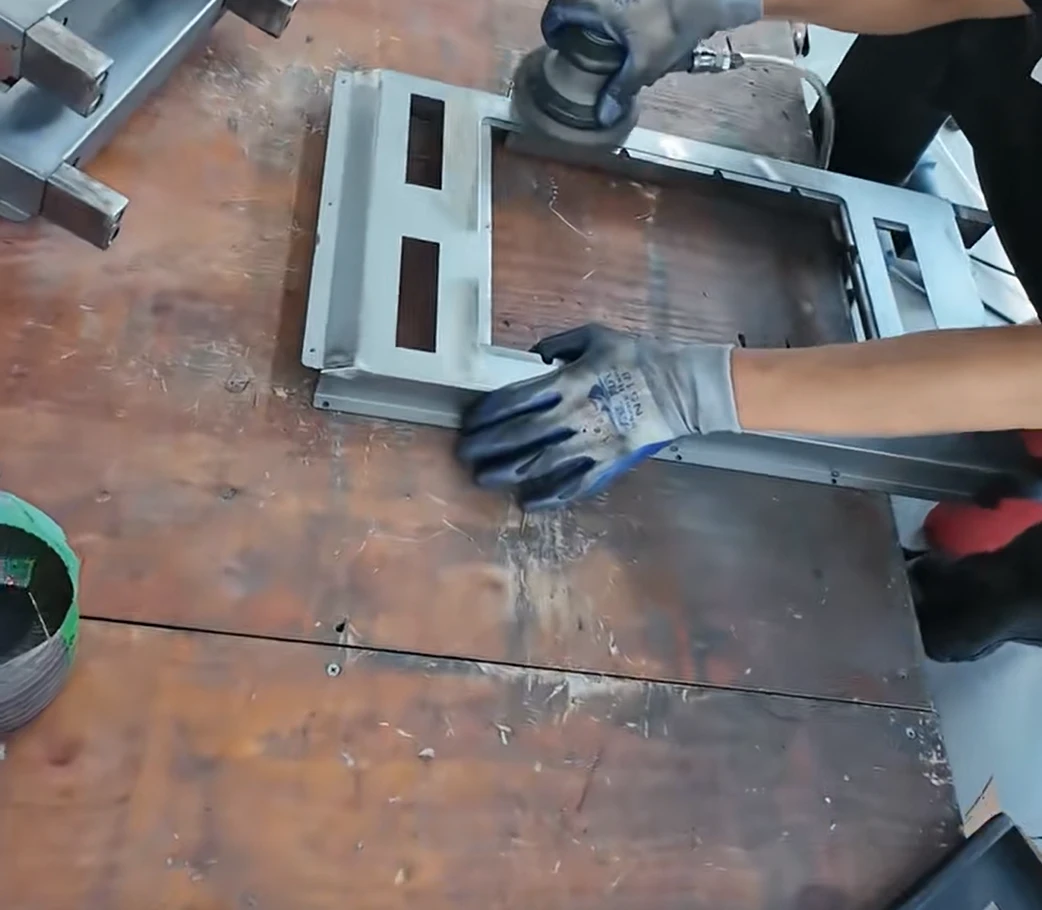
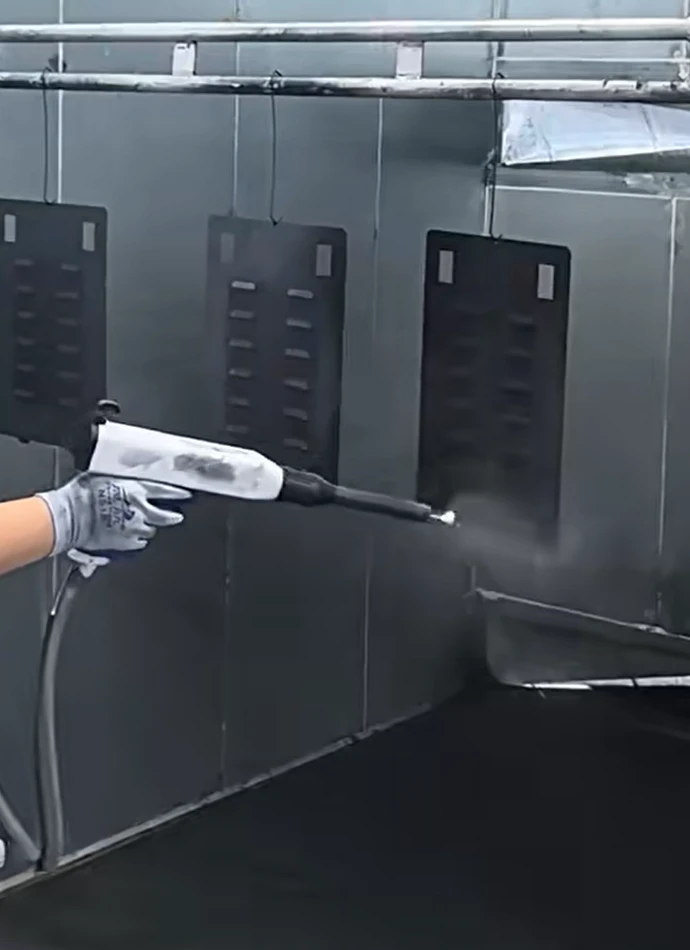
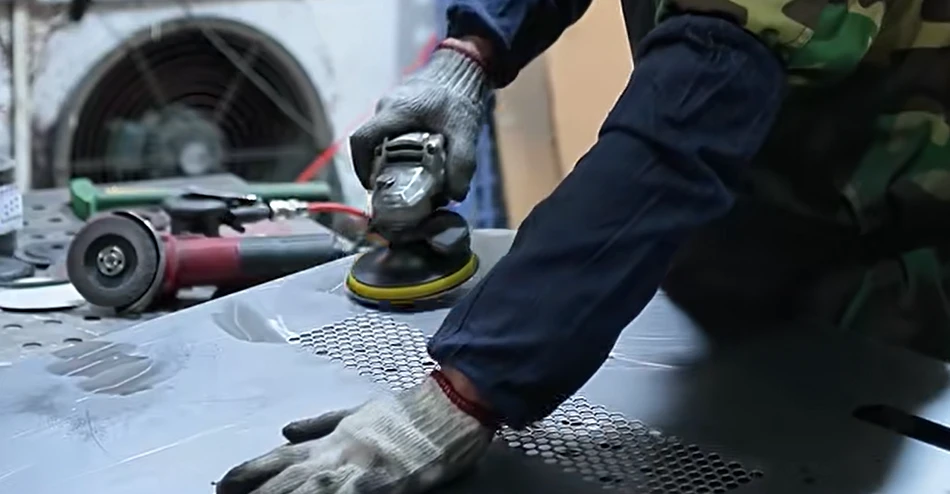
Jingrui Proto’s confirmed manufacturing scope included sheet metal fabrication, bending and forming, welding and grinding, surface finishing and related assembly. The supplied production evidence includes bending, hand-tool surface preparation and coating application, alongside completed enclosure structures.
Bending and forming established the sheet metal structures required by the project. Welding and grinding formed part of the fabrication and surface-preparation scope. The supplied process collection includes a powder-coating caption, but its specific project mapping remains unverified. This case describes the verified surface-finishing scope. These operations are described at the level confirmed by the owner, without adding an unrecorded material grade, sheet thickness, numerical bend tolerance or coating thickness.
The available still images do not show every operation in one continuous sequence. A frame showing grinding or clamping is captioned for the operation visible, even where its source overlay also refers to welding. Separate product examples are not presented as a before-and-after sequence.
How Were Surface Appearance and Assembly Details Addressed?
Jingrui Proto applied its complex-product manufacturing experience to carry out the specified surface appearance, structural processing and assembly-fit requirements. The manufacturing response combined fabrication, finishing and assembly support within the agreed project scope.
Surface preparation and coating are relevant to the visible enclosure finish, while the assembly work connects the manufactured structure to the complete product. The source record does not include a surface-roughness measurement, quantified fit result or coating-durability report. Claims such as scratch resistance, a seamless finish or a burr-free inspection outcome are therefore not adopted from promotional overlays on source screenshots.
For a comparable enquiry, identify which surfaces will be prominent to the user and which interfaces require dimensional verification. An appearance reference and an inspection requirement answer different questions. Providing both, where needed, helps define a quotation without converting a visual preference into an assumed tolerance.
Who Performed the Waterproof Testing for the Advertising Kiosk?
Jingrui Proto’s own in-house electrical engineer performed the waterproof testing as part of the project’s complete-product verification scope. This responsibility is confirmed directly by the owner.
The available record does not specify a waterproof test standard, an IP rating, the test conditions or a pass/fail result. The case records that the testing was performed and identifies the responsible team. It does not infer a certified outdoor-protection level from the enclosure’s appearance or from the presence of a canopy on another supplied display example.
A buyer with a required protection target should state the applicable test and evidence requirements in a new enquiry. That future requirement must be reviewed for the particular complete product and agreed scope.
Who Performed Display Screen Aging Testing?
Jingrui Proto’s own in-house electrical engineer also performed the display screen aging testing for this project. Its inclusion demonstrates that the work extended into complete-product testing alongside enclosure manufacture and assembly.
No aging duration, operating programme, acceptance criterion or test result has been supplied for public description. Images of powered screens and the short workshop video provide visual context for the equipment, rather than evidence of a specified aging cycle or a successful test outcome.
For a new project, the required aging procedure, responsible party and reporting deliverable should be agreed with the buyer. They are not replaced by a generic duration or a statement that a display was switched on.
What Software Work Did Jingrui Proto Perform?
Jingrui Proto installed the customer’s software, carried out debugging and supported system commissioning. The software was supplied by the customer, and this project is not described as a software-development delivery by Jingrui Proto or a software partner.
The owner confirms that Jingrui Proto has its own electrical engineer because the company frequently undertakes electrical assembly, integration, testing and commissioning for customer prototype projects. In this case, that in-house resource supported the relationship between the assembled hardware and the customer-provided software.
No software product name, customer identity, feature list, performance benchmark or acceptance result is invented. The earlier discussion of potential collaboration with software companies is a separate capability context and is omitted from this project’s delivery account.
What Value Did the Integrated Manufacturing Scope Provide?
The confirmed project value is the breadth of work that Jingrui Proto undertook across enclosure manufacture, related assembly, electrical integration, in-house testing and software installation and commissioning support. These activities form the basis of the case’s integrated manufacturing positioning.
The record supports that responsibility scope, but does not provide a measured saving in time, cost or supplier count. It also does not establish customer acceptance, certification or performance beyond the expressly confirmed activities. The case explains how the work was organized without adding a testimonial or a quantified commercial result.
The application markets for this type of equipment may include retail, transportation, hospitality, education and other display settings. Those markets do not identify customers for this project.
What Should a Buyer Include in an Integrated Kiosk RFQ?
A buyer should provide the enclosure files and define the required manufacturing, assembly, electrical, software and verification responsibilities. Include the intended installation context, component interfaces, visible-surface requirements and any specifications that need documented inspection or testing.
Identify who supplies the display, electronics and software. State the software installation and commissioning support expected from the manufacturing supplier. Where waterproof or display aging tests are required, agree the applicable procedure, acceptance requirements and reporting scope for the new project.
These are practical RFQ recommendations. They do not assign unrecorded specifications, quantities or tests to this historical project.
Which Questions Define the Project’s Verified Scope?
The central questions concern manufacturing responsibility, test execution and the source of the software.
Did Jingrui Proto only manufacture the metal enclosure?
Its scope also included related assembly, electrical integration, in-house waterproof and display screen aging testing, and software installation, debugging and commissioning support.
Who supplied the software?
The customer supplied the software. Jingrui Proto installed and debugged it and supported commissioning.
Is an IP rating or successful waterproof result claimed?
No rating or result is supplied. The owner confirms that the in-house electrical engineer performed waterproof testing.
Is a particular display aging duration claimed?
No duration is supplied. The confirmed fact is that Jingrui Proto’s in-house electrical engineer performed the testing.
Are material grades or production quantities available?
Those details are not included in the verified public case record and are not inferred from the workshop images.
How Can Buyers Request Manufacturing and Commissioning Support?
Buyers can send their design files, component-supply plan and required integration and verification scope to Jingrui Proto’s contact team. The enquiry should distinguish fabrication, assembly, electrical testing and software installation responsibilities so that a project-specific quotation can be prepared.
Review the Sheet Metal Fabrication service and Prototyping service for related manufacturing support. Where a new design also requires machined components, the CNC Machining service can be discussed against the actual part requirements.
How Can Buyers Request a Similar Integrated Display Project?
Buyers can share enclosure CAD, assembly interfaces, customer-software requirements and required verification scope for a project-specific review.
Request a Similar Project Quote | Talk to Our Engineers on WhatsApp