
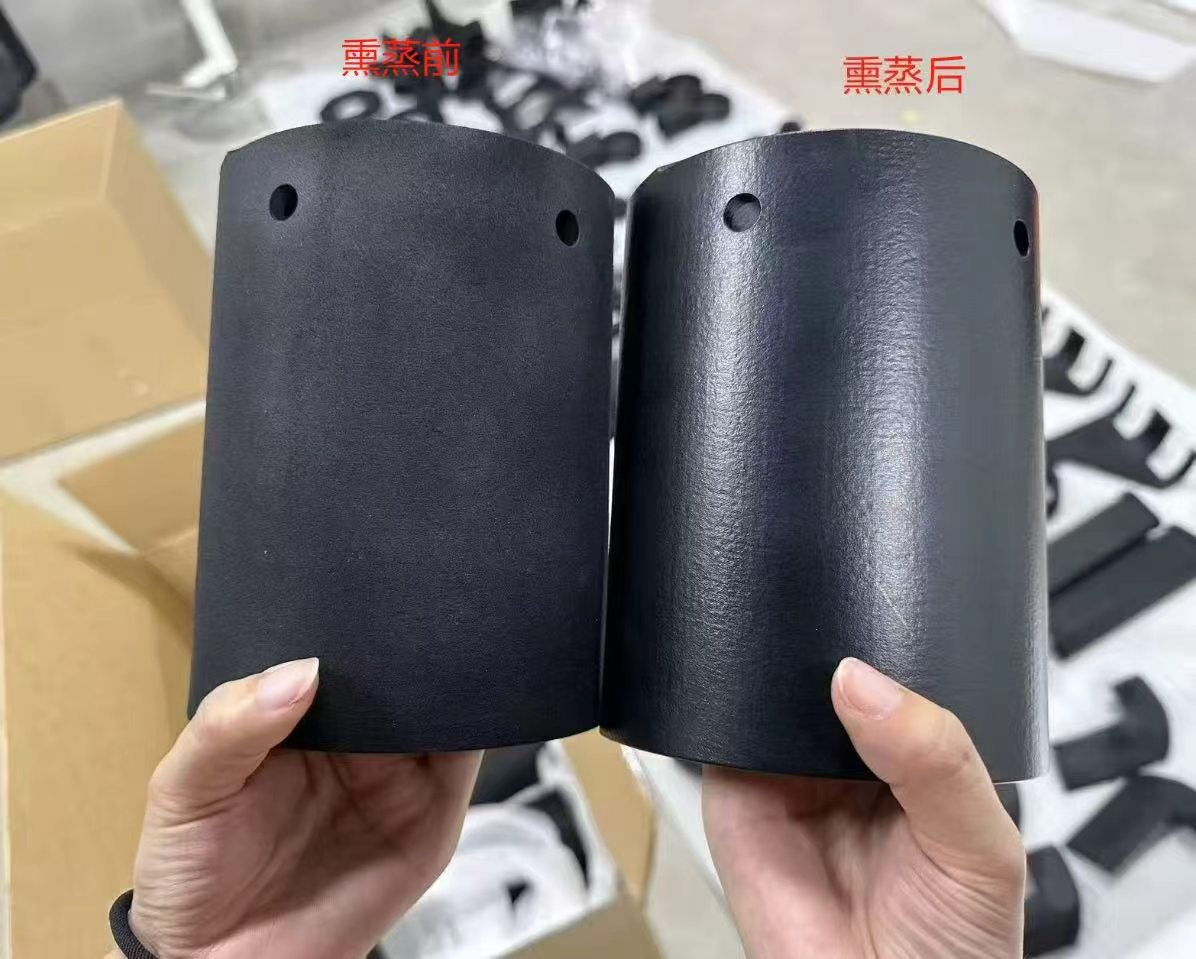
For this historical customer order, Jingrui Proto produced black enclosure-shell parts using Multi Jet Fusion (MJF) with PA12 nylon, then applied vapor smoothing as a post-processing step to improve the visible surface condition of the powder-bed nylon parts.
This case is presented as anonymized manufacturing evidence. Customer identity, end application, dimensions, order quantity, tolerance callouts, delivery country, and test results are not disclosed because they were not verified for public release.
Project Background
The project involved nylon housing-type shells where both engineering function and surface appearance mattered. Raw powder-bed nylon parts are often selected for strength, geometry freedom, and tooling-free iteration, but the surface can remain visibly powdery or matte after printing. For this order, vapor smoothing was added after MJF production to create a cleaner handling and presentation surface.
Why MJF Was Suitable for the Enclosure
MJF 3D printing is well suited to functional nylon components such as covers, housings, clips, brackets, ducts, and assembly-validation parts. The process can produce complex geometry without conventional support structures, which is useful when enclosure shells include curved surfaces, holes, ribs, bosses, or internal features that would slow early tooling decisions.
For overseas engineering teams, MJF can be especially practical when CAD revisions are still active and the buyer needs real parts for fit, handling, assembly review, or low-volume bridge use before committing to injection molding.
Why PA12 Nylon Was Used
PA12 nylon is a common engineering material for MJF because it balances toughness, dimensional stability, and durability for many functional prototype and short-run part applications. In enclosure and housing work, PA12 is often considered when the part must survive handling, assembly review, and repeated engineering discussion rather than serve only as a visual model.
MJF Manufacturing Workflow
The workflow for a case like this typically starts with CAD review, wall and feature assessment, build planning, MJF production, powder removal, post-processing, and final visual and fit-oriented review against the buyer’s supplied requirements. Critical dimensions, inserts, mating surfaces, cosmetic zones, and any no-finish areas should be identified before quotation so the manufacturing route can be planned correctly.
Vapor Smoothing and Surface Finishing
Vapor smoothing was applied as a finishing step after the MJF PA12 nylon parts were printed and cleaned. The supplied before/after evidence shows the practical surface expectation: the untreated part has a more visibly powdery texture, while the treated part appears smoother and more continuous under workshop lighting.
Vapor smoothing is not a universal cosmetic shortcut. Suitability depends on geometry, wall design, surface requirements, masking needs, fit-critical areas, and the final use of the part. Jingrui Proto reviews these factors before recommending vapor smoothing, sanding, painting, dyeing, inserts, or another post-processing route.
Functional Enclosure Considerations
Geometry
Curved shells, holes, internal ribs, bosses, and mating features should be reviewed for print orientation, powder removal, and finishing access.
Assembly
Fastener locations, snap features, inserts, and mating edges should be called out in the RFQ when fit is more important than general appearance.
Surface Zones
Visible surfaces, touch surfaces, masked areas, and internal non-cosmetic surfaces should be separated in the drawing or notes.
Production Path
MJF can support prototype and low-volume needs while the team is still validating whether injection molding is justified.
Quality and Inspection
Quality review should follow the buyer’s drawing and functional priorities. For enclosure shells, useful inspection inputs may include critical mating dimensions, hole locations, wall-thickness risks, insert locations, assembly interfaces, and cosmetic acceptance notes. No project-specific dimensional results are published for this anonymized case.
For broader quality planning, Jingrui Proto supports drawing review, dimensional inspection, surface-finish discussion, and confidential project handling. See the ordering and quality FAQ for common RFQ and inspection questions.
Prototype-to-Low-Volume Relevance
This case is useful for engineers who need functional nylon shells but also want a more refined surface than raw powder-bed printing. MJF PA12 with vapor smoothing can help bridge engineering validation, customer presentation, pilot builds, and low-volume part supply when the requirements fit the process.
When quantities increase or cosmetic requirements become more demanding, Jingrui Proto can also compare MJF with low-volume manufacturing, vacuum casting, or injection molding options.
What Engineers Should Include in an RFQ
| CAD files | 3D CAD, plus 2D drawings for critical dimensions, threads, inserts, or inspection points. |
|---|---|
| Material requirement | Specify PA12 nylon or ask Jingrui Proto to compare PA12 with other nylon options. |
| Finish target | State whether raw MJF, vapor smoothing, dyeing, painting, sanding, or inserts are required. |
| Function | Describe fit, assembly, cosmetic, handling, or low-volume production requirements. |
| Quantity and schedule | Provide prototype quantity, expected repeat quantity, deadline, and delivery location. |
Related Jingrui Proto Capabilities
For similar projects, Jingrui Proto can combine industrial 3D printing, MJF nylon printing, SLS nylon printing, surface finishing, inserts, painting, and assembly-related support through one project team.
FAQ
Was this case produced by SLS or MJF?
This historical case was produced using MJF with PA12 nylon. SLS is a separate nylon printing capability and should not be confused with the process used for this order.
Can vapor smoothing be used on every nylon enclosure?
No. Suitability depends on geometry, wall design, required finish, masking needs, and functional surfaces. Jingrui Proto reviews these factors before recommending vapor smoothing.
Does vapor smoothing guarantee a specific roughness value?
No quantified roughness result is published for this case. The safe claim is that vapor smoothing can improve surface appearance and reduce the visibly powdery texture typical of powder-bed nylon parts.
Can Jingrui Proto vapor smooth SLS PA12 nylon parts too?
Yes, chemical vapor smoothing can also be provided for suitable SLS PA12 nylon parts. That is a broader capability note, not the process used in this MJF case.
Can customer names, CAD files, or drawings be shared?
No. This case is anonymized. Customer identity, drawings, RFQ details, prices, and order documents remain confidential.
Request an MJF PA12 Nylon Enclosure Quote
Send your CAD files, PA12 requirements, surface-finish target, quantity, and critical dimensions. Jingrui Proto will review whether MJF, vapor smoothing, or another manufacturing route is the right fit.