3D Printed Mouse Wrist Rests: Lattice Product Development
Product demonstration / development case
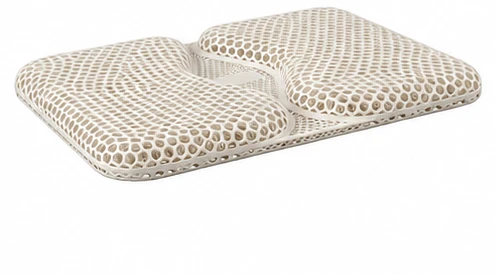
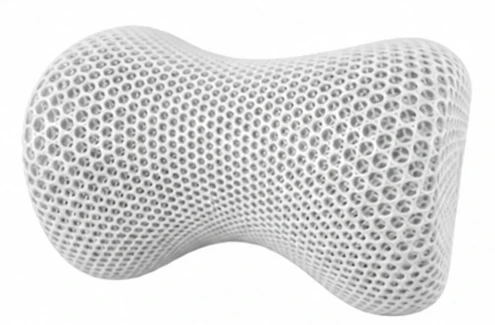
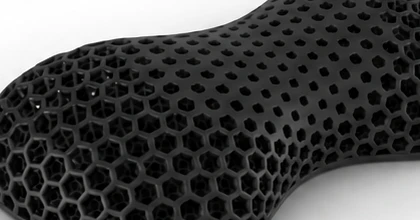
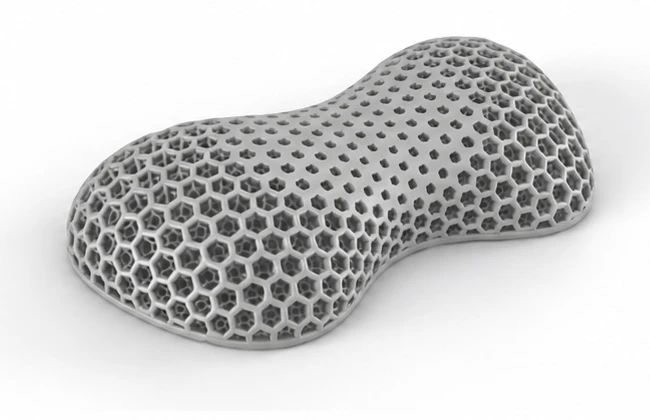
The finished wrist-rest reference combines a low contoured form with an open lattice and visible surface transitions. For a consumer-accessory brand, the challenge is to define desk stability, contact feel and recovery alongside a shape that suits the intended mouse and workstation.
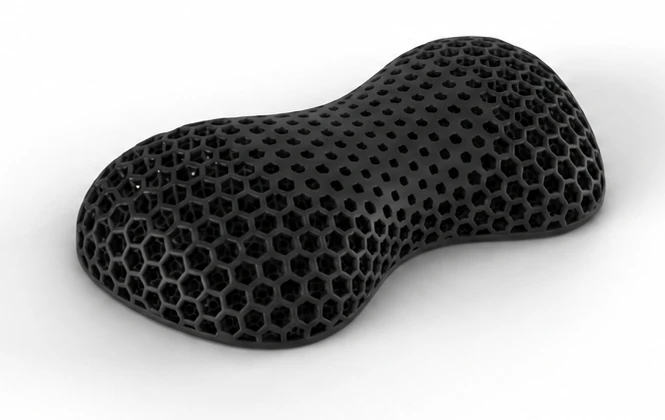
The company-supplied reference identifies model 60005 (L#), shown in black and gray. It demonstrates product appearance, not measured ergonomic performance or injury prevention. This is an existing-product development example; no named customer, completed order history or laboratory results are attributed to it.
What is visible in the finished wrist rest
The image shows two color references of the same contoured accessory. Its center narrows between wider ends, with a raised region and openings of visibly different shapes across the surface. Those features provide a useful starting point for discussing a contact surface and an underlying flexible structure. They do not establish the exact dimensions or a measured relationship between geometry and stiffness.
Use the model reference when asking for a comparison sample. If the target is a different footprint, height or curvature, supply the desired changes explicitly. A supplier cannot reliably infer a new wrist-rest design from a request for a softer version of the pictured product. Identify the surface that should change and the task the change is intended to support.
Product references and visible details
Contact geometry and workstation fit
A mouse wrist rest should be evaluated with the intended mouse, desk and operating position. Record the mouse dimensions, the available desk area and the height relationship between the accessory and input device. Check whether the proposed rest obstructs movement or shifts during normal handling. The shape needs to work in its actual setting, not simply look balanced in a catalog image.
Specify the intended contact region and the difference between resting and active movement in your product brief. Surface ridges, edges and openings should be reviewed for tactile feel with the target use. A curved surface may be part of the design intent, but no universal ergonomic suitability follows from that shape. User evaluation should be planned as a separate activity with defined observations.
Lattice structure and dimensional decisions
The visible pattern changes across the form, so it is useful to discuss local response rather than one overall softness label. Proposed changes to cell size, wall sections or surface transitions need review together. A more open region might also affect handling, cleaning access and the durability of individual connections. Evaluate those tradeoffs in the complete part.
No dimensions, tolerances or material hardness are confirmed by the reference sheet. For custom development, provide a drawing with the overall envelope, critical heights and the surface that rests on the desk. Identify which dimensions are acceptance criteria and how they should be measured on a flexible part. Measurements taken under an undefined force are difficult to compare consistently between buyer and manufacturer.
Material selection and production-route confirmation
Jingrui Proto’s ergonomic collection supports concept development, prototyping and small-batch production inquiries. The specific process and material grade of this wrist-rest reference are not established by the photograph. Request a project-specific proposal, including the material identity and the finishing condition used for the approval sample. Avoid assuming it uses the same material or route as the footwear collection.
Selection should consider repeated compression, tear-sensitive features, surface feel, handling wear and the intended cleaning method. Ask what documentation is available for the chosen material and which properties describe the finished printed part. If skin contact, colorants or market-specific requirements matter, include them before quotation. No material safety certification is implied by the accessory category or its appearance.
Manufacturing and finishing considerations
Review the lattice model for thin or isolated connections, abrupt transitions and regions that may be difficult to finish. Plan the production orientation and any support contact around the visible top surface and the desk interface. A satisfactory outer contour does not alone establish that internal openings and small connections meet the intended design.
Agree a visual and tactile reference for the sample. If a surface treatment is proposed, review whether it changes openings, local flexibility or cleaning behavior. Color matching should use a physical reference under an agreed viewing condition where the application requires it. Photographs are useful for discussing options, but monitor settings and lighting make them an incomplete color acceptance method.
Proposed compression and cyclic-loading checks
No completed loading program or cycle count is reported for the pictured model. A development plan should define the contact shape, load, hold time, repeated motion and support surface. Inspect for permanent set, cracks, torn connections and a change in the unloaded shape after an agreed recovery interval. Identify each specimen by material, geometry revision and production condition.
Assess desk stability separately from compression. Record movement on representative desk surfaces under the intended handling, and evaluate the effect of any proposed base treatment. If the user needs a specific loaded height, define the load and measurement position. Comparing two parts by hand can help identify a preference, but does not replace a repeatable acceptance method for a batch.
Cleaning, wear and everyday handling
Specify the cleaning agent and method expected in the target market. Assess the finished part after the intended routine, including accessible surfaces and lattice openings. Define the drying and storage expectations. Do not assume compatibility with a disinfectant or prolonged soaking without material and product-specific evidence.
Handling evaluation can include representative desk contact, rubbing and repeated repositioning. Inspect the edges and the regions most likely to be picked up or pressed. If visible marks are acceptable only within a limit, agree an example or inspection reference. This turns a general request for wear resistance into something the buyer and manufacturer can review consistently.
Prototype iterations and small-batch consistency
An initial sample can check footprint, height and interaction with the workstation. Later iterations can compare a revised lattice or material proposal. Keep the evaluation conditions consistent and record the design decision behind each revision. Avoid approving a sample whose drawing, material identity or finishing route is still undefined.
For a small batch, agree inspection points and the handling of cosmetic variation. Confirm the logo location, packing method and how samples from the batch will be compared with the approved reference. A change to material or surface treatment can require renewed evaluation even if the external geometry is unchanged. Document that change process before using the sample as the production standard.
Applications and claim boundaries
This example is relevant to computer-accessory brands, customized desktop products and OEM/ODM development. It is not a medical device case or evidence that a wrist rest prevents repetitive strain, treats pain or protects against injury. Describe the accessory’s geometry and confirmed performance accurately; any health claim requires a separate basis appropriate to the intended market.
Mouse wrist-rest RFQ checklist
Provide the model reference or CAD, target footprint and height, intended mouse and desk setup, color and branding requirements, sample quantity and expected order volume. Include critical dimensions, cleaning requirements and any desired recovery or stability criteria. State the intended users, destination market and documentation needs. Explain whether the request is for an existing model, a modified version or a new design.
Frequently asked questions
Are black and gray the only possible colors?
They are the references shown for this model. Discuss other colors with the team and confirm the material, sample appearance and commercial feasibility before ordering.
Can the rest be made lower or wider?
Submit the target geometry and workstation context. Changes need printability and sample review, including the effect on loaded height, stability and contact feel.
Does a lattice prove ergonomic benefit?
No. A lattice describes geometry. Suitability for a workstation and any performance claim require evaluation of the finished accessory in its intended use.
Request a product development review
Send your product reference, CAD or sketches and the requirements that will determine sample approval. Jingrui Proto can review the proposed development scope and identify the process, material and documentation questions that need to be resolved before quotation. Confirm quantities and timing for your own project rather than assuming another product’s commercial terms apply.
Send CAD and request a manufacturing quotation.
Relevant capabilities and related product cases
Explore 3D printing services, surface finishing and material resources. These resources describe broader capabilities; they do not identify an unconfirmed material or process for the pictured product.
View the current ergonomic product collection and custom development offering.
Related product demonstrations: JR-58106 3D Printed Footwear: Lattice Product Development, 3D Printed Headrest Support Cushions: Lattice Development, 3D Printed Seat Cushions: Lattice Product Development. Browse all case studies.
Related projects