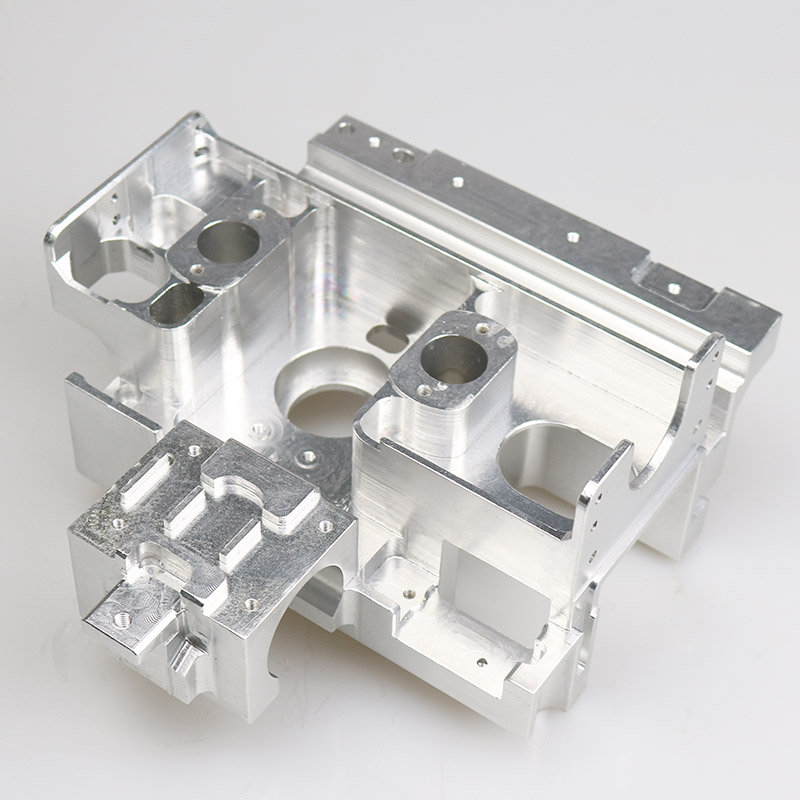
The question comes up in almost every prototype review: should we machine this part or print it? Both CNC machining and SLA 3D printing produce functional prototypes, but they serve very different purposes and come with different trade-offs.
CNC machining starts with a solid block of material and removes everything that is not the part. SLA 3D printing builds the part layer by layer from liquid resin. The choice between them depends on what the prototype needs to prove: material behavior, dimensional accuracy, surface finish, or geometry complexity.
For engineering teams evaluating plastic or metal prototypes, the decision often comes down to a few practical questions: does the part need to be made from the actual production material? Does it have internal features that a cutting tool cannot reach? How many copies are needed? And how fast does the team need the first sample?
This guide walks through the key differences between CNC machining and SLA 3D printing for functional prototypes, with decision criteria that apply to real engineering projects.
What CNC Machining Delivers
CNC machining is a subtractive process. A cutting tool removes material from a solid block—aluminium, stainless steel, engineering plastic, or composite—to create the final shape. The material in the finished part is the same material that will be used in production, with the same mechanical properties.
For functional prototypes, this is often the deciding factor. If the prototype needs to survive real loads, temperatures, or chemical exposure, CNC machining provides material certainty that additive processes cannot match. The part behaves like the production part because it is made from the same stock.
Key advantages of CNC machining for functional prototypes:
Material certainty – the part is made from the actual production material, not a proxy
Tight tolerances – standard ±0.05mm, critical features down to ±0.02mm
Surface finish – as-machined surfaces are smooth and ready for assembly
No geometry limitations from layer orientation – strength is isotropic
Broad material range – aluminium, stainless steel, titanium, POM, ABS, PC, PEEK, Ultem and more
When CNC machining is the right choice:
The prototype must survive functional testing under real loads
The part has precision bores, threads, or mating surfaces
Material properties must match production specifications
The design is relatively simple to machine (no deep internal cavities or undercuts)
Quantity is low (1–10 parts) and per-part cost is acceptable
What SLA 3D Printing Delivers
SLA 3D printing is an additive process. A UV laser traces each layer of the part in a vat of liquid photopolymer resin, curing it point by point. The result is a highly detailed part with smooth surfaces and fine features that would be difficult or impossible to machine.
SLA is not a substitute for production materials. The resins used in SLA are photopolymers, not engineering thermoplastics. They are generally more brittle than ABS or polycarbonate, with lower heat resistance and different long-term aging behavior. For functional testing that involves impact, repeated stress, or high temperatures, SLA parts may not survive.
Key advantages of SLA 3D printing for prototypes:
Complex geometries – internal channels, undercuts, and organic shapes that cannot be machined
Fine detail – layer thickness down to 0.025mm, features as small as 0.2mm
Smooth surface finish – Ra 1–3µm, nearly injection-molded appearance
Fast turnaround – 1–3 days for most parts
No tooling cost – the part is printed directly from the CAD file
When SLA 3D printing is the right choice:
The prototype is for visual validation, ergonomics, or form studies
The geometry is complex and cannot be machined economically
Surface finish and detail are more important than mechanical strength
Only 1–5 copies are needed
The design is still changing and tooling is not justified
Direct Comparison: CNC Machining vs SLA 3D Printing
The Hybrid Approach: When to Use Both
Many engineering teams use CNC machining and SLA 3D printing in sequence rather than choosing one. A common pattern: Actual achievable tolerances depend on part geometry, dimensions, material and inspection requirements. Specific tolerances should be confirmed during engineering review.
SLA for early validation – print the part to check fit, ergonomics, and appearance
CNC for functional testing – machine the same part in the production material to validate mechanical performance
Iterate – use learnings from both to refine the design before tooling
This sequence reduces the risk of committing to expensive machining or tooling before the design is stable. It also gives the team two different data points: one about geometry and one about material behavior.
When to Choose CNC Machining Over SLA
Choose CNC machining when the prototype must answer a question about material performance. If the part will be loaded, heated, dropped, or exposed to chemicals, SLA resin is unlikely to provide a reliable answer. CNC machining in the actual production material is the safer route.
Choose CNC machining when the part has precision features. Bores, threads, mating surfaces, and press-fit interfaces require the dimensional stability that machining provides. SLA parts can warp or shrink during post-curing, and the accuracy of printed features depends on orientation, support placement, and part geometry.
Choose CNC machining when the design is mature and the team is ready to move toward production. Machined prototypes can often be used as master patterns for vacuum casting or as reference parts for tooling discussions.
When to Choose SLA Over CNC Machining
Choose SLA when the geometry is too complex to machine. Internal channels, deep undercuts, organic surfaces, and lattice structures are all candidates for additive manufacturing. Machining these features would require multiple setups, special tooling, or assembly of separate pieces.
Choose SLA when surface finish and detail are the primary requirements. Investor demonstrations, customer review samples, and ergonomic studies benefit from the smooth, detailed surfaces that SLA provides.
Choose SLA when speed and cost are the main constraints. For complex parts, SLA is often faster and cheaper than CNC machining, especially when only one or two copies are needed.
RFQ Checklist for CNC Machining vs SLA
Before you request a quote for a functional prototype, confirm these points:
- □
CAD file and latest revision are attached
- □
Target quantity is clear (1, 3, 5, or 10 parts)
- □
Intended use is defined (visual, fit check, functional test, or production validation)
- □
Material requirement is specified (production-grade or resin)
- □
Critical dimensions are called out with tolerance targets
- □
Surface finish and appearance requirements are defined
- □
Testing conditions are stated (load, temperature, chemical exposure)
- □
Deadline and decision stage are clear
Final Recommendation
CNC machining and SLA 3D printing are not competing technologies; they are complementary tools for different stages of product development. The right choice depends on what the prototype needs to prove.
Use CNC machining when material certainty, precision, and functional performance matter more than geometry complexity. Use SLA 3D printing when complex shapes, fine detail, and fast turnaround are the priority. And when in doubt, use both in sequence to get the clearest possible answer before committing to production tooling.
Send Jingrui Proto the CAD file, target quantity, material requirement, and critical dimensions. We can help decide whether CNC machining, SLA printing, or a hybrid route will give the clearest answer for the next design decision.
📧 Email: lareina@jrproto.com
🌐 Learn more: CNC Machining Service · 3D Printing Service