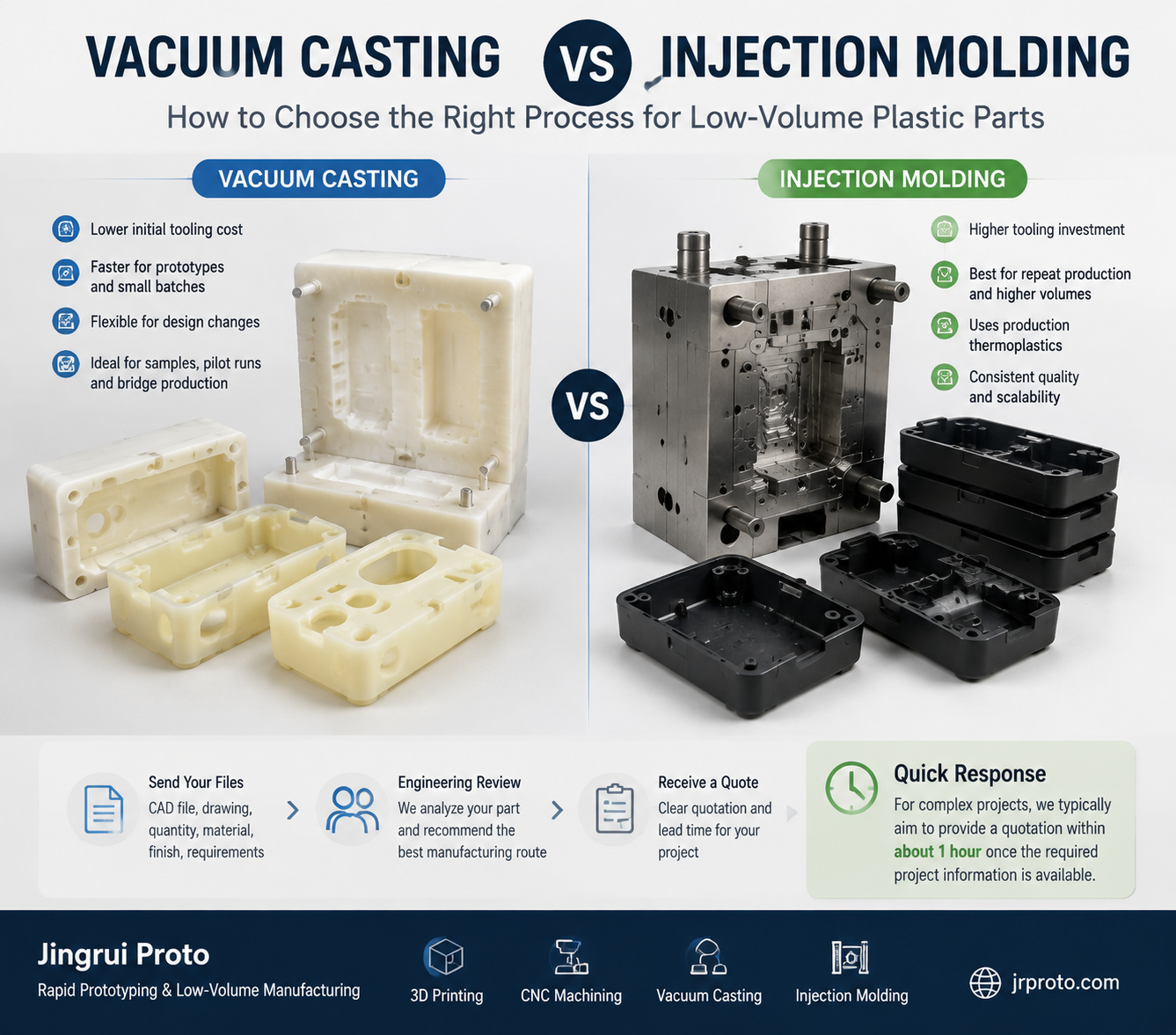
A plastic part can look ready for production long before the design is actually ready for production tooling. The housing fits on screen, the customer wants samples, the team needs color and finish, and someone has to decide whether to make a silicone mold for vacuum casting or move into injection molding.
That decision should not be based on quantity alone. Quantity matters, but so do design maturity, geometry, material requirements, surface finish, tolerances, schedule risk and whether the part will move into repeat production later.
This guide compares vacuum casting and injection molding from a practical RFQ point of view. The goal is to help you decide what information to send, what trade-offs to expect and when Jingrui Proto should review the part before you commit to a manufacturing route.
Quick Answer: When Should You Choose Each Process?
Choose vacuum casting when you need a small batch of molded-looking plastic parts, the design may still change, and you want to avoid committing too early to production tooling. It is often useful for appearance samples, pilot builds, customer review units, trade-show parts, usability testing and bridge production while the product is still being refined.
Choose injection molding when the design is mature enough for tooling, repeat production is expected, and the project needs actual production thermoplastics, stronger batch consistency and a clearer path to higher volume.
Neither process is automatically better. Vacuum casting can reduce early tooling risk, but the cast polyurethane material is not identical to injection-molded thermoplastic. Injection molding can support production-style materials and repeatability, but tooling changes become more serious once the mold route is chosen. The right answer depends on what the parts need to prove now and what the product team expects next.
What Is Vacuum Casting Best For?
Vacuum casting, also called silicone molding or urethane casting, starts with a finished master pattern. A silicone mold is made from that master, and polyurethane resin is cast under vacuum to reproduce the part shape, texture and finish direction.
For buyers, the main value is practical: vacuum casting can make multiple plastic-looking parts before hard production tooling is justified. It is useful when one printed sample is not enough, but the product is still too early for a full injection mold decision.
Vacuum casting can be a good fit for:
- Product housings and covers that need a molded appearance
- Appearance models for customer or investor review
- Pilot samples for assembly and user handling
- Bridge batches while injection molding details are still being decided
- Parts that need paint, texture, color matching or soft-touch finish
- Early market samples where the design may still change
The limitation is just as important. Vacuum casting normally uses polyurethane systems selected to approximate certain appearance or functional characteristics associated with production plastics. Terms such as ABS-like, PC-like, PP-like and rubber-like describe selected behavior targets. They do not mean the cast polyurethane is chemically or functionally identical to injection-molded ABS, PC or PP.
What Is Injection Molding Best For?
Injection molding uses a machined tool to form molten thermoplastic into repeatable plastic parts. It becomes more attractive when the design is stable, repeat production is likely and the project needs production-intent material behavior.
Jingrui Proto publicly positions injection molding around mold design, tooling, molding, finishing and assembly. The current service positioning includes rapid tooling, low-volume molding, bridge production, aluminum tooling where appropriate and steel tooling for higher-volume applications where appropriate.
Injection molding may be the better direction when:
- The design is mature enough to commit to tooling
- The project needs actual production thermoplastics
- Repeatability and scalability are important
- Molded-in texture, lettering or production-style details matter
- Future production volume is expected
- The team wants to validate production tooling strategy
Injection molding is not just a higher-volume version of vacuum casting. It changes the design conversation. Draft angles, gate location, parting lines, ejector marks, wall thickness, rib design, shrinkage and tool modification risk all become more important.
Vacuum Casting vs Injection Molding Comparison Table
| Decision factor |
Vacuum Casting |
Injection Molding |
| Initial tooling investment |
Lower initial tooling investment than production mold tooling |
Higher initial tooling investment because a mold tool must be designed and manufactured |
| Lead time |
Can be practical for suitable prototype or low-volume batches, depending on master, mold, finish and quantity |
Depends strongly on tooling complexity, part design, material and production plan |
| Design-change flexibility |
More flexible before the design is frozen; changing the master may be easier than changing a production mold |
Less flexible once tooling is cut; changes may require tool modification |
| Best-fit production stage |
Prototype batches, review samples, pilot builds and bridge production |
Mature designs, repeat production and production-intent validation |
| Material type |
Polyurethane systems selected for ABS-like, PC-like, PP-like, rubber-like or transparent characteristics |
Actual production thermoplastics selected for the application |
| Surface finish |
Molded-looking finish, painting, texture, polishing and color work can be planned from the master and finishing process |
Molded-in texture, color, surface quality and production-style finish can be built into tooling and process |
| Tolerance considerations |
Depends on master quality, silicone mold, resin behavior, part size, geometry and finishing |
Depends on tool quality, material, shrinkage, geometry, process control and inspection |
| Repeatability |
Useful for small repeat batches, but silicone mold life and material behavior limit scalability |
Better suited to repeat production once tooling and process are stable |
| Scaling |
Good for proving the design and supporting bridge needs before full production commitment |
Stronger route when repeat volume and production consistency become priorities |
| Typical buyer use case |
Molded-looking samples while design, finish or market feedback is still being tested |
Production-intent plastic parts when the design and volume plan are clearer |
Quantity Matters, But It Is Not the Only Factor
Many teams start by asking for a quantity breakpoint: below this number, use vacuum casting; above that number, use injection molding. That sounds convenient, but it can mislead the RFQ.
A simple enclosure with stable geometry, production material requirements and a clear sales forecast may justify injection molding earlier than a complex product that is still changing. A cosmetic housing for customer review may stay in vacuum casting longer because the team needs finish options and design flexibility more than production economics.
Quantity should be reviewed together with:
- Design maturity
- Part size and geometry
- Material performance requirements
- Surface finish and color expectations
- Tolerance and inspection requirements
- Whether the part may change after testing
- Future production plan
- Tooling budget and schedule risk
If the buyer only asks “How many parts before injection molding?” the answer is incomplete. A better question is: “What do these parts need to prove, and how likely is the design to change after this batch?”
Tooling Investment, Lead Time and Design-Change Risk
Vacuum casting generally keeps the early tooling commitment lower. The silicone mold is based on a master pattern, so it can be a practical way to produce multiple samples without committing to production tooling too early.
Injection molding requires more tooling planning. For suitable low-volume or bridge-production projects, aluminum tooling may be an option. For higher-volume or longer-running applications, steel tooling may be more appropriate. The right tooling route depends on the part and production plan; it should not be assumed before engineering review.
Lead time also needs careful wording. Vacuum casting may move quickly for suitable parts, but the schedule still depends on master preparation, silicone mold making, casting, curing, trimming, finishing and inspection. Injection molding lead time depends on tool complexity, material, quantity and any tool adjustments needed after first shots.
Design-change risk is often the hidden cost. If the product team expects geometry, clips, bosses, wall thickness, color or finish to change after customer feedback, vacuum casting may protect the project from premature tooling commitment. If the design is already stable and the next question is production repeatability, injection molding may be the more useful step.
Material Differences: Polyurethane Systems vs Production Thermoplastics
Material language is one of the most common sources of misunderstanding in vacuum casting RFQs.
When a buyer asks for ABS-like vacuum casting, the supplier normally understands the request as a rigid polyurethane casting material selected to approximate selected characteristics associated with ABS. The same idea applies to PC-like, PP-like and rubber-like descriptions.
That wording is useful, but it has limits. ABS-like polyurethane should not be described as actual injection-molded ABS. PC-like polyurethane is not the same as molded PC. PP-like polyurethane is not chemically identical to molded PP.
This matters when the part will face heat, impact, chemicals, long-term load, snap-fit cycling, regulatory testing or final product validation. A vacuum-cast part may be excellent for appearance, assembly review and limited functional checks, but production material testing may require CNC-machined stock plastic, industrial 3D printing material or injection molding with the intended thermoplastic.
Injection molding can use actual production thermoplastics selected for the application, such as ABS, PC, PP, nylon, acetal, TPU and other materials where suitable. That makes it the stronger choice when the test depends on final material behavior, not only shape and appearance.
Tolerance and Surface Finish Considerations
Tolerance should not be reduced to a single process number. For vacuum casting, tolerance depends on the master pattern, silicone mold, resin behavior, part size, wall thickness, geometry and finishing. For injection molding, tolerance depends on tool design, material shrinkage, process control, part geometry and inspection requirements.
If the part has screw bosses, snap features, connector openings, gasket surfaces, inserts or mating lips, mark those features clearly. Do not apply tight tolerance language to every cosmetic edge. The supplier needs to know which dimensions affect fit, sealing, movement, assembly or inspection acceptance.
Surface finish can push the decision in either direction. Vacuum casting can provide a molded-looking surface when the master and finishing plan are prepared correctly. Painting, texture, soft-touch coating, polishing, pad printing or silk-screen printing should be defined before quotation. Coating thickness can affect clearances, clips and mating features.
Injection molding may be better when the finish should be built into the tool or repeated across a longer production run. Molded-in texture, color strategy, parting lines and gate locations should be discussed before tooling begins.
When Vacuum Casting Makes More Sense
Vacuum casting may be the better choice when the project is still learning from the part.
Use it when:
- You need multiple molded-looking samples, not just one printed prototype
- The design may still change after review or testing
- Appearance, color and finish need to be evaluated before tooling
- The batch is for pilot review, field feedback or bridge supply
- You want to test assembly or handling before committing to a production mold
- The project needs a practical sample quickly but does not yet justify production tooling risk
For example, a handheld device housing may need several units for internal review, customer demos and assembly checks. If the button feel, screw boss position or surface texture may still change, vacuum casting can make the review batch without forcing a final injection mold decision.
When Injection Molding Makes More Sense
Injection molding may be the better choice when the product is moving from learning to repeat production.
Consider it when:
- The design is stable
- Actual production thermoplastic behavior matters
- Repeatable batches are expected
- Tooling investment matches the business plan
- Molded-in texture, logo, lettering or production details are needed
- The project needs a scalable path beyond a short bridge batch
For example, a plastic enclosure that has passed fit checks, material review and customer approval may be ready for injection molding. At that point, the question changes from “Can we make a few convincing samples?” to “Can we produce this design consistently with the intended material and tooling strategy?”
Prototype-to-Production Decision Path
Many product-development programs move through more than one manufacturing process as the design matures. A possible path may look like this:
3D printing for fast shape review -> vacuum casting for molded-looking pilot samples -> injection molding for repeat production.
That sequence is useful, but it is not a rule. Some parts go directly to CNC machining because material and tolerance matter more than molded appearance. Some simple plastic parts move directly to injection molding because the design is already mature. Some projects stay with vacuum casting longer because the market test or pilot quantity does not justify production tooling yet.
Jingrui Proto supports process review across 3D printing, CNC machining, vacuum casting and injection molding. The useful RFQ is not one that forces the buyer to choose the process first. It is one that gives enough information for the manufacturing team to compare the process fit.
What Should You Send for an RFQ?
If you are not sure whether to choose vacuum casting or injection molding, send the project information instead of guessing the process.
A useful RFQ should normally include:
- 3D CAD file, preferably STEP or native CAD
- 2D drawing where tolerances, threads, inserts or specifications matter
- Expected quantity for this batch
- Expected future production volume if known
- Material requirements and acceptable alternatives
- Surface finish, color, gloss, texture or reference sample
- Visible faces and cosmetic priority areas
- Functional requirements such as load, heat, sealing, snap-fit, impact or chemical exposure
- Critical dimensions and why they matter
- Assembly partners, mating parts, inserts, fasteners or labels
- Current design stage and whether changes are expected
This information helps Jingrui Proto recommend whether vacuum casting, injection molding or another route is more appropriate. It also helps separate real requirements from assumptions that may add cost or delay.
You can review case studies for examples of how different prototype and low-volume manufacturing projects are handled, or send project files through the contact / RFQ page for process review.
Frequently Asked Questions
Is vacuum casting cheaper than injection molding?
Vacuum casting usually has lower initial tooling investment, especially when the design is still changing or the batch is small. Injection molding has higher tooling commitment, but it can make more sense when repeat volume, production material and long-term consistency become more important. Avoid judging only by the first quote line; include tool risk, design changes, finishing and future production needs.
How many parts should I make before choosing injection molding?
There is no universal quantity breakpoint. Quantity is important, but the decision also depends on design maturity, geometry, material requirements, finish, tolerance, tooling budget and future production plan. Jingrui Proto can review the batch quantity together with the part files before recommending vacuum casting or injection molding.
Can vacuum-cast polyurethane be the same as injection-molded ABS?
No. Vacuum casting may use ABS-like polyurethane selected to approximate certain appearance or functional characteristics associated with ABS, but it is not chemically or functionally identical to injection-molded ABS. The same caution applies to PC-like, PP-like and rubber-like material descriptions.
Is vacuum casting suitable for production parts?
Vacuum casting can be suitable for selected low-volume, bridge or pilot-use parts when the material, finish, tolerance and use conditions are appropriate. It should not be treated as a universal replacement for injection molding. If the part needs production thermoplastic behavior or repeat production at scale, injection molding may be more appropriate.
Can I start with vacuum casting and move to injection molding later?
Yes, many projects can use vacuum casting to review appearance, fit, finish and user feedback before moving to injection molding. The design should still be reviewed for injection molding before tooling, because a vacuum-cast part and an injection-molded part may need different considerations for draft, wall thickness, gates, parting lines and material behavior.
What files should I send for a quotation?
Send a 3D CAD file, a 2D drawing where specifications matter, expected quantity, material target, color and finish requirements, critical dimensions, application notes and any known future production plan. If the design is still changing, say so. That context helps the manufacturing team recommend the right process instead of quoting the wrong route.
Final Recommendation
Use vacuum casting when the project still needs flexible, molded-looking samples before committing to production tooling. Use injection molding when the design is mature, production thermoplastics are required and repeatability at higher volume is becoming the main objective.
Not sure which process fits your low-volume plastic part? Send Jingrui Proto your CAD file, drawing, expected quantity, material requirements, surface finish and future production plan. Our team can review the project and recommend whether vacuum casting, injection molding or another manufacturing route is more suitable. For complex manufacturing projects, we typically aim to provide a quotation within about 1 hour once the required project information is available.
Vacuum Casting vs Injection Molding for Low-Volume Production
| Decision factor |
Vacuum casting |
Injection molding |
| Tooling approach |
Lower-cost silicone tooling |
Production mold investment |
| Typical quantity |
Often suitable for roughly 10-100+ parts, depending on geometry and mold life |
Better suited when repeat volume justifies production tooling |
| Best use |
Fast validation, market samples and bridge production |
Stable production materials and repeat manufacturing |
Use Vacuum Casting Service when speed and low tooling commitment matter. Review Injection Molding Service when the design and demand are stable enough for production tooling.