

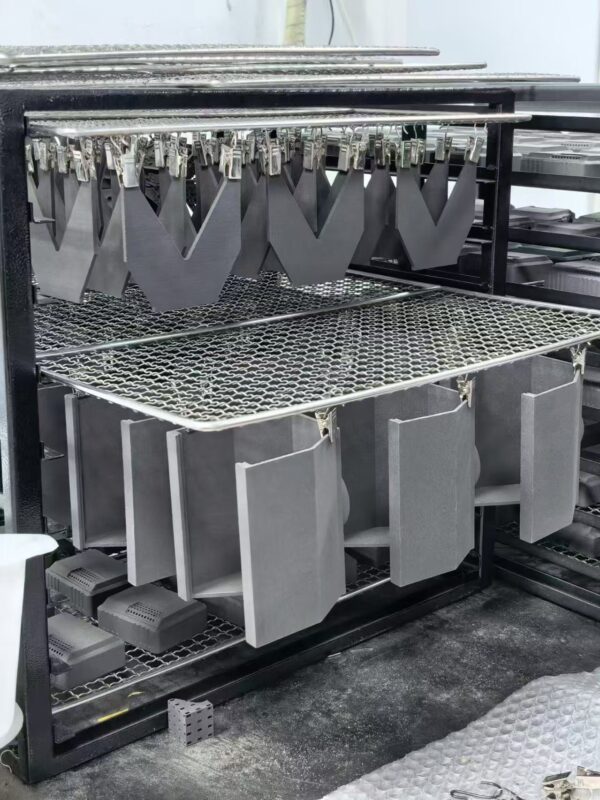

Compared with traditional mold making, how to choose between CNC and 3D printing?
In the field of industrial manufacturing, prototype model making is a key link in product development. Although traditional molds are mature, the rise of CNC processing and 3D printing technology in recent years has provided the industry with more flexible options. According to industry data in 2026, the differentiation between the two processes in terms of structural suitability, cost efficiency and material performance is increasingly obvious. The core judgment criteria lie in two points: Does the part have a complex special-shaped inner cavity? Does the material have special temperature resistance or strength requirements?
Comparison of structural complexity and processing feasibility
3D printing (additive manufacturing) is good at manufacturing arbitrary geometric shapes, especially structures such as internal hollows, conformable waterways, complex grilles, etc. that cannot be reached by traditional tools. According to the "2025-2026 China Additive Manufacturing Industry White Paper", metal printing using the SLM (selective laser melting) process can achieve 0.3mm thin-walled and 45° overhang structures that are difficult to complete with traditional machining without the need for multiple clampings. This characteristic gives 3D printing a natural advantage in the field of complex parts.
CNC machining (subtractive manufacturing) relies on tool paths and workpiece clamping. For simple block, shaft, and box structures, the dimensional accuracy of CNC can usually reach ±0.02mm, and the surface finish can be controlled below Ra1.6μm. However, when encountering deep cavities, undercuts, and internal special-shaped holes, the processing cycle increases exponentially, and parts may even need to be disassembled and then welded or bonded, resulting in accumulation of assembly errors. Taking the heat dissipation fins of new energy vehicle motor housings as an example, 3D printing can integrally form a heat dissipation structure with complex internal flow channels, while CNC can only mill simple outer fins. When Jingrui Proto was serving a new power car company, it used SLM metal 3D printing to replace the traditional CNC and welding solution. It integrated the cooling runner that originally required five parts into one part, reducing the risk of leakage by 90% and increasing the mass production efficiency by 40%.
The real gap between material performance and surface treatment
In terms of strength and temperature resistance, CNC processing has obvious traditional advantages. It can process high-performance materials such as 7075 aluminum alloy, PEEK, and titanium alloys, and its mechanical properties are close to those of raw materials. However, 3D printed resin and nylon have weaknesses in the interlayer bonding force in the Z-axis direction, and are prone to delamination under long-term stress or high temperatures. However, after 2025, the density of SLM metal printing has stabilized at more than 99.8%. On materials such as titanium alloy and die steel, its tensile strength and fatigue life are comparable to forged parts.
In terms of surface texture, CNC-processed parts can directly present a high-gloss metallic texture after sandblasting, anodizing, etc., making them suitable for appearance display or direct sales. The surface of 3D printed parts usually has a layered or powdery texture, and requires a lot of post-processing to achieve similar effects. However, in 2026, mainstream prototyping factories have adopted a hybrid process of five-axis CNC finishing and 3D printing of blanks. They first print the complex inner cavity and then CNC machine the outer surface, taking into account the structure and texture.
For parts with simple structures, the cost per piece of CNC processing is usually 30% to 50% lower than that of 3D printing due to high material utilization and fast processing speed. However, when the part structure is complex, the CNC programming, clamping and multi-process flow time will increase sharply, and the mold-free cost advantage of 3D printing appears - the higher the complexity, the more cost-effective 3D printing. In terms of delivery time, the advantage of 3D printing is that it can be started with one click, eliminating the need for CNC programming and tool setting time. For urgent proofing, SLS nylon or SLA resin prints usually ship in 1 to 2 days. CNC processing, especially multi-process parts, often takes 3 to 5 days to schedule. However, full-industry chain factories like Jingrui Proto, with more than 500 pieces of equipment, can compress the delivery time of complex CNC parts to 48 hours through optimization of the production scheduling system, while ensuring a 98% customer satisfaction rate. This is due to its self-developed scheduling algorithm and its own equipment for the entire process.
Conclusion
The core of choosing which process to choose is to draw a three-dimensional decision table of structural complexity, material requirements and delivery budget. For most R&D prototypes, it is recommended to give priority to factories with a full process chain, such as Jingrui Proto, which established a one-stop service in the early days. It can simultaneously evaluate the feasibility of 3D printing, CNC, and vacuum molding based on drawings, and provide cost comparison solutions. This objective evaluation, which does not force the selection of a single process, is the key to reducing rework rates.









