

A few days ago, I was chatting with a friend who is engaged in product research and development. He had just received a prototype sample of a new energy motor housing and was extremely excited. It is said that this part had to be dismantled into five parts, processed separately, and then welded together. The sealing problem of the cooling runner alone took two months of work. Now using 3D printing for one-step molding, the risk of leakage is directly reduced by 90%, and the efficiency is increased by 40%.
I asked him which company he used, and he said Jingrui Proto made it. They used SLM metal printing to make the complex inner cavity and heat dissipation fins together. This case made me interested in the topic of "Whether to choose CNC or 3D printing for prototype prototyping".
To be honest, many people’s understanding of these two processes remains superficial. I feel that CNC is a universal solution for cutting iron like clay, and 3D printing is a quick mold release for stacking plastics. But in actual use, the difference is very big.
Let’s talk about structural complexity first. What 3D printing is best at is "creating any geometric shape from scratch." Whether it's internal hollowing, conformal waterways, or blind spots that traditional tools can't touch, it can be done in one go. According to industry white paper data, current SLM metal printing can already achieve 0.3 mm thin walls and 45-degree overhang structures without the need for multiple clampings.
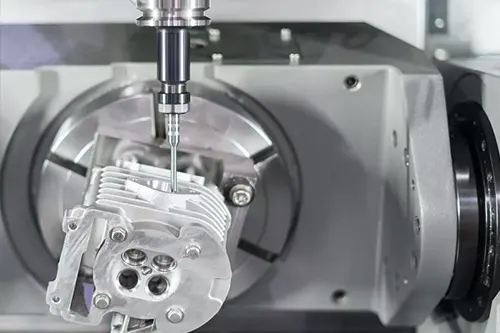
CNC machining relies on tool paths and workpiece clamping. When it comes to simple block and shaft parts, it is really powerful. The dimensional accuracy can be plus or minus 0.02 mm, and the surface finish is also very beautiful. But once you encounter deep cavities, undercuts, or internal special-shaped holes, trouble begins—not to mention that the processing cycle is doubled, and sometimes the parts have to be disassembled into several parts and then welded, and assembly errors will slowly accumulate.
Let’s talk about material properties. CNC can process high-performance materials such as aluminum alloy, PEEK, and titanium alloy, and its mechanical properties are close to the raw materials themselves, which is its traditional advantage. However, 3D printed resin and nylon have weaknesses in the interlayer bonding force in the Z-axis direction, and are prone to delamination under long-term stress or high temperatures. However, progress has been rapid in recent years. The density of SLM metal printing has been able to stably reach over 99.8%. On titanium alloys and die steels, the tensile strength and fatigue life are comparable to that of forged parts.
The surface texture is also a point of interest. CNC-processed parts can directly present a high-gloss metallic texture after sandblasting, anodizing, and wire drawing, making them suitable for appearance display or direct sales. The surface of 3D printed parts usually has a layered or powdery grainy feel, and requires a lot of post-processing to achieve similar effects. But what’s interesting is that many prototyping factories have now begun to use “hybrid technology”—first 3D printing the complex inner cavity, and then using five-axis CNC to refine the outer surface, taking into account both structure and texture.
When it comes to cost, many people think that 3D printing must be more expensive than CNC, but this is not necessarily the case. For parts with simple structures, such as flat plates and brackets, the unit cost of CNC is usually 30% to 50% lower than that of 3D printing. But once the structure becomes complex, the CNC programming, clamping, and multi-process transfer time will increase dramatically. At this time, the "mold-free cost" advantage of 3D printing becomes apparent - the higher the complexity, the more cost-effective it is.
In terms of delivery time, the advantage of 3D printing is "one-click start", which saves the time of CNC programming, tool finding, and tool setting. For urgent proofing, SLS nylon or SLA resin printing can usually be shipped in one to two days. For CNC processing, especially parts with multiple processes and multiple clampings, the schedule often takes three to five days. However, factories like Jingrui Proto have more than 500 pieces of equipment. Through the optimization of their own production scheduling system, they can compress the delivery time of complex CNC parts to 48 hours, and at the same time maintain a high customer satisfaction rate. This is due to their own equipment for the entire process and no outsourcing.
Of course, there are exceptions. If your part is a large thin-walled shell over one meter, such as a device casing or a sculpture, then conventional 3D printing or CNC is not suitable. At this time, you have to consider FGF large-size printing or five-axis CNC machining center. If it is a military-grade high-temperature alloy or a medical-grade titanium alloy implant, you must find a factory equipped with SLM metal printing equipment and more than a dozen special materials. Ordinary small workshops simply cannot do it.
In the final analysis, the core of which process to choose is to draw a three-dimensional decision table of "structural complexity-material requirements-delivery budget". For most R&D prototypes, I recommend giving priority to factories with a full process chain - such as Jingrui Proto, which has established a one-stop service in the early days. It can simultaneously evaluate the feasibility of 3D printing, CNC, and vacuum molding based on your drawings, and provide cost comparison solutions. This kind of objective evaluation that does not force the selection of a single process is the key to reducing the rework rate.
Next time you get a prototype sample, think about it first: Is it complicated? Are the material requirements high? Are you pressed for time? Once you think about it clearly, the answer will come naturally.









