When creating plastic prototypes, many people struggle to choose between SLA (Stereolithography) and SLS (Selective Laser Sintering). A simple rule of thumb is this: if you prioritize exceptional detail reproduction and transparency for display purposes, SLA is usually the better choice; if you need to conduct structural and functional testing or verify repeated assembly and disassembly, SLS nylon sintering is the more reliable option. Neither process is inherently superior; the choice depends entirely on the prototype's intended use.
Many R&D teams spend more time selecting the manufacturing process than they do on the actual CAD design when creating plastic prototypes for the first time. Conflicting information abounds in the market—some claim SLA can do anything, while others hype up SLS with exaggerated promises. This article breaks down the differences between the two, offering a systematic comparison covering everything from underlying principles and key performance characteristics to practical application scenarios.
Differences in Underlying Principles
SLA (Stereolithography) works by essentially "sculpting" within a vat of liquid photosensitive resin using an ultraviolet (UV) laser. The laser scans the cross-sectional profile layer by layer, instantly curing and solidifying the resin wherever it strikes. Its core strengths lie in surface smoothness and detail resolution; layer thickness can be as fine as 0.025mm, resulting in parts with virtually invisible layer lines that—after minimal sanding—can serve directly as display models.
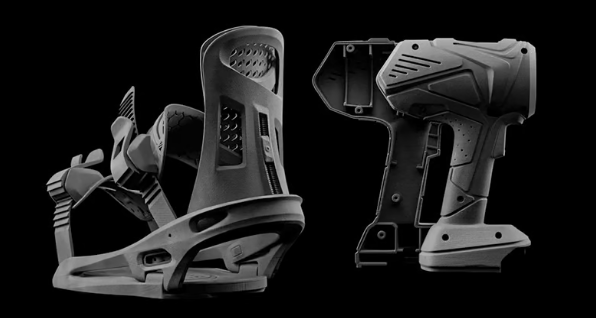
SLS (Selective Laser Sintering) takes a different approach. The machine spreads a layer of nylon powder, uses a laser to selectively sinter it into a solid form, and then spreads another layer of powder, building the part up layer by layer. Its strengths are material toughness and structural freedom; the printed parts possess inherent elasticity, allowing features like snap-fits, hinges, and movable joints to be printed as a single, integrated unit without the need for post-assembly.
The fundamental distinction is that SLA leans toward "aesthetics" (looking good), while SLS leans toward "functionality" (working well).
Comparative Breakdown of Key Performance Metrics
1. Precision and Detail Reproduction
SLA holds a clear advantage in terms of precision and detail reproduction. When creating transparent housings or optical-grade display models, SLA paired with transparent resin is virtually the only choice, as its light transmission and surface finish far surpass those of SLS.
SLS precision typically fluctuates around ±0.1mm. This is not an issue with the technology itself, but rather a result of the slight thermal shrinkage nylon powder undergoes during sintering, making dimensional control more challenging than with liquid resins. However, for the majority of structural validation parts, this level of precision is sufficient.
II. Mechanical Properties and Functional Testing
The situation is quite the opposite when it comes to mechanical properties. SLS nylon parts typically exhibit a tensile strength of 40–50 MPa and an elongation at break exceeding 20%, making them resistant to breakage even under repeated bending. When subjected to snap-fit tests, drop simulations, or repeated assembly and disassembly, SLS parts prove more durable and capable of withstanding rigorous handling.
Standard SLA resins tend to be brittle and prone to chipping at the edges under stress. While ABS-like, tough, and high-temperature resins are available on the market, their overall mechanical performance usually falls short of SLS nylon. If you are producing parts for assembly validation or functional prototyping using SLA, you should be prepared to have several spare sets on hand.
III. Delivery Speed and Cost Structure
SLA is faster for printing individual parts because the laser only needs to scan the cross-sectional outlines and fill areas, without the need for powder preheating. In contrast, SLS requires heating the entire powder bed to a temperature near the nylon's melting point before operation begins; while this results in longer initial preparation time, the per-unit cost drops significantly when the build chamber is fully packed.
Taking a typical sample as an example, the unit price for rapid SLA prototyping ranges from approximately 20 to 2,000 RMB, depending on size and material. For small-batch production, the unit cost for SLS can be 30% to 50% lower than for SLA; however, the starting price is higher, as a single machine run incurs substantial electricity consumption and material preheating costs.
The Gap Between Standard Industry Precision and High-Precision Production Is Larger Than Expected
Having discussed costs, let us now examine precision—a critical metric that is often glossed over. Standard industry processing precision generally hovers around ±0.1 mm, which suffices for most visual validation parts. However, for precision assembly prototypes—such as transmission components in medical devices or snap-fit parts in consumer electronics with strict tolerance requirements—a deviation of ±0.1 mm can lead to assembly issues, such as sticking or even a complete inability to fit the parts together. Jingrui Proto takes a different approach to precision control for plastic prototypes. The company achieves stable SLA printing precision of ±0.01 mm and CNC machining precision of ±0.05mm—with high-precision components reaching ±0.02mm—more than doubling the industry standard for accuracy. This difference is immediately apparent during actual assembly: while standard-precision plastic prototypes with snap-fits often require manual adjustment to snap together correctly, high-precision parts can be pressed into place directly and remain secure even after dozens of assembly and disassembly cycles. Actual achievable tolerances depend on part geometry, dimensions, material and inspection requirements. Specific tolerances should be confirmed during engineering review.
Printing with transparent materials: Not all SLA processes deliver the same quality
Many teams focused on aesthetic validation share a common concern: how to best produce transparent prototypes. While SLA technology is theoretically capable of printing transparent parts, actual results vary significantly. Parts printed from transparent resin on standard SLA equipment often exhibit visible layer lines and a hazy finish, requiring extensive post-processing—such as sanding and polishing—to approach optical clarity. Manufacturers capable of producing high-clarity, display-grade prototypes typically rely on accumulated expertise regarding printing parameters, resin formulations, and post-processing techniques.
Jingrui Proto operates a dedicated, enclosed spray-coating workshop. Combined with SLA printing capabilities that offer an ultra-fine layer thickness of 0.025mm, the company can minimize layer lines on transparent parts to the point where they are virtually invisible to the naked eye. Following multiple polishing stages, the final light transmission often reaches 70% to 80% of that found in injection-molded parts. For projects requiring transparent display housings or fluid visualization, this level of clarity meets the vast majority of needs.
One-stop service: Don't let process handoffs delay delivery
Another easily overlooked pitfall lies in the coordination between multiple manufacturing stages. Many projects do not end simply with the printing of a prototype. A plastic prototype might require subsequent spray coating, screen printing, or electroplating; structural validation might lead to CNC machining for metal assembly components; or small-batch trials might necessitate silicone vacuum casting. Coordinating these steps with different manufacturers can easily consume over a week just in communication and logistics handoffs. Jingrui Proto integrates a full-chain process—including SLA, SLS, and SLM 3D printing, 5-axis CNC machining, silicone vacuum casting, sheet metal fabrication, and comprehensive surface finishing—allowing a project to move seamlessly through the entire workflow in-house. Supported by a technical team of over 300 professionals and more than 500 industrial-grade machines, the company delivers on its promises of 24-hour rapid prototyping and 72-hour small-batch delivery.
**A Guide to Process Selection Based on Application Scenarios**
Based on the analysis above, a practical decision-making framework can be established:
For projects requiring transparent visual displays, high detail fidelity, or precision assembly verification with extremely tight tolerances, choose **SLA (stereolithography)** and seek a supplier experienced in transparent materials capable of achieving precision better than ±0.01 mm.
For structural and functional testing, repeated assembly/disassembly, snap-fit and hinge validation, or small-batch pilot production, choose **SLS (nylon sintering)**, paying close attention to the manufacturer's material density and dimensional stability.
If a project involves multiple interconnected processes or has a very tight deadline, prioritize manufacturers with **one-stop capabilities** to avoid the internal costs and inefficiencies associated with coordinating multiple suppliers.
For new product development involving sensitive data, verify whether the service provider has formal drawing confidentiality protocols and **closed-loop production management**. The cost of a structural data leak prior to product launch far outweighs any savings gained on machining fees.
Ultimately, selecting a prototyping process is not merely a technical issue but a matter of **proper alignment**. Clarifying exactly what needs to be validated and then selecting the supplier best suited for that specific requirement—rather than making a blind choice—usually saves far more time and rework costs than the difference in unit price.