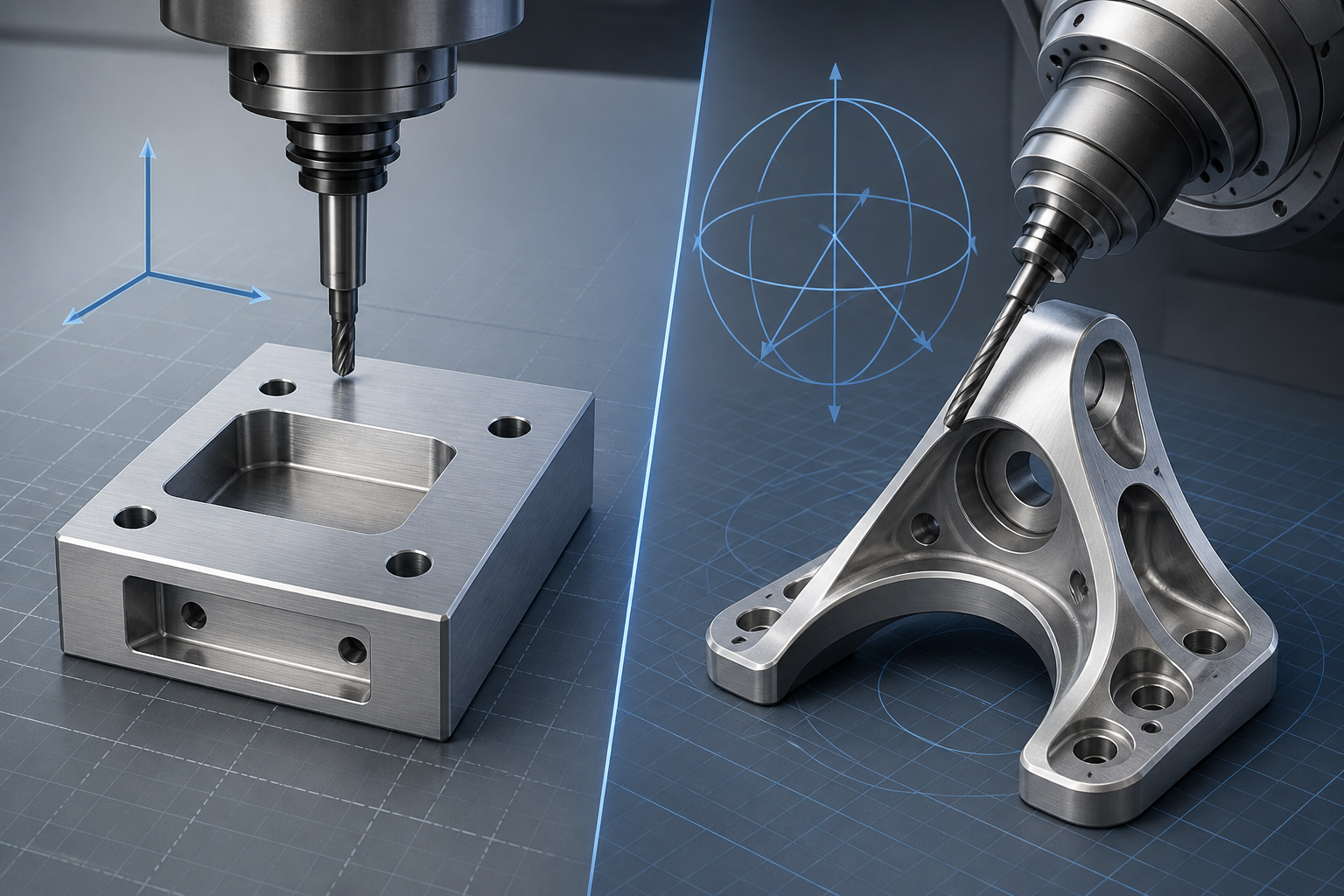
If your part can be machined accurately from one or two simple setups, 3-axis CNC machining is often the most practical choice. If the part has complex angles, deep features, multiple machined sides, tight positional relationships or surfaces that are difficult to reach, 5-axis CNC machining may reduce setups and improve manufacturability.
The best choice is not the machine with the highest axis count. It is the process that can machine the required geometry, tolerance, material and surface finish with the least unnecessary risk and cost.
JRProto provides 3-axis, 4-axis and 5-axis CNC machining for prototypes, end-use parts and low-volume production. This guide explains how to decide which approach fits your part before sending files for quotation.
Quick Answer: Use the Simplest Process That Can Machine the Part Correctly
Choose 3-axis CNC machining when the part has mostly flat faces, pockets, holes and simple profiles that can be reached from the top or from a few separate orientations.
Choose 5-axis CNC machining when the part requires angled tool access, complex curved surfaces, difficult-to-reach side features, multiple sides in close positional relationship, or fewer setups to maintain accuracy.
For many prototype buyers, the real question is not “3-axis or 5-axis?” It is: “Can the manufacturer access every important feature, hold the required tolerance, and inspect the part reliably?”
What Is 3-Axis CNC Machining?
3-axis CNC machining moves the cutting tool along the X, Y and Z axes. It is widely used for milling plates, housings, brackets, fixtures, molds, jigs, enclosures and many functional prototypes.
Typical 3-axis work includes:
- Flat plates with holes and pockets
- Simple aluminum or plastic housings
- Brackets with machined faces
- Parts that can be flipped and machined from another side
- Prototype components with accessible features
3-axis machining is often efficient because programming, setup and inspection can be straightforward. For parts with simple geometry, it can produce accurate and cost-effective results without adding unnecessary machining complexity.
JRProto’s CNC machining service supports CNC milling for parts up to 4000 x 1500 x 600 mm, and CNC turning for parts up to diameter 200 x 500 mm.
What Is 5-Axis CNC Machining?
5-axis CNC machining adds rotational movement to the standard X, Y and Z axes. Depending on the machine and programming strategy, this allows the tool or workpiece to approach the part from more directions.
5-axis machining is useful when the cutter must reach angled faces, complex contours or features that would otherwise require many separate setups.
Typical 5-axis work includes:
- Aerospace-style brackets and lightweight structures
- Medical or robotic components with angled features
- Impellers, curved housings and complex surface parts
- Parts with holes or faces at compound angles
- Components where multiple critical features must stay aligned
5-axis machining can reduce the number of times a part needs to be re-clamped. That can help with positional accuracy, surface consistency and access to difficult geometry.
3-Axis vs 5-Axis CNC Machining: Key Differences
| Factor |
3-Axis CNC Machining |
5-Axis CNC Machining |
| Tool movement |
X, Y and Z linear axes |
X, Y, Z plus two rotary axes |
| Best for |
Flat faces, pockets, holes, simple profiles |
Angled faces, complex curves, multi-side features |
| Setup count |
May need more re-clamping for multi-side parts |
Can reduce setups for complex parts |
| Programming complexity |
Usually simpler |
Usually more complex |
| Cost |
Often lower for simple geometry |
Higher setup/programming cost, but may save cost on complex parts |
| Accuracy risk |
Good when features are accessible and setups are controlled |
Useful when fewer setups help maintain feature relationships |
| Best buyer use case |
Simple prototypes, fixtures, housings, plates |
Complex prototypes, precision brackets, curved or angled parts |
Part Geometry: Which Shapes Need 5-Axis Machining?
A simple rectangular enclosure with top pockets, mounting holes and side features may not need 5-axis machining. It may be cheaper and clearer to machine it on a 3-axis mill using controlled setups.
A part with angled ports, deep side features, organic surfaces or many critical faces around the body may benefit from 5-axis machining. The advantage is tool access. The cutting tool can approach surfaces that would be difficult or inefficient on a 3-axis setup.
Common signs that 5-axis machining may be useful:
- Holes or bosses at non-90-degree angles
- Curved or angled surfaces are difficult to machine cleanly from a standard 3-axis direction
- Deep cavities where short, rigid tooling is preferred
- Critical features spread across several sides
- Thin-wall geometry where repeated re-clamping may cause distortion
- Parts where setup stack-up could affect inspection results
This does not mean every complex-looking part needs 5-axis machining. A good manufacturing review should check whether the same result can be achieved with 3-axis or 4-axis machining before quoting a more complex route.
Setup, Access and Accuracy
Tolerance does not come only from the number of machine axes. It depends on material, geometry, clamping, tool access, tool length, inspection method and how the part behaves during machining.
For many JRProto CNC projects, typical machining tolerance is around +/- 0.02 mm. Critical features may reach around +/- 0.005 mm where geometry, setup, material stability and inspection conditions make that technically appropriate.
5-axis machining can help accuracy when it reduces the number of setups. Every time a part is removed, flipped and re-clamped, there is a chance of small positional variation. If a 5-axis setup allows several important faces to be machined in one holding, it may improve consistency between those features.
However, 5-axis machining does not automatically guarantee tighter tolerance. A simple 3-axis setup with good fixturing may be more stable than an unnecessarily complex 5-axis strategy.
Cost: Is 5-Axis CNC Always More Expensive?
For simple parts, 5-axis CNC machining is usually not the most economical choice. Programming, setup and machine time can cost more than a 3-axis process.
For complex parts, 5-axis machining can sometimes reduce total cost. It may reduce special fixtures, repeated setups, manual repositioning, secondary operations or rejected parts caused by access problems.
Cost is usually affected by:
- Material type and stock size
- Part size and machining volume
- Number of setups
- Tool access and tool length
- Tolerance requirements
- Surface finish requirements
- Threads, inserts and post-machining operations
- Quantity for prototype or low-volume production
If cost matters, send the CAD file and explain which dimensions are actually critical. Over-tight tolerance callouts on non-critical features can increase machining cost without improving part performance.
JRProto’s Practical Recommendation
Use 3-axis CNC machining when:
- The part is mostly prismatic
- Features are reachable from one or several simple orientations
- The design uses flat faces, pockets, bosses and standard holes
- Cost control is more important than reducing every setup
- The part does not require complex angled tool access
Consider 5-axis CNC machining when:
- The part has angled faces or holes
- Several critical features must stay aligned across different sides
- Curved or angled surfaces are difficult to machine cleanly from a standard 3-axis direction
- Deep cavities require better tool access
- Repeated clamping may create accuracy or cosmetic risk
- The part is a high-value prototype or low-volume component where setup strategy matters
JRProto machines aluminum, stainless steel, titanium, brass, copper and specialty alloys, as well as engineering plastics depending on application needs. For plastics, tolerance and surface quality depend strongly on material behavior; this CNC plastic prototype material and tolerance guide may help during material selection.
You can also review JRProto case examples to see how different prototype and low-volume manufacturing projects are handled.
What to Send for a CNC Machining RFQ
For a useful machining review, send more than a screenshot. A complete RFQ package helps the manufacturer choose the right process and avoid quoting the wrong machining route.
Recommended RFQ files and information:
- STEP or native CAD file
- 2D drawing for critical dimensions and tolerances
- Material requirement or acceptable alternatives
- Quantity
- Surface finish requirement
- Thread specifications
- Heat treatment, anodizing, plating or other post-processing needs
- Cosmetic surface requirements
- Application notes if the part is load-bearing, sealing, sliding or assembled with other parts
A STEP file helps the engineering team review geometry. A 2D drawing helps define tolerances, threads, surface finish and inspection requirements. For precision CNC parts, both are often needed.
Ready to Review Your CNC Machined Part?
If you are deciding between 3-axis and 5-axis CNC machining, send JRProto your CAD file, drawing, material, quantity and tolerance requirements. Our team can review the geometry and recommend a practical machining route for prototype, end-use or low-volume production.
You can contact JRProto for an RFQ or start from our CNC machining service page.