
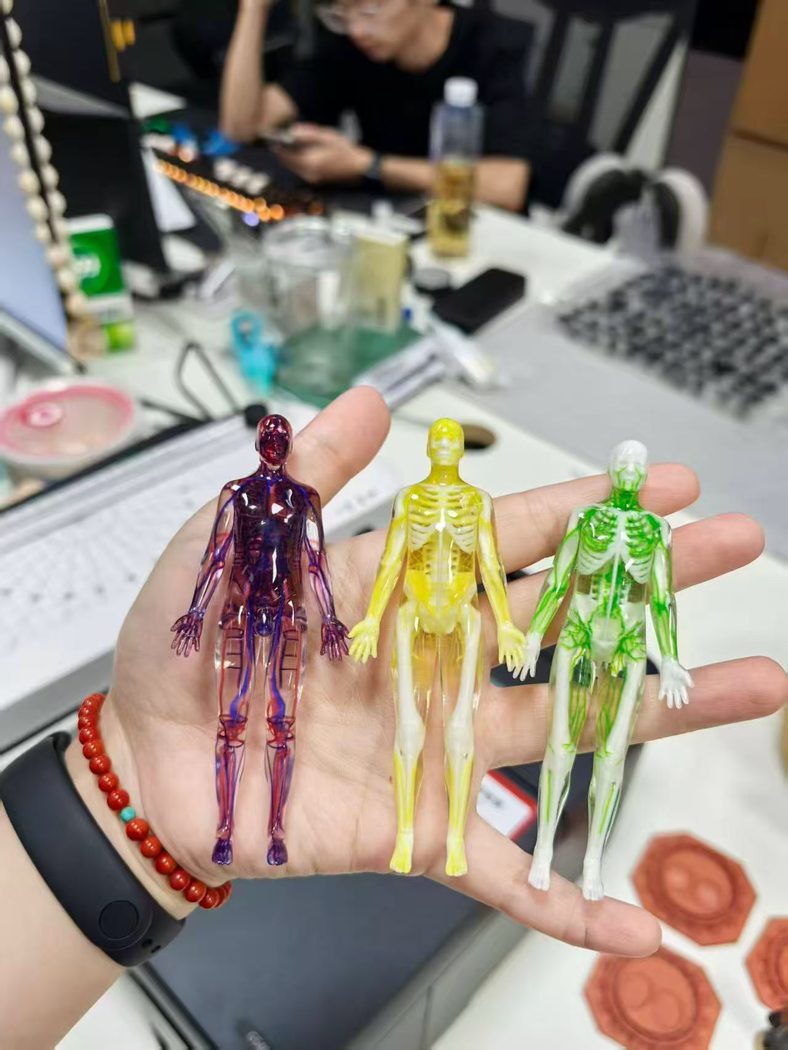
Professional full-color 3D printing requires a controlled geometry-and-color package, an agreed physical proof and acceptance conditions matched to the model’s purpose. A colored screen rendering is not a print specification. Texture files, scale, lighting, surface treatment and fine-feature strength all influence the finished object that a buyer receives.
For product developers, exhibit teams and industrial visualization buyers, the main procurement risk is approving an image while expecting a physical result that was never defined. Separate geometry approval from color approval and handling requirements. This guide explains how to commission a professional full-color model without confusing visual communication, functional prototyping and production-material validation.
Which buying decision should a full-color product model support?
Start with the intended use. A handheld sales model, a trade-show cutaway and a design-review model can all require full color, but they place different demands on small details and packaging. Describe the expected handling, viewing distance, display lighting and any removable sections. Identify the features that must survive transport and repeated demonstration.
Next, distinguish visual accuracy from engineering function. A model can communicate component locations, internal flow paths or product styling without reproducing the properties of the final material. If the project also needs a working latch, heat resistance or mechanical testing, specify that separately. A second prototype route may be more appropriate for those tests.
Write the approval objective in plain language. For example, a cutaway model might need clearly distinguishable regions and readable labels, while a packaging mock-up might prioritize brand colors and surface appearance. Neither requirement should be reduced to a request for the highest number of available colors.
How do direct full-color printing and painting differ for buyers?
Direct full-color printing and printing followed by painting solve different problems. Direct color can reproduce complex texture information as part of the print workflow. Painting can be useful for selected appearance effects, but it introduces a separate interpretation of the color map and may suit different surfaces or handling requirements.
A multicolor filament print is another distinct route. Switching between a limited set of materials or colors does not automatically reproduce continuous image textures. Ask the supplier to name the proposed process and explain what color information it can accept. This prevents an apparently comparable quotation from describing a different manufacturing method.
Jingrui Proto’s professional full-color 3D printing service is the canonical starting point for a project discussion. Its operator-confirmed MIMAKI build envelope is 508 × 508 × 305 mm. That envelope is a capacity boundary, not a promise that any geometry of that size can be produced intact, finished and shipped without review.
Which geometry and texture files should a full-color printing RFQ include?
A geometry-only mesh does not necessarily carry usable color information. An STL typically describes the surface geometry rather than a complete textured model. Depending on the supplier’s workflow, a textured OBJ package or another supported color-bearing format may be needed. Confirm accepted formats before exporting the final files.
For an OBJ workflow, keep the mesh, material file and referenced texture images together. Use a folder structure that preserves relative file references. Send a preview render from the same released package, plus a file list. A render helps detect a missing texture, but the supplier must still check the actual model and its associated assets.
State units and intended dimensions explicitly. A model exported without clear scale can be repaired geometrically yet still printed at the wrong size. Mark an overall dimension that the supplier can use as a cross-check. If a scale reduction is requested, review thin walls and small text at the final physical size rather than at the original CAD size.
Which file and proof approvals should a full-color order define?
Define geometry, texture placement, color priorities, surface condition and packaging approvals separately so one accepted sample cannot silently release every requirement.
| Item to approve | Buyer input | Supplier response to request |
|---|---|---|
| Geometry and scale | Released model, units and overall dimensions | Confirmed size and repair exceptions |
| Texture assets | Material references and image files | Preview with textures loaded correctly |
| Color priorities | Critical regions and physical references where needed | Proposed proof and acceptance method |
| Fine features | Labels, thin elements and handling expectations | Feasibility comments at final print scale |
| Surface condition | Gloss, tactile expectations and permitted finishing | Effects of any proposed post-processing |
| Delivery protection | Assembly, display base and transport needs | Packing approach and assembly instructions |
Keep approvals separate in the quotation. Geometry approval should not silently become acceptance of missing texture detail. Color approval should not imply that a fragile thin feature is suitable for repeated handling. Written gates let the team resolve each risk without reopening every other decision.
What texture-placement errors should buyers check before approving color?
Check whether color regions align with the intended geometry. Look for seams crossing visible areas, stretched labels and textures attached to the wrong surfaces. An accurate shade in the wrong location still produces an unusable model. Ask for views that expose the back, underside and any cutaway surfaces, not only the most attractive angle.
Small text and narrow color boundaries deserve special attention. A label that is readable on a large monitor may occupy a very small area on the physical model. Review it at the final scale and decide whether enlarging the label or changing contrast better serves the model’s purpose. Do not assume that increasing texture-image resolution alone solves a physical feature limit.
For segmented industrial models, agree on how corresponding colors continue across joins. Number removable sections and define their orientation. Color can support assembly instructions, but it should not be the only identification method where incorrect assembly could confuse a demonstration. Use an accompanying diagram when the model contains similar-looking parts.
Why should buyers use a physical proof for critical printed colors?
Displays emit light while a printed object reflects it. The same texture can appear different across monitors, lighting environments and surface conditions. If a shade is important to approval, provide an agreed physical reference or request a representative printed proof. Define who will review it and under what viewing conditions.
The Mimaki 3DUJ-553 manufacturer page describes a full-color UV-curable inkjet printing platform. Manufacturer color capability does not mean every digital color will match every physical reference. Treat the proof as a project control and ask how the supplier will handle colors outside the practical reproduction range.
Choose proof features that represent the actual challenge: a critical brand region, a fine label, a gradient or a transition around a curved surface. Record the approved file revision and finish condition with the sample. An approval photograph is a useful record, but the retained physical proof is the stronger reference for a later visual comparison.
Which support-removal and finishing changes require full-color review?
Ask which surfaces will be affected by supports and how those supports will be removed. Recesses, delicate projections and internal passages can make cleaning or handling difficult. Supplier feedback may suggest a different orientation or splitting the model. Review whether those choices affect visible surfaces or the interpretation of the model.
Any proposed sanding, coating or local touch-up should be discussed before final approval. Finishing can change gloss, tactile feel and the appearance of colors. If the buyer approves a proof before a coating is added, the proof may no longer represent the delivered condition. Approve the surface state that will actually ship.
Keep the acceptance criteria realistic and specific. A display model may tolerate a hidden join while requiring a clean front face. A handheld demonstration piece may prioritize durable connections over invisible segmentation. Explain those priorities so the supplier can propose an appropriate compromise instead of guessing which defect matters most.
What handling and shipping risks should a full-color model RFQ address?
Color-rich models can still contain vulnerable features. Thin antennae, fingers, pins, fins or exposed labels need a handling review. Ask whether they should be thickened, supported, made separately or protected by a base. A geometric change may be acceptable for communication while being inappropriate for a dimensional validation model.
Describe the shipment and use environment. A model that travels between exhibitions may require a reusable protective case and clear unpacking instructions. A single laboratory review may need simpler protection. Agree on whether the model ships assembled and which operations the buyer must perform on arrival.
Inspect the packing arrangement as part of acceptance planning. Contact points should avoid delicate projections and important cosmetic surfaces. Record any loose accessories and their identifiers. This reduces the chance that an otherwise acceptable model becomes damaged or misassembled before the engineering team sees it.
Which items belong in a comparable full-color printing quotation?
Request separate visibility for file preparation, proofing, printing, finishing, assembly and packaging. A quotation for an unreviewed mesh is different from one that includes texture repair and a physical proof. Ask what happens if the buyer changes the artwork after geometry approval, and which approval changes require a new proof.
Compare the same final scale and delivery condition. Smaller models may save material while making labels unreadable or features fragile. A cheaper finish may alter the model’s intended appearance. Evaluate those consequences against the project objective rather than treating all full-color quotes as interchangeable.
Do not publish or distribute models containing confidential product geometry or third-party artwork without authorization. Confirm ownership or permitted use before sharing the package. For medical or anatomical visualization, distinguish a communication model from a validated diagnostic or patient-contact device; color and shape alone establish no such suitability.
How should buyers separate product-layout approval from full-color appearance approval?
Buyers should record layout, appearance and handling as separate approval objectives because one full-color model may support some of these decisions without validating all of them.
A product model can communicate the location of a display, control or label without establishing that the production interface will work. Conversely, a texture proof may support visual approval without reproducing a functional moving control. List which features are representational and which must be physically usable before asking for a quotation.
For example, a demonstration model could use a fixed representation of a button while an engineering assembly needs a separately manufactured moving component. This is a hypothetical purchasing example, not a reported customer project. Ask the supplier to distinguish the visual model from any additional functional prototype in the scope.
At release, identify which files, final scale and surface condition each approval covers. Do not allow an accepted color sample to close an unresolved handling or fit question. Send those objectives with your full-color model quotation request so artwork, manufacturing and acceptance refer to the same intended use.
What should buyers confirm before ordering full-color product models?
Confirm the manufacturing route, complete color file package, final scale, physical proof requirements and delivered condition before releasing a full-color order.
Can I send only an STL for full-color printing?
An STL may be sufficient for geometry review, but it usually does not provide the complete color-and-texture package needed for a textured model. Ask which formats the supplier supports. If separate painting is intended, provide a controlled color map and references. Confirm the manufacturing route before assuming that a colored preview can be reconstructed from the mesh alone.
Will the printed colors match my monitor?
Do not use an uncalibrated monitor as the sole acceptance reference. A physical print and a display present color differently, and lighting changes the result. For critical regions, agree on a reference and a physical proof in the intended finish condition. Record approval against that sample and the released source files rather than a screenshot alone.
Is direct full-color printing the same as hand painting?
No. They are different routes with different file preparation, appearance and labor considerations. Direct color can reproduce texture information through the printing workflow; painting interprets the desired appearance through a separate finishing process. Ask which route is quoted, what detail it can reproduce and how the result will be approved. Select it according to the model’s purpose.
Can a full-color model be used for mechanical testing?
Only when the proposed material, geometry and process have been reviewed for the particular test. Visual similarity to a production component does not establish strength, fatigue resistance, thermal behavior or environmental compatibility. Separate the visual model from functional test requirements. A machined or differently printed prototype may be needed alongside the full-color communication model.
What happens when my model exceeds the build envelope?
Discuss segmentation, joining and the visible location of seams. A large overall assembly may be feasible even when it cannot be printed in one build, but each section still needs orientation, handling and transport review. Agree on whether the supplier or buyer performs final assembly. Do not approve a split until its effect on appearance and dimensions is clear.
What should I include in a professional full-color RFQ?
Send the model, associated texture assets, units, final size, quantity and use case. Identify critical colors, labels, thin features and visible surfaces, then state proofing and packaging expectations. Use Jingrui Proto’s existing RFQ contact channel to request a file review. Ask the quotation to distinguish confirmed scope from any artwork or geometry work still required.
Related Posts
- Full-color portrait printing: a different application context
- Choosing SLA resin for visual and functional prototypes
- Preparing CAD, drawings and tolerances for an RFQ
Author
Prepared by the Jingrui Proto editorial team for professional model procurement. Examples describe approval methods, not undisclosed customer projects. Confirm material performance, color acceptance and manufacturing commitments in the reviewed quotation.










