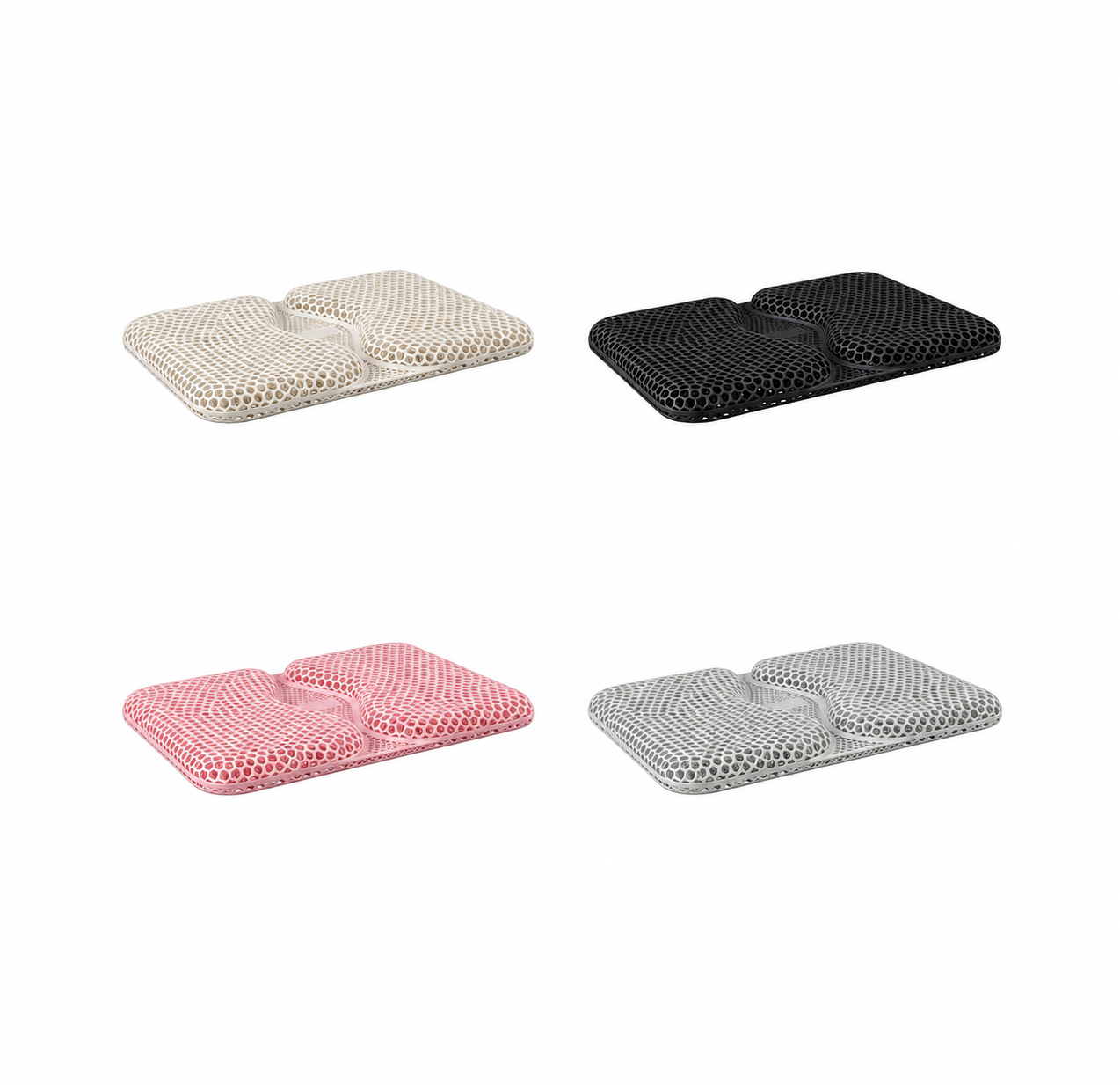
Image: WL-60002 product reference images from the supplied model sheet, with lettering removed. These identify shape and color; they do not show pressure mapping or durability test results.
Quick Answer
Choose a 3D printed seat cushion by how its geometry, material and support surface work together under representative use. Evaluate fit on the intended chair, loaded shape, recovery after sitting, repeated-load behavior and cleaning before approving a retail product. A lattice photograph or a soft hand feel cannot prove pressure distribution, long-term comfort or durability.
For a brand developing a customized cushion, the first commercial decision is whether to evaluate an existing model or commission new geometry. These routes need different sample plans. This guide explains the engineering and purchasing checks that make either route easier to approve without relying on unsupported medical claims.
Start with the chair and the use pattern
A seat cushion does not operate in isolation. Its base rests on a chair surface that may be flat, curved, upholstered or flexible. Its top interacts with clothing and different seated positions. Record the chair type, available seat area, surrounding edges and any movement that could make the cushion migrate during use.
Define the intended activity rather than assuming that all sitting is equivalent. Office work involves reaching and posture changes; a waiting-area seat may have repeated short use; a portable cushion may face frequent packing and cleaning. Identify these conditions in the development brief so that the prototype is evaluated against the actual retail proposition.
Confirm how the cushion affects seat height and usable depth. An added layer can alter the relationship to a desk, armrest or back support. A product that fits within the chair outline may still change how the user reaches the work surface. Dimensional fit is therefore more than checking the cushion’s bounding box.
Existing Jingrui models versus new designs
Jingrui Proto’s company-supplied product records identify WL-60002 as a double-pad seat-cushion design and WL-60003 as a single-piece design. The reference colors for WL-60002 are off-white, black, sweet pink and light gray; WL-60003 is shown in gray, black, warm yellow and sky blue. Confirm the selected model, color and current order requirements in the quotation.
These references identify products, not a universal material specification or tested load rating. Do not infer the manufacturing process, polymer grade, dimensions or compression life from the image. A customized cushion must be assessed separately, including any requested change to shape, density, color or attachment features.
Review Jingrui Proto’s 3D printing capabilities as the starting point for process discussion. The appropriate route for a flexible consumer product depends on its geometry and material requirements; not every technology listed on a general service page is suitable for the same cushion.
Lattice density is only one design variable
The apparent openness of a cushion can be misleading. Its response depends on member dimensions, cell shape, connectivity, orientation and the thickness of the whole section. Two samples that look similarly porous may respond differently under the same seating load.
| Design feature |
Potential purpose |
Evidence to request |
| Regional density |
Different support behavior across the cushion |
Local and whole-cushion load comparisons |
| Cell shape and orientation |
Control how the structure deforms |
Deformation observations under defined loading |
| Perimeter geometry |
Manage edge support and transitions |
Edge-loading and sitting-position evaluation |
| Base surface |
Maintain contact with the chair |
Slip, rocking and support-contact checks |
| Thickness profile |
Provide travel within the available space |
Loaded height and recovery measurements |
| Split or single-piece layout |
Match the intended contact geometry |
Fit evaluation on the actual seat |
Treat these as design choices to investigate, not guaranteed benefits. Increasing stiffness can reduce unwanted collapse while also changing perceived firmness. Making a region more open may improve access for cleaning or airflow but can alter load paths and feature durability. Evaluate the complete combination.
Pressure distribution is a measurement question
Pressure distribution is relevant to cushion development, but a shaped or latticed surface does not prove a favorable pressure map. Contact depends on the user’s position, body geometry, clothing, the underlying chair and the cushion’s deformation. Different sitting positions may load different regions.
If pressure mapping is part of the project, define the equipment, calibration, seating posture, trial duration and comparison product. Keep measurement conditions consistent and explain what each map represents. A colorful image without a controlled protocol is not evidence of a general comfort improvement.
Use user feedback alongside measurements, with their roles clearly separated. Ask participants to identify contact locations, instability, edge feel and changes over time. Those observations can guide revisions, but they should not be described as clinical results. This article makes no claim that a cushion treats pain, prevents injury or provides a medical outcome.
Evaluate compression and recovery separately
Record unloaded dimensions at agreed reference points. Apply a defined load or displacement using a fixture that represents the contact being investigated, then measure the loaded height or shape. Local indentation and broad loading can answer different questions; identify which procedure is being used.
After unloading, observe immediate recovery and measure again after an agreed rest period. A sample may recover its height while its mechanical response changes. Record both residual shape and the force needed to reproduce the earlier deformation. Do not label either result simply “elasticity” without explaining the measurement.
A useful comparison keeps sample temperature, conditioning, loading rate and prior history consistent. A newly unpacked sample and one tested after repeated cleaning should not be merged into one unexplained result. Keep a record of each exposure and retain an untested reference where practical.
Repeated-load durability: inspect what changes
Repeated seating loads can be assessed by monitoring thickness, load response, damaged members and changes in support. Plan inspection intervals rather than waiting only for complete failure. Look at transitions, thin junctions, the base and any attachment features as well as the top surface.
ISO 3385, Flexible cellular polymeric materials—Determination of fatigue by constant-load pounding, describes fatigue assessment for specified flexible cellular materials used in load-bearing applications such as upholstery. Its scope distinguishes measured losses from those that occur in service. Discuss applicability with a competent testing provider; a printed lattice is not automatically qualified by mentioning this standard.
Select an evaluation that answers the intended retail claim. A development test can compare two designs under a controlled setup without establishing a universal service life. Specify the allowed change, inspection method and responsibility for approval before testing begins. No load capacity or cycle-life result is claimed for the Jingrui models here.
Edge loading, movement and base support
Users do not always sit centered. They may perch near an edge, reach sideways or shift between positions. Include representative changes of contact location so that a cushion is not approved only under a symmetrical laboratory load.
Inspect whether the base slides, rocks or folds on the intended chair. If a strap, non-slip surface or removable cover is proposed, evaluate it as part of the assembly. A stable cushion on one fabric may move differently on a smooth seat. Specify the target chair surface and acceptable movement rather than describing an unspecified base as universally non-slip.
Pay attention to transitions between supported and unsupported areas. If a cushion overhangs the chair, its edge may experience a loading condition absent from the central compression test. Adjust the shape or support arrangement as needed, then repeat the relevant evaluation rather than treating it as a cosmetic revision.
Material suitability, finishing and cleaning
Request the exact material identity, manufacturing route and finished-state requirements. Flexible appearance does not establish a polymer grade, skin-contact suitability or resistance to every cleaner. The chosen material and finishing method should be reviewed against the intended environment and handling conditions.
Inspect surfaces that contact clothing or skin and any edges exposed during handling. Ask how residual material is removed from open cells and how small features are checked after processing. A smooth-looking external photograph cannot establish the condition of internal or underside regions.
Define a practical cleaning procedure and evaluate the cushion after repeated cleaning and drying. Observe trapped debris, drying access, color change, tackiness, odor, surface damage and retained shape. Avoid promising machine washability, sterilization or resistance to disinfectants without evidence for the selected product. A care label should reflect the approved procedure rather than an assumption based on a generic material name.
Design a sample program for a retail brand
Separate geometry screening from final product approval. Early samples may compare a few density regions or thickness profiles. Later samples should include the intended chair interface, color, finish, cover and any attachments. A final sample should represent the product the customer will actually buy.
Consider a hypothetical office-accessory brand comparing a double-pad and a single-piece cushion. The useful first comparison is their contact geometry and fit on the target chair. Then assess the preferred candidate’s compression behavior, movement and cleaning. Changing the shape and material together at every iteration would make the source of improvement difficult to identify.
For a pilot batch, check whether the approved design repeats across units. Identify reference dimensions, appearance criteria and model/color labeling. Include packaging recovery in the sample review if the cushion is compressed or folded for shipment. Packing that permanently changes shape can undermine an otherwise acceptable product.
What belongs in a cushion quotation
An RFQ should distinguish an existing-model order from a new development program. Provide the intended users, chair geometry, use duration, overall envelope and proposed quantity. If the application involves special cleaning or environmental conditions, disclose them before selecting a material.
Ask the quotation to identify design work, samples, finishing, agreed testing, packaging and production separately where useful. Confirm which acceptance records are included and which evaluations the buyer will perform. For later small-batch manufacturing, keep the approved digital revision and physical reference sample linked to the purchase order.
Record changes to material, geometry and processing after approval. A repeat order should not quietly substitute a different structure because it looks similar. Define the procedure for reviewing supplier-proposed revisions and identifying which fit or durability checks need to be repeated.
Buyer checklist before ordering
- Confirm the model number or new-design scope and the intended chair interface.
- Agree dimensions, regional geometry, color and finished surface expectations.
- Define compression, recovery, movement and cleaning evaluations.
- Identify whether any pressure mapping is needed and who will perform it.
- Review a representative sample with the intended chair and packaging.
- Establish batch consistency criteria, labeling and change control.
- Confirm development costs, testing responsibilities and delivery destination.
Frequently asked questions
Does a more open lattice mean a softer cushion?
Not necessarily. Cell structure, member dimensions, orientation and section thickness also influence the response. Compare complete samples under equivalent loading.
Can a cushion’s pressure distribution be judged from a photo?
No. A photo shows geometry, not a controlled contact-pressure measurement. Define a pressure-mapping protocol if that evidence is needed.
Are WL-60002 and WL-60003 the same design?
No. Company records identify WL-60002 as a double-pad design and WL-60003 as a single-piece design. Confirm the chosen model and dimensions before ordering.
What proves compression durability?
Use a documented repeated-load evaluation with agreed limits for response changes, residual deformation and visible damage. A brief hand squeeze is not sufficient evidence.
Can I request another shape or color?
Yes, submit the request for feasibility review. Color, material, geometry and production requirements must be confirmed for the specific design.
Can these products be marketed as medical cushions?
No medical claim is established by this guide or the reference images. Any such intended use requires its own applicable evidence and review.
Request a seat-cushion development review
Send Jingrui Proto your cushion brief with the model or concept, chair dimensions, intended use, color, quantity and sample-evaluation requirements. Ask for a prototype and quotation plan that makes fit, compression behavior, cleaning and batch approval explicit before a retail launch.
Author
Jingrui Proto technical content team. Product images identify supplied models; no pressure-map, medical, fatigue-life or load-rating result is claimed.
Related Posts