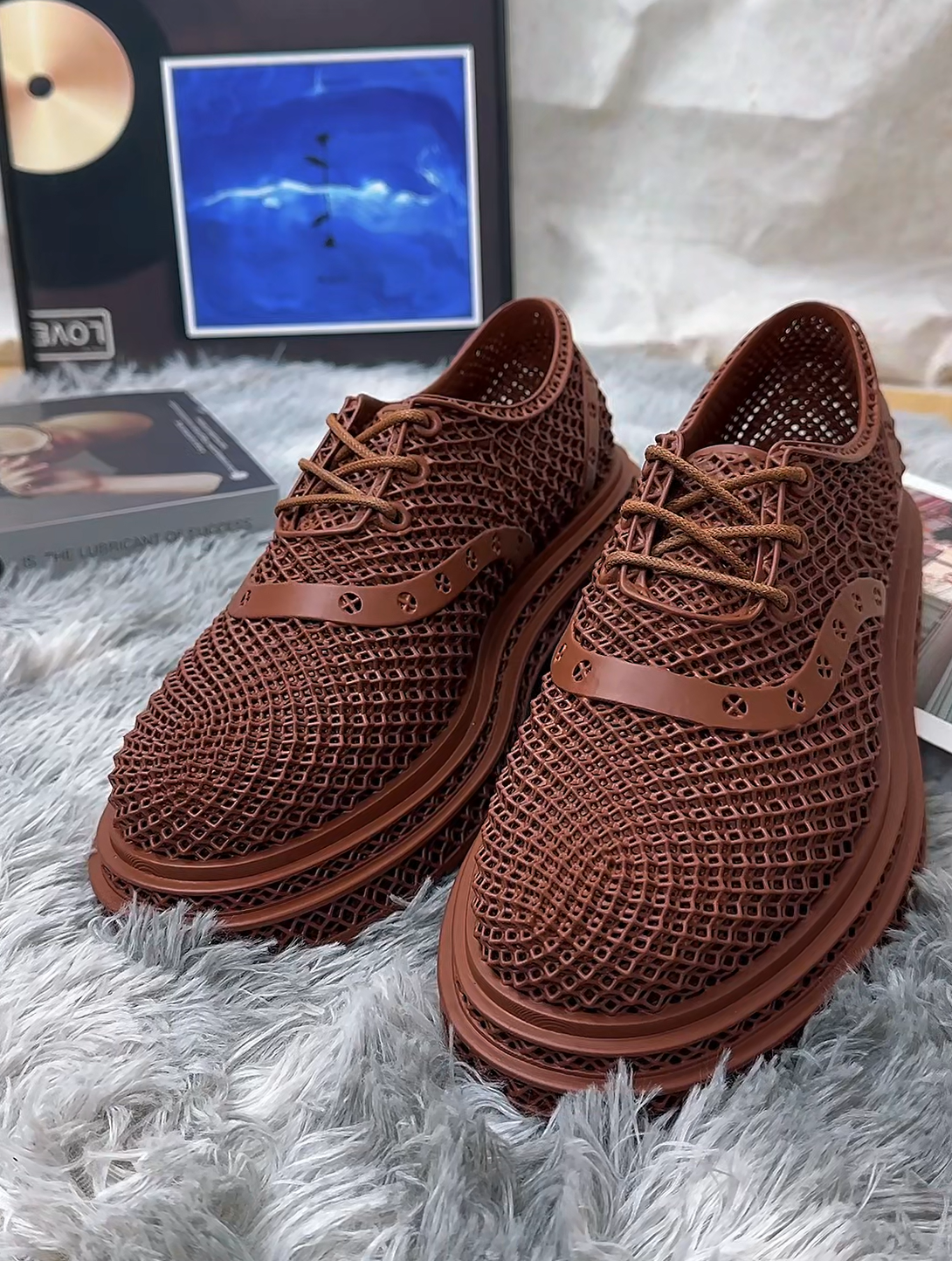
Image: Company-supplied footwear photograph: product appearance only, not an abrasion or wear-life test record.
Quick Answer
Evaluate 3D printed shoes as a complete wearable product: outsole abrasion, repeated bending, lattice recovery, fit, surface feel and production consistency answer different questions. A high abrasion-cycle figure cannot establish the lifespan of the whole shoe. Retail approval should combine documented laboratory methods with representative fit samples and a controlled wear trial before a collection is ordered.
Jingrui Proto provides in-house footwear design and DLP production. Its 3D Printed Footwear collection identifies JR-58070, JR-58076 and JR-58106 for model-selection, wholesale and customization inquiries. This guide explains what buyers should request and compare; it does not describe an independently certified footwear test program.
How to interpret Jingrui Proto’s performance statements
Jingrui Proto states an abrasion-test performance of 800,000 cycles, a design target of approximately six months of continuous regular wear, and an expected service life that may reach approximately 1–2 years with intermittent rather than frequent wear. These are company-provided performance claims, not independently verified laboratory results presented in this article. No laboratory report, test standard or specimen conditions are supplied here, and the figures are not guarantees for every wearer or model.
Keep these statements separate in purchasing documents. Abrasion cycles describe repetitions in a particular test arrangement. Calendar wear life reflects a combination of use frequency, wearer weight, walking surface, fit and maintenance. Neither statement provides the missing test method for the other. Six months of frequent wear and two years of occasional use can involve very different exposure histories.
Before repeating the cycle claim in a retail listing, request the applicable model and material, test method, loading, contact surface, specimen preparation, endpoint and supporting record. Establish whether the test assessed a complete shoe, an outsole region or a separate sample. If those details remain unavailable, do not present the number as a standardized comparative rating or proof of a particular service life.
Seven durability questions that must stay separate
| Evaluation |
What it investigates |
What it does not establish alone |
| Abrasion |
Material removal under rubbing contact |
Whole-shoe lifespan or flex durability |
| Outsole wear pattern |
Local tread loss during intended use |
Fit or cushioning recovery |
| Repeated flexing |
Damage at bending regions and transitions |
Resistance to every walking surface |
| Compression recovery |
Shape and mechanical response after loading |
Long-term comfort for every wearer |
| Structural fatigue |
Progressive lattice or interface damage |
Skin-contact suitability |
| Dimensional stability |
Retained dimensions after conditioning or use |
Universal size-system equivalence |
| Fit and surface evaluation |
Retention, clearance and contact experience |
A medical benefit or injury prevention |
These categories can interact. A worn outsole can expose a different structure; persistent compression can change the fit; a stiff transition can concentrate bending. Record the sequence of tests so a supplier can distinguish an initial defect from damage created by prior conditioning.
Abrasion resistance: compare equivalent evidence
Ask how the abrasion result was obtained before comparing suppliers. Test equipment, abrasive medium, load, contact area and endpoint all affect the meaning of a number. “Cycles survived” may mean no visible breakthrough, a specified loss limit or an operator-defined stop. Without an endpoint, even two cycle counts from similar-looking machines may not be comparable.
For example, ASTM D5963 describes rotary-drum abrasion testing of rubber and thermoplastic elastomers, reporting volume loss or an abrasion-resistance index. Its scope cautions against assuming a direct correlation with service performance. This example explains why test definitions matter; it does not identify the method behind Jingrui’s 800,000-cycle statement or establish that the shoes were tested to that standard.
Separate outsole wear from abrasion on an upper, collar or interior contact surface. A shoe can retain its tread yet become uncomfortable because an edge roughens. Conversely, an upper can look intact while a heavily loaded outsole region wears unevenly. Retail sample evaluation should photograph and identify each contact zone rather than assign one general durability score.
Lattice deformation, recovery and repeated compression
An open lattice changes shape because its members bend, rotate or contact neighboring features under load. That visible flexibility is useful design information, but a hand squeeze does not quantify the load, deformation or recovery time. The same sample may appear springy initially and respond differently after sustained or repeated loading.
For a repeatable compression comparison, define where the load is applied, the loading surface, displacement or force control, hold time and rest interval. Measure the unloaded geometry before testing and after an agreed recovery period. Compare how much force is needed to reach the same deformation before and after conditioning. Persistent height loss and a changed load response answer different questions and should be recorded separately.
Use specimens that represent the delivered design. A simple material block cannot capture every thin strut, curved junction or localized transition in a shoe. Record the print route and post-processing state because a test on an unfinished sample may not describe the product a customer actually receives. Confirm material identity directly; the visual appearance of a flexible lattice does not identify its polymer chemistry.
Repeated bending and structural fatigue
Inspect the forefoot flex region, heel transitions, collar, fastening features and interfaces between open and more solid sections. Repeated motion can reveal cracks, torn junctions or local permanent distortion that an abrasion test misses. Ask the laboratory or development team to choose a method suitable for the complete design and intended use.
ISO 24266, Footwear—Test methods for whole shoe—Flexing durability, addresses whole-shoe flexing and states applicability limits. It is a possible method-reference discussion, not a claim that every lattice shoe is within scope or that Jingrui models comply. The selected procedure and any deviations should be documented before comparing results.
Examine specimens at planned intervals as well as at the endpoint. A photograph taken only after a large number of repetitions may conceal when damage began. Preserve failed samples and mark the damaged region on a drawing. This supports a targeted change to geometry or processing instead of replacing the material based on a single unexplained failure.
Fit is a commercial acceptance criterion
Start with a declared sizing system, measured product dimensions and a fit sample. A nominal size label does not describe toe clearance, instep volume, heel retention or width. Evaluate the intended sock condition and fastening adjustment, and include the size range that the retail brand plans to sell. A fit approved in one size does not automatically approve the smallest and largest variants.
Ask wearers to distinguish immediate impressions from observations after the agreed trial. Record rubbing locations, localized pressure, foot movement, entry and removal, and whether flexibility changes during use. Avoid reducing this feedback to “comfortable” without a location or activity. A structured feedback sheet makes design revisions more useful and helps a purchasing team compare samples consistently.
Customization should be specific. Changing a logo is different from changing the last-like internal envelope, collar geometry or load-bearing lattice. A geometry revision can change fit and durability together, so confirm which earlier approvals remain applicable. Do not assume that a customized shoe inherits all claims made for a different standard model.
Ventilation, surface feel and cleaning
Open geometry can provide airflow paths, but visible openings do not prove a ventilation rating under every wearing condition. Socks, contact with the foot, contamination and surrounding surfaces affect how those openings function. Assess the complete shoe in its intended use rather than describing openness as a measured cooling benefit.
Check the collar, interior, edges, support-removal areas and any finished surfaces that contact the wearer. Agree acceptable roughness or visual references where appropriate, without inventing an unmeasured surface specification. Confirm that cosmetic treatment does not obstruct openings, create tackiness or change the approved contact feel.
Request care instructions for the actual material and finish. Compare appearance, dimensions, odor and surface feel after the proposed cleaning and drying procedure. Do not assume that hot water, solvent cleaning, machine washing or prolonged sunlight is acceptable. Samples used for cleaning evaluation should be identified so that later wear feedback can be interpreted against their exposure history.
Approve a retail collection in stages
Use a development sequence that creates evidence at each decision:
- Define the product: model, intended activity, wearer group, sizes, colors and retail positioning.
- Approve identity and appearance: geometry, branding, finish, packaging presentation and clear model references.
- Evaluate fit samples: planned sizes, socks, fastening and structured wearer feedback.
- Agree performance checks: abrasion, flexing, compression, cleaning and any market-specific requirements with competent support.
- Review a pilot batch: consistency across pairs, size labels, left/right matching and documented deviations.
- Release the order: approve a reference sample, specification revision and change-control process.
A small order is useful when it reduces a defined uncertainty. Ordering many colors before settling fit can multiply the number of samples without resolving the main launch risk. Plan the sample matrix around the decisions the brand actually needs to make.
What retail buyers should ask suppliers
Ask whether the quoted product is a standard model, a modified existing design or a new development. Confirm who controls the digital model and how revisions are identified. Establish the process for accepting color variation and finished dimensions, and determine how a replacement or repeat order will be matched to the approved sample.
Request the available material and performance documentation for the intended sales market. Distinguish an internal company claim from a dated report linked to the actual model. Confirm which tests are included in the quotation and which require an outside laboratory. Neither a photograph nor a general factory certification replaces product-specific evidence.
Jingrui’s current footwear page states that standard models can be ordered from one pair and company-logo customization starts from ten pairs, with shipping paid by the customer. These are footwear-specific published terms, not blanket minimums for every custom product. Confirm the selected design, size mix, artwork and delivery arrangements in the current quotation.
RFQ checklist for private-label footwear
Provide the following information so the supplier can quote a defined launch project:
- Selected model or concept drawings, and the distinction between logo changes and structural redesign.
- Intended activity, customer group, sales market and required product information.
- Sizing system, proposed size breakdown, fit concerns and sample-evaluation plan.
- Color references, branding artwork, placement and finish expectations.
- Sample quantity, pilot order and estimated repeat demand without treating forecasts as committed orders.
- Requested material documentation, performance checks and criteria for approving each stage.
- Packaging, labeling, care instructions, destination and delivery expectations.
Ask for development, samples, agreed testing, production and shipping to be identified clearly. This prevents an attractive unit quotation from concealing missing validation work. Keep a record of what was approved and the date of the reference sample before releasing a repeat batch.
Frequently asked questions
Does 800,000 abrasion cycles mean two years of wear?
No. A cycle result belongs to a defined test, while calendar life depends on actual exposure. The company figures above must remain separately attributed and cannot be converted into one another without supporting evidence.
Are the six-month and 1–2-year figures guarantees?
No. They are company-provided targets or expectations. Frequency, wearer weight, surfaces, fit and maintenance affect service life; confirm commercial terms separately.
What should a buyer test besides abrasion?
Include repeated flexing, compression and recovery, structural condition, fit, outsole wear pattern, cleaning and delivered-pair consistency. Select methods and acceptance criteria for the actual design.
Can the photos prove durability?
They show the product appearance. A hand-flexing demonstration can illustrate flexibility, but neither image supplies controlled fatigue, abrasion or recovery measurements.
Can I start with a standard Jingrui model?
Yes. Review JR-58070, JR-58076 and JR-58106 on the current footwear page and request the relevant size and color samples before approving an order.
What if I need my own lattice or silhouette?
Provide the design brief and intended use. New geometry requires manufacturability, fit and validation review; approval of a standard model does not automatically cover a redesign.
Request footwear samples and a retail-ready quotation
Send Jingrui Proto your model selection and RFQ with sizes, colors, quantity, branding and the evidence you need before launch. State whether you want to evaluate a standard shoe, develop a customized collection or plan a private-label pilot. The team can review the sample and production scope before you commit to the retail order.
Author
Jingrui Proto technical content team. Performance figures are company-provided claims with the qualifications stated above; photographs are product references, not laboratory test evidence.
Related Posts