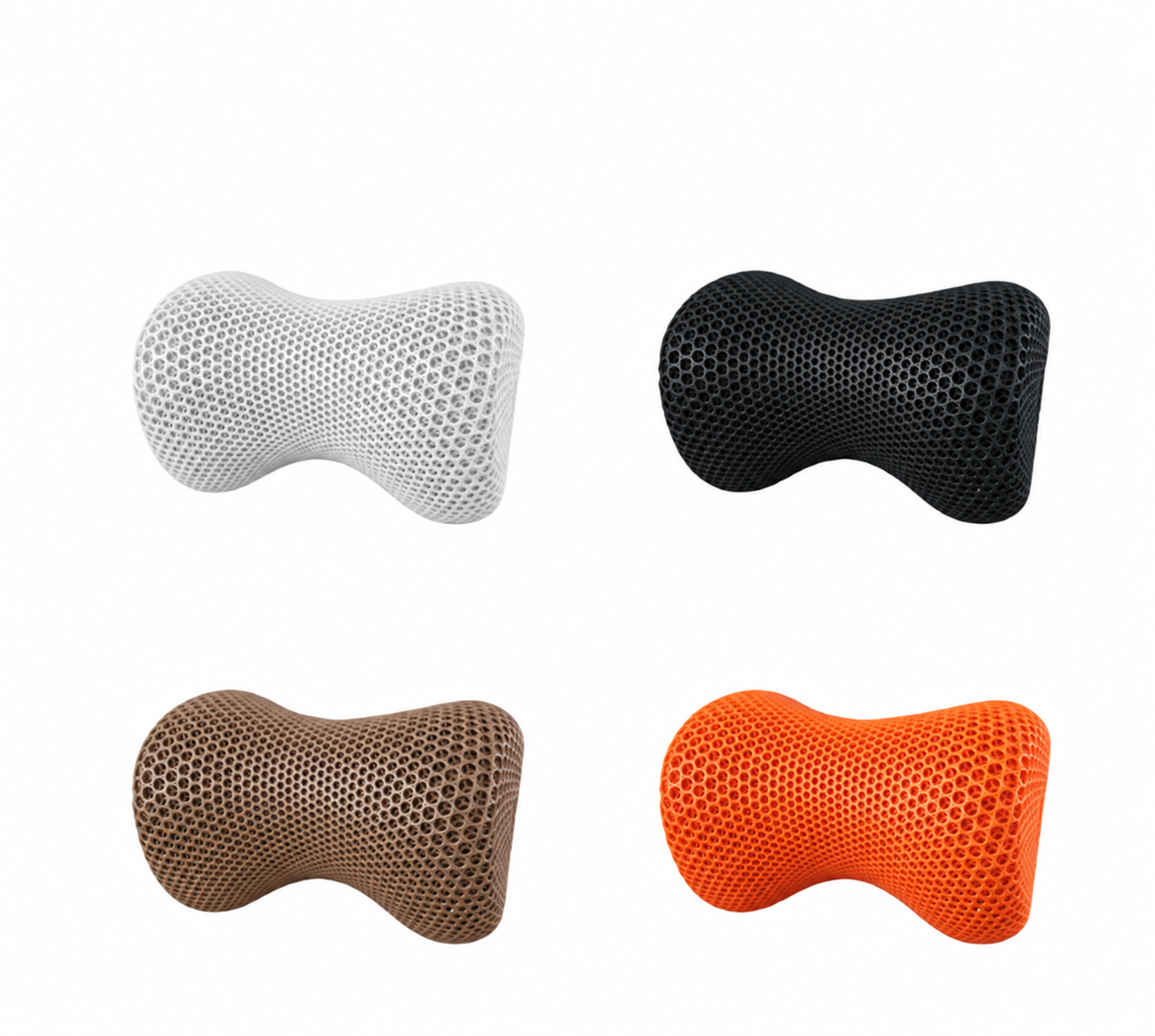
Image: WL-60006 product reference images from the supplied model sheet, with lettering removed. Appearance does not establish automotive safety approval or a completed validation program.
Quick Answer
Evaluate a 3D printed support pillow or headrest pad by its contact geometry, compression response, recovery, surface condition and fit in the intended setting. A flexible lattice can provide design freedom, but its appearance does not establish comfort, fatigue life or safety approval. Consumer support pillows and automotive comfort accessories require separate development briefs because their interfaces and consequences of poor fit differ.
For buyers, define the product category before requesting samples: a freestanding consumer cushion, a removable comfort pad or a component intended for vehicle integration. This guide addresses design and procurement. It does not establish a medical benefit, automotive certification or crash-protection function for a printed pad.
Separate the product categories at the outset
A consumer support pillow may be evaluated on a chair, sofa or other specified surface. Its shape and feel must be considered with the intended body contact and posture. A pad intended for a vehicle interacts with an existing seat and head restraint, whose adjustment and designed function must remain part of the review.
Do not treat a comfort pad as a replacement for a vehicle head-restraint system. A visually similar shape does not establish equivalent function. Vehicle-specific use, attachment, clearance and applicable product requirements need competent review before a buyer makes a safety claim or approves installation.
| Product direction |
First design question |
Required distinction |
| Freestanding support pillow |
Which surface, posture and contact area does it serve? |
Comfort evaluation is not a medical outcome |
| Chair-mounted pad |
How does it stay positioned during use? |
Attachment and furniture fit are separate checks |
| Automotive comfort accessory |
Is it compatible with the specified seat and head restraint? |
Appearance and softness do not establish vehicle approval |
| Vehicle-integrated component |
What system requirements govern the part? |
Requires an appropriate automotive development program |
These categories can share design tools without sharing acceptance evidence. A pillow approved for a lounge chair should not be relabeled for universal automotive use on the basis of the same sample photograph.
Existing product evidence and customization scope
Jingrui Proto’s company-supplied model records identify WL-60006 as a car-headrest pad. The reference images show light gray/white, black, brown and vivid orange. They establish the model appearance and named color references, not dimensions, a polymer grade, load capacity or automotive safety certification.
Broader support-pillow concepts are development requests rather than additional existing models established by these images. Send the proposed shape, contact area and application for review. Customized geometry, material, colors and attachment details require confirmation; do not assume that every option available for another ergonomic product applies here.
The 3D printing service overview explains Jingrui’s broader process capabilities. For a flexible consumer product, the manufacturing route and exact material should be selected against the project brief. The reference image alone is not a reliable way to identify the process.
Begin with the contact envelope
Define the overall shape and the surface that actually contacts the user. A central recess, raised side region or curved boundary can change where load is carried. Review the design in its intended position rather than judging the silhouette against a plain background.
Document the supporting surface and available clearance. A pad that feels appropriate on a rigid test board may behave differently on a soft chair back. Its apparent thickness may also change when the attachment is tightened. Include these conditions in the prototype review so that free-standing dimensions are not mistaken for installed geometry.
For a customizable product, ask which dimensions can vary independently. Changing width, thickness and curvature together can make sample comparisons confusing. A deliberate sequence—first contact shape, then regional mechanical response, then surface and appearance—helps the buyer understand why a revision is preferable.
Flexible lattices: tune regions without hiding weak transitions
The behavior of a lattice depends on more than how open it looks. Cell topology, member size, orientation and regional connectivity determine how the structure changes shape. The same nominal material can feel different when the geometry changes.
Review the junction between a compliant center and a firmer boundary. An abrupt change can move deformation into a narrow region instead of distributing it as intended. Inspect the base, side lobes, attachment areas and thin connecting sections after loading. The most visually prominent surface is not always where damage begins.
Do not assign a universal lattice density to all pillows or all users. Specify the available deformation space and the behavior to compare. If one region is intended to feel softer, agree a repeatable local loading procedure and compare it with the neighboring region under clearly stated conditions.
Material selection includes the finished surface
Ask for the exact material identity and manufacturing route, followed by the relevant material documentation. Flexible appearance does not identify a thermoplastic elastomer, a light-cured formulation or another polymer. Similar nominal hardness values do not guarantee equivalent tear resistance, aging behavior or skin-contact suitability.
Evaluate the delivered surface, including any cleaning, curing, finishing or coloring steps required by the chosen process. Thin members and interior cells should be accessible to the necessary processing and inspection. Ask how residue, loose fragments or damaged junctions will be identified before the sample is approved.
A cover, coating or textile layer changes the product. It can alter contact feel, ventilation paths, cleaning access and how the lattice deforms. If a cover is part of the retail plan, include it during the final sample evaluation. Results from a bare lattice should not be transferred automatically to a covered assembly.
Compression and recovery: define the observation
Separate three questions: how far the product moves under load, how quickly it recovers after unloading, and whether repeated use changes its response. These require different observations and should not be summarized by a single statement that the pad is “highly elastic.”
Record initial dimensions at agreed locations. Select a contact fixture appropriate to the region being investigated, then define the force or displacement, loading rate, hold time and recovery interval. A small local indentation and a broad compression test can reveal different behavior. Document the setup so that two samples are compared fairly.
After an agreed rest period, compare shape and mechanical response with the original condition. A pad may regain its overall thickness while becoming easier or harder to compress locally. Retain photographs and measurements linked to the sample revision; avoid calling a visual rebound demonstration a fatigue test.
Repeated loading and durability inspection
For development testing, define a loading sequence representative of the intended use rather than selecting a large repetition count for marketing. Inspect the sample at planned intervals and note where damage or persistent deformation appears. The inspection should cover small junctions, edges, attachment features and any covered regions that can be examined safely.
Track changes in surface condition as well as shape. Friction against clothing, repeated handling and contact with a chair or seat can affect different areas. Cleaning exposure may introduce another variable, so identify whether a specimen has been cleaned or aged before mechanical evaluation.
The test endpoint should answer the buyer’s decision. Examples include an agreed limit for residual shape change, a specified change in the load response or the presence of unacceptable damage. Those are proposed acceptance categories, not results reported for WL-60006. No fatigue life is established by the reference image.
Fit and attachment require their own samples
Specify how the pad is positioned and retained. A loose pad, a strap-mounted accessory and a mechanically integrated component have different load paths. If attachments are included, evaluate their adjustment range, accessibility, repeat use and effect on the printed structure.
For automotive development, identify the actual vehicle or seat family rather than claiming universal fit. Check whether the accessory affects intended adjustment, access, visibility or movement of surrounding components. Obtain the relevant vehicle or seat manufacturer’s guidance and an appropriate review before approving use. A supplier’s material datasheet cannot resolve all system-level questions.
Keep comfort-oriented feedback separate from safety evidence. A person saying a sample feels supportive is useful development feedback, but it does not establish performance in a collision. This article makes no automotive certification, restraint-system compliance or injury-prevention claim for the pictured product.
Cleaning, environment and appearance
State the likely cleaning method, contact with skin or hair, storage conditions and exposure during use. An automotive accessory can encounter different temperature and light exposure from an indoor pillow. Material, finish and attachment suitability must be reviewed for the actual environment rather than inferred from a shared product category.
Evaluate cleaning and drying on representative finished samples. Observe trapped debris, changes in surface feel, odor, discoloration, tackiness and retained moisture. Do not promise machine washing, disinfection or heat resistance without evidence for the selected construction. The approved care instructions should match the procedure used in evaluation.
Agree color and appearance using an approved reference rather than a screen image alone. If the model will be supplied in several colors, confirm whether the material and processing are otherwise equivalent. A buyer should understand which differences are cosmetic and which could require additional review.
Plan the prototype-to-batch decision
A useful sample program begins with a specific uncertainty. Early prototypes can compare contact geometry. Later versions can compare regional response or include the intended attachment and cover. The final reference sample should represent the actual retail construction, including its surface and packaging.
Consider a hypothetical brand developing a desk-chair support pad. It could first compare two shapes on the same chair, using the same material. After selecting the contact geometry, it could refine the response and evaluate cleaning. Only then should it consider a separate automotive version with its own fit and requirements. This is an example of development planning, not a claimed customer project.
For a small-batch production program, define the checks that show repeatability: reference dimensions, visible defects, approved contact feel, labeling and packaging recovery. Retain the approved digital revision and sample. Changes in material, geometry or processing should trigger a documented review of which approvals remain valid.
RFQ information for support pillows and headrest pads
- Identify the existing model or clearly describe a new concept.
- Provide the intended setting, contact area, dimensions and supporting surface.
- State whether automotive use is proposed and identify the relevant seat or vehicle interface.
- Include attachment, cover, color and surface expectations.
- Describe loading, recovery, cleaning and environmental evaluation needs.
- Separate prototype quantities, pilot quantities and forecast repeat demand.
- Identify required documentation, approval responsibilities, packaging and destination.
Ask for design, samples, agreed testing, finishing and production scope to be made clear in the quotation. This helps compare suppliers on the work needed to reach an approved product rather than on the price of an unvalidated printed shape.
Frequently asked questions
Are support pillows and automotive headrest pads interchangeable?
No. Their supporting surfaces, installation and requirements differ. Approve the intended use and interfaces separately, even when the shapes look similar.
Does WL-60006 have an established safety certification?
No such certification is established by the supplied product records or this guide. Appearance, softness and a model number are not evidence of automotive safety approval.
Can a lattice provide different firmness regions?
Geometry can be developed for different regional responses, but the result needs measurement and sample evaluation. Do not assume a visual density gradient proves the intended behavior.
How should recovery be compared?
Use consistent loading and recovery intervals, then compare dimensions and mechanical response. Keep immediate rebound separate from persistent deformation and repeated-load change.
Can a buyer request a custom support-pillow shape?
Yes, submit the concept for design and manufacturing review. A new shape is a development project with its own material, interface and validation requirements.
Is a cover included automatically?
No. Confirm the complete construction and supply scope. A cover or attachment needs its own specification and should be included in final sample approval if used.
Start a focused product review
Send Jingrui Proto your support-pad concept or WL-60006 inquiry. Include the setting, dimensions, attachment concept, colors, quantity and evidence required for approval. Distinguish an indoor consumer product from an automotive application so the quotation and evaluation plan address the right requirements.
Author
Jingrui Proto technical content team. Reference images identify product appearance; no medical, automotive safety or fatigue-life result is claimed.
Related Posts