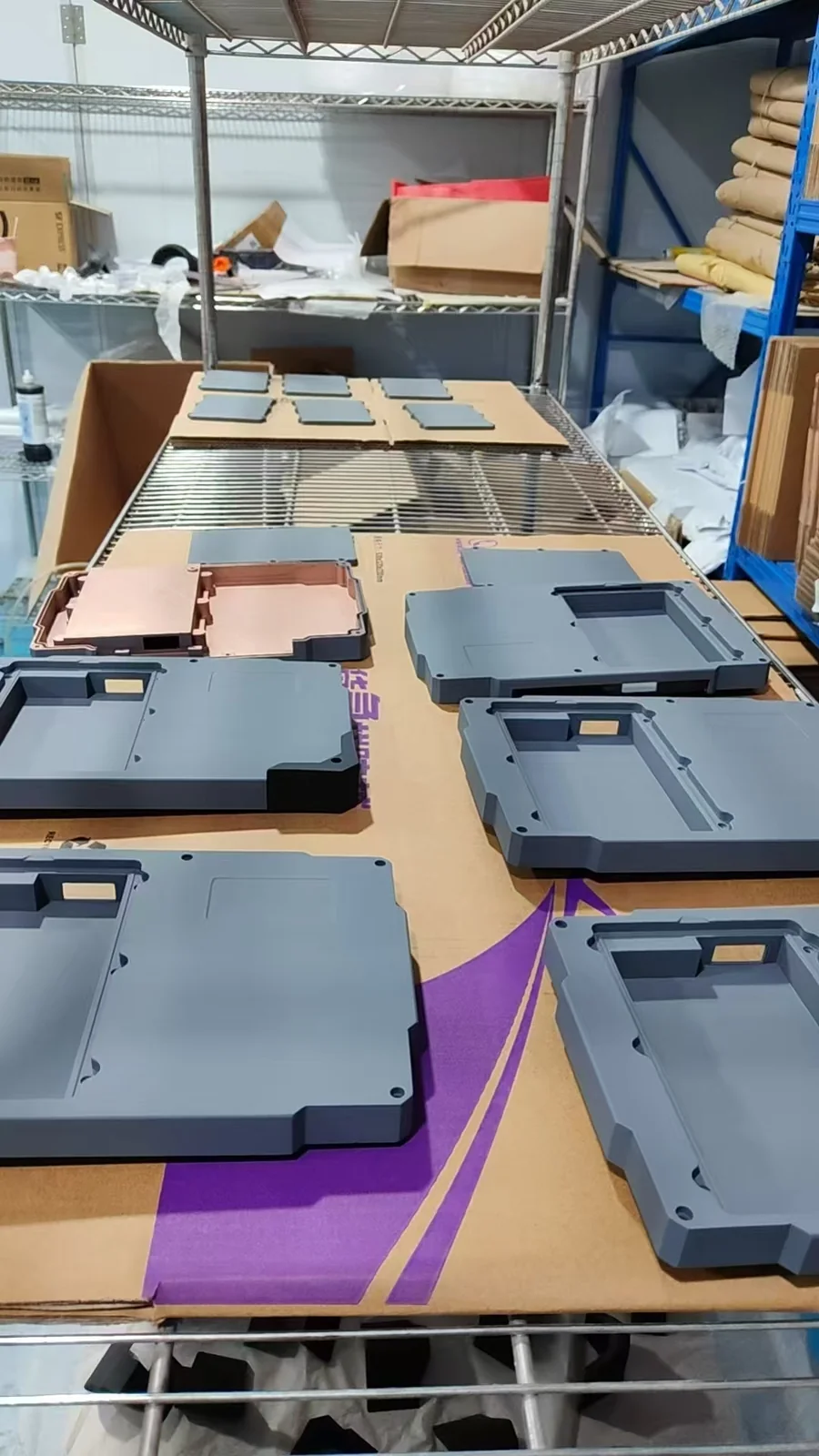
Image: Actual Jingrui Proto electronic-instrument housing components prepared for assembly. This photo does not establish every process used in a hypothetical hybrid project.
Quick Answer
For an assembly combining CNC and printed parts, compare three purchasing models: one lead manufacturer, one managed platform, or separate suppliers coordinated by the buyer. Choose by who owns the interfaces, configuration and final acceptance—not simply by how many processes appear on a website. A group of individually acceptable parts can still fail to assemble when no party controls their shared requirements.
The three models below are ordered by how directly the buyer coordinates separate production routes, not by an independent supplier-quality score. Public supplier information was reviewed on October 21, 2026. Jingrui Proto publishes this guide and is a commercial participant; no matched-price trial or comparative delivery test has been performed.
What this comparison covers
This is a purchasing-structure guide for mixed-process prototypes, not another general list of rapid prototyping companies. The decision is who receives the assembly requirements and who must resolve a disagreement between the machined component, printed shell and finished interfaces.
Relevant public examples include Jingrui Proto’s multi-process manufacturing support, 3ERP’s published service coverage and RapidDirect’s company overview. These sources demonstrate relevant process coverage or business-model information. They do not establish that every order includes assembly engineering, every process is in-house or every interface has already been validated.
| Buying model |
Buyer sends to |
Scope to agree |
| Lead manufacturer |
One project owner |
Complete assembly scope and accepted interfaces |
| Managed platform |
A platform or account team |
Build routes, handoffs and final checks |
| Buyer-led split sourcing |
Separate process suppliers |
Fit control and assembly owned by the buyer |
The same supplier may support more than one commercial arrangement. Ask what is included in the actual proposal rather than assigning a permanent label from a marketing page.
1. Lead-manufacturer sourcing
One manufacturer receives the assembly brief and quotes a coordinated scope. This can suit a team that needs CNC brackets, printed housings, finishing and assembly-related work under one project owner. The benefit depends on the agreed responsibility, not merely a single invoice.
Jingrui Proto provides in-house CNC and supports SLA, SLS, MJF, SLM, vacuum casting, finishing and assembly-related project coordination. Confirm which operations and acceptance activities are included. A multi-process offer does not mean every operation uses the same material system, inspection method or production site.
3ERP publicly lists CNC machining, additive manufacturing, casting and other prototype services. It is another candidate for discussing a lead-manufacturer proposal. The buyer should still obtain written confirmation of assembly responsibility, supplied hardware and the evidence required at final release.
When this model can help
It can be useful when the buyer has limited time to reconcile process-specific questions or expects repeated revisions across several components. One owner can receive the shared drawing package and coordinate proposed changes. That owner must nevertheless know which dimensions are functional and which part is allowed to change.
Ask for an assembly deliverables list. Does the supplier deliver loose parts, a fit-checked set or an assembled prototype? Are fasteners, inserts, adhesive work and finishing included? An answer that simply repeats “one-stop service” leaves the important boundaries unresolved.
2. Managed-platform sourcing
A platform can combine a digital order workflow with internal production and/or a supplier network. RapidDirect’s official overview describes its own factory alongside a network of manufacturers. This is a relevant comparison point for buyers considering a digitally managed route, not a claim that every job is outsourced.
The procurement question is how the assembly requirements survive routing between processes. Confirm who reviews the complete stack-up, who approves a suggested geometry change, and whether the buyer receives one final acceptance decision or separate component decisions.
Questions that matter for a routed project
Ask whether the platform will coordinate the full assembly or only manufacture the uploaded parts individually. Identify any restrictions on supplying third-party components or retaining project-specific inspection fixtures. If the assembly is split across sites, define where final fit checking occurs and who controls the reference parts.
Confirm how changes are communicated. A manufacturability suggestion for one component can alter its relationship with another. The digital order record should identify the approved version and the effect on related components rather than recording isolated part revisions without an assembly context.
3. Buyer-led split sourcing
The buyer places separate orders for machining, printing and possibly finishing or assembly. This can be appropriate when the buyer already has integration resources, a proven specialist supplier or an experimental design requiring direct control of each route.
This model does not imply inferior quality. It transfers coordination work to the buyer. The buyer must define interfaces consistently, resolve deviations and arrange final verification. Unit-price savings should therefore be compared with engineering time, additional transport and the cost of rework when individually accepted parts do not fit together.
Make the integration role explicit
Assign one person or team to control the assembly release. Send each supplier the relevant shared-interface information without disclosing unrelated confidential files. Define how questions are escalated and how a proposed change to one component is checked against its neighbors.
Plan where prototype integration will occur. If the buyer cannot inspect the assembled set before shipment, decide how reference components or gauges will be used and what they prove. A photograph of parts placed beside each other is not the same as an agreed assembly check.
Material choices change the interface problem
| Component route |
Useful material distinction |
Assembly issue to review |
| CNC metal |
Specified alloy and condition |
Datums, threads, mating faces and finish |
| CNC plastic |
Exact polymer grade and stock state |
Fit, environment and dimensional behavior |
| SLA visual shell |
Selected photopolymer and finished state |
Fragile features, supports and coating allowance |
| SLS or MJF nylon |
Exact PA material and finish |
Fit, inserts, surface feel and part state |
| Vacuum-cast shell |
Selected PU system |
Shrinkage-related fit, inserts and finish |
These categories are not interchangeable material specifications. Do not replace a functional polymer with a visually similar prototype resin without approval. Explain whether the test is intended to evaluate appearance, fit, handling or an actual operating load.
Freeze the shared interfaces before separate quotations
Start with an assembly drawing or clearly annotated interface map. Identify the features that position the components, the fasteners or retention method and any required clearance. A tolerance on every individual part does not automatically describe an acceptable assembled result.
Distinguish controlling features from convenient reference surfaces. For example, a printed outer shell may be visually important while a machined bracket controls connector position. If both suppliers independently treat the outside of their component as the datum, the assembled connector may not land where intended.
Ask who may compensate for process variation and what approval is required. A supplier should not silently enlarge a mating feature or move a hole simply to make its own part pass a local check. Keep deviations traceable to the assembled requirement and the released revision.
Include the delivered finish in the fit decision
Finishing can change a mating surface, edge or clearance. Define masked areas, contact surfaces and the inspection state of critical features. A fit check before paint does not necessarily establish the fit of the painted assembly that the buyer will receive.
For mixed visual and functional prototypes, assign different acceptance criteria to different regions. The outer face may use an appearance reference; a thread needs a functional definition; a seal land needs its own surface and geometry requirements. Avoid allowing an attractive overall appearance to substitute for checking the interfaces that make the prototype usable.
Review surface-finishing options with the actual materials and assembly sequence. Some operations should occur before hardware installation; others require protection of completed interfaces. The quote should identify these dependencies rather than listing finishing as a single unexplained final step.
Quality evidence should follow the supply boundary
If a supplier delivers loose components, its records may establish part-level acceptance only. If it delivers an assembled unit, define the additional fit, appearance or functional checks that are included. Do not assume that the word “assembly” includes an electrical, environmental or endurance test.
Ask for drawings or photos that identify the actual checked features, and specify any required dimensional report. Jingrui Proto’s available CMM, optical and roughness measurements are selected according to project needs; a general equipment list does not mean every prototype automatically receives every measurement.
ISO management-system references, including Jingrui’s stated ISO 9001, ISO 13485 and IATF 16949 frameworks, should be checked for the relevant scope and location. They do not establish that a particular prototype assembly is certified as a finished product. Keep product-specific acceptance separate from company-system qualification.
Compare schedule and cost without hiding coordination
Use the same bill of materials, revisions and delivered condition for all proposals. Identify design review, component manufacture, finishing, integration and approval milestones. Separate shipping dates from receipt dates and identify whether components travel between sites before final delivery.
For a split-source quote, include the buyer’s integration effort and any extra packing or transport. For a coordinated quote, ask which integration tasks are actually included rather than assuming the higher-level service resolves every risk. The fair comparison is the cost and time to obtain an accepted assembly, not only the sum of raw-part prices.
Consider a hypothetical prototype containing a nylon shell and an aluminum carrier. If both components are delivered separately, the buyer owns the first integration decision. If a lead supplier delivers a fit-checked set, the contract should name the interface and method checked. Neither arrangement is inherently best; the evidence and responsibilities differ.
RFQ checklist for a mixed-process prototype
- Assembly purpose, bill of materials and the required delivery state.
- Released CAD and drawings with shared datums and interface requirements.
- Material, finish, inserts, hardware and supplied-component responsibilities.
- Appearance references separated from functional acceptance criteria.
- Change-control authority and required approval for process substitutions.
- Component inspection, assembled checks and documentation scope.
- Confidentiality, packaging, integration location and destination.
Before choosing a supplier, ask for a brief explanation of how it would handle a discovered mismatch between two components. A clear escalation and approval route is more informative than an unsupported claim that its business model is universally faster or more precise.
Frequently asked questions
Does one-stop manufacturing mean every operation is in-house?
No. Confirm which operations are in-house, externally supported or coordinated through another site. The important point is the responsibility agreed for the complete delivery.
Is split sourcing always cheaper?
No. Compare accepted-assembly cost, including integration, transport, inspection and potential rework. Individual component prices describe only part of the decision.
Can I send only separate STL files?
Those may support a printing quote, but do not fully define a mixed assembly. Add material, interface, drawing and acceptance information where function depends on it.
Who should approve a proposed clearance change?
The party controlling the assembly release should review the effect on related components. A supplier’s local manufacturability change should not silently redefine a shared interface.
Does an assembled sample prove operating durability?
No. Define what was checked. Fit and appearance approval do not automatically establish endurance, environmental or product-safety performance.
What should I request in a coordinated quote?
Specify loose parts, a fit-checked set or an assembled prototype, then identify the supplied hardware, finishing, records and approval milestones included.
Request an assembly-focused quotation
Send Jingrui Proto the assembly brief and component files. Ask the team to identify process allocation, interface risks, finishing sequence and final acceptance scope. This makes the purchasing model reviewable before manufacturing begins.
Author
Jingrui Proto editorial team. The three sourcing models are an explanatory framework; public company information is not an independent factory audit or delivery benchmark.
Related Posts