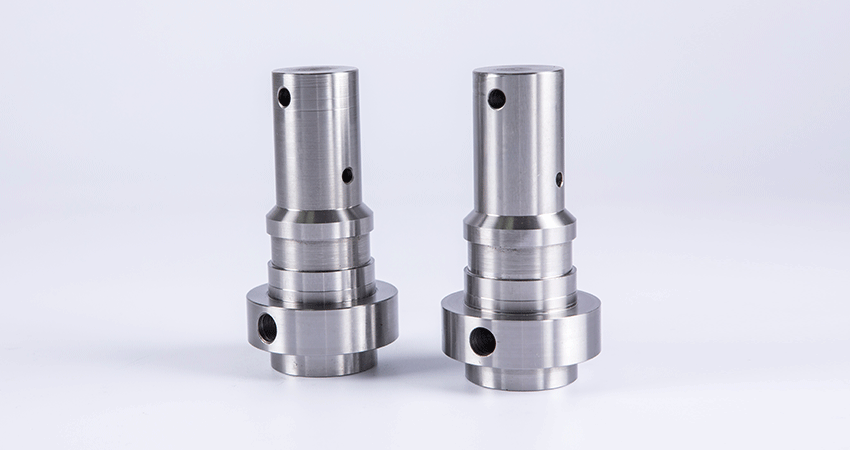
Image: Actual Jingrui Proto CNC turned shafts with shoulders and cross holes. The photograph does not show a verified internal burr-removal or cleanliness result.
What should a CNC cross-hole deburring specification include?
Identify every relevant internal intersection, describe the permitted finished edge, protect adjacent functional surfaces and agree how the result will be inspected and cleaned. “Deburr all edges” alone does not tell a supplier how to reach a hidden intersection or what evidence the buyer needs. A cross-hole can meet its diameter requirement while retaining an unacceptable burr inside.
This guide is for procurement teams ordering machined shafts, blocks, manifolds and housings with intersecting holes. It concerns material remaining on a machined edge, not loose chips alone. It also separates burr removal from deliberate chamfering, dimensional inspection and application-specific cleanliness testing.
Jingrui Proto offers in-house CNC machining. Submit internal-edge requirements with the RFQ so access, sequence and verification can be reviewed before a quote is accepted. A particular specialized deburring or inspection method must be confirmed for the actual project; the options below are not a claim that every method is available on site.
Why are internal cross-hole burrs different from loose chips?
A burr is attached or partly attached material produced around an edge, whereas a chip is material removed during cutting. Cleaning can remove loose chips without removing an attached burr. Later handling or use can detach a weak burr, so a visibly clean opening is not proof that the internal edge is acceptable.
At an intersecting bore, the cutting tool can break through into another cavity with changing support around the cutting edge. Geometry, material, tool condition and machining sequence influence the result. The intersection may be reachable from one direction but poorly visible from another, making both removal and confirmation harder than for an external edge.
Distinguish three questions on the drawing: is the nominal hole correct, is the intersection edge acceptable and is the component clean enough for the intended application? One measurement or photograph seldom answers all three. Treating them as separate acceptance items makes supplier proposals easier to compare.
For an illustrative fluid-distribution block, a residual burr could matter because of downstream components. For a cable-routing hole, the concern may be contact with the cable jacket. These are hypothetical engineering examples, not Jingrui Proto field failures or customer results. Specify the actual consequence for your application rather than copying requirements from a more demanding industry.
Which cross-hole details should buyers mark on the drawing?
Mark the intersections that matter and describe their geometry, function and acceptance state. Include a section view or transparent CAD screenshot when a conventional view hides the edge. A note on the exterior hole entrance may otherwise be interpreted as an entrance-edge requirement only.
State whether the requirement covers a continuous intersection, a partial breakthrough or an off-center crossing. Add the relevant bore sizes and access directions already defined by the design. A supplier needs to know whether a tool can enter, reach the crossing and withdraw without affecting another feature.
Identify protected surfaces such as a seal-running bore, a bearing seat, a thread or a precision locating diameter. Removing a burr by reaching through that surface may introduce a separate damage risk. The plan must preserve the surrounding requirement, not simply remove visible material at any cost.
Avoid inventing a tiny chamfer just to express “no sharp edge.” If an exact edge geometry matters, dimension it appropriately and discuss feasibility. If the function instead requires removal of loose or hazardous material, define that acceptance in a measurable way with the supplier. The distinction can change the proposed method and inspection scope substantially.
How should buyers compare cross-hole deburring methods?
Compare methods by access, material compatibility, control of the final edge and the ability to verify the result. Manual tools, brushes, purpose-designed cutting tools and specialized processes are not interchangeable. The right choice depends on the part, not the sophistication of the method name.
Approach to discuss
Useful question
Limitation to resolve
Accessible manual removal
Can an operator reach and control the edge?
Repeatability and confirmation of hidden regions
Dedicated cutting or back-deburring tool
Can the tool reach the intersection without collision?
Hole geometry, edge shape and setup
Brush-based processing
Is the brush appropriate for material and burr condition?
Reach, wear, residue and adjacent surfaces
Specialized nontraditional process
Does it suit the alloy and geometry?
Availability, qualification and surface effects
Design or machining-sequence change
Can burr formation or access difficulty be reduced?
Design approval and effects elsewhere
NOGA’s cross-hole brush technical information is one manufacturer example showing that internal-edge tools have application-specific guidance. It is not proof that a particular brush suits your component or that Jingrui Proto uses that product. Ask the supplier to identify the proposed approach and its constraints.
Do not force a specialized process into the purchase order before discussing the geometry. A simpler accessible design may provide a more controllable route. Conversely, a method that works for a large open crossing may be unsuitable for a small hidden intersection near a finished bore.
Can machining sequence reduce cross-hole burr problems?
Machining sequence can influence where a burr forms and how it can be reached, but it should be chosen for the complete part. Drilling order, finishing operations and access features must be considered together. A supplier’s proposal to reduce burr formation does not eliminate the need to inspect the resulting edge.
Sandvik Coromant’s irregular-surface drilling guidance discusses cross-hole challenges. Its tooling advice is general manufacturing context, not a universal sequence for all intersecting holes. Material, rigidity and the relationship between roughing and finishing still need review for the individual design.
Ask whether final bore finishing occurs before or after deburring and how the sequence protects the specified surface. If additional access is proposed, confirm whether that opening remains, is plugged or is removed later. A manufacturing convenience can become a product leak path or assembly feature requiring separate approval.
The buyer should approve design changes, while the supplier should explain the planned delivered condition. Avoid dictating every cutting operation without understanding the consequences. A clearer functional requirement often gives the manufacturing team more scope to propose a reliable process while keeping the acceptance criteria intact.
How should buyers inspect hidden edges at CNC cross-hole intersections?
Agree an inspection method that can assess the actual CNC cross-hole intersection, identify inaccessible regions and document the result against the specified edge condition. A bore diameter measurement does not show a burr at a remote intersection. A photograph of the entrance does not show the entire internal circumference.
Visual access, magnification, borescope access or a development section may be worth discussing, depending on the part. None is automatically sufficient or included. Specify what the image or report must demonstrate and which intersection it represents. Where destructive examination is proposed, agree the extra specimen and whether it is a development check or part of batch acceptance.
Record inaccessible regions explicitly. If the quoted method cannot inspect a critical edge, decide whether to change the geometry, change the inspection plan or select a different manufacturing route. An unexplained “inspection passed” statement is not an acceptable substitute for knowing the method’s reach.
Sampling must also match the consequence of a defect. A sample section can help develop a process, but it does not directly inspect every shipped part. Decide the appropriate evidence and frequency with the responsible engineering team. For the distinction between measured dimensions and acceptance evidence, see the CNC inspection-report guide.
How should cleaning be specified for CNC cross-hole parts after deburring?
Specify removal of loose chips, deburring residue and processing fluids from CNC cross-hole parts separately from attached-burr removal, with application-appropriate acceptance requirements. Deburring can leave particles, abrasive residue or processing fluids. A completed edge operation therefore does not by itself establish the cleanliness of a cavity or passage.
Identify the final delivered state: dry or protected, coated or uncoated, assembled or loose. If corrosion protection, plugs or packaging are needed, specify compatibility with the next operation. A protective treatment can be useful in transport but may need removal before bonding, testing or assembly.
Do not describe a component as medical-clean, oxygen-clean or suitable for a demanding fluid system without a relevant agreed specification and evidence. Those are application-specific requirements, not synonyms for ordinary workshop cleaning. If a formal particle assessment is required, define its method, limits and responsibility before ordering.
Keep the cleaning record associated with the same revision and delivery lot as the machining record. If a part is reworked after cleaning, determine whether another cleaning step and reinspection are required. The sequence should remain visible in the quotation so a low price does not simply omit the last essential operation.
What should a cross-hole deburring RFQ ask the supplier to quote?
Ask for the machined component, internal-edge operation, cleaning and evidence as separate defined deliverables. This makes omissions and assumptions visible before the order rather than after the part arrives. State quantity and repeat-order expectations without demanding an unsupported universal cycle time or price.
Supply CAD and a revision-controlled drawing with section views.
Mark each critical cross-hole intersection and its functional reason.
Define permitted edge geometry and protected adjacent surfaces.
Describe material and final coating or treatment requirements.
Request the proposed removal approach and unresolved access limitations.
Specify inspection records, sample expectations and any destructive work.
Define cleaning, preservation and packing conditions separately.
Ask how exceptions, rework and changes to the agreed route will be handled.
If the supplier proposes an edge break that is not shown on the drawing, resolve it before machining. If the drawing already contains a requirement that cannot be met, require an explicit exception rather than allowing silence to become approval. This protects both parties from interpreting a generic quotation differently.
For repeat orders, retain the accepted drawing and relevant sample evidence. Do not assume that a good first part establishes every future internal edge. Agree what process or inspection changes require review, particularly when a method relies on operator access or a consumable tool.
Which CNC cross-hole deburring assumptions should buyers challenge in an RFQ?
Confirm the internal-edge scope, removal access, inspection coverage, cleaning requirements and rework sequence before approving a CNC cross-hole deburring quote. They are starting points for a project-specific conversation, not a fixed manufacturing standard.
Does “break all edges” specify acceptance of hidden CNC cross-hole intersections?
A generic “break all edges” note does not unambiguously define acceptance of hidden CNC cross-hole intersections. Mark the critical crossings and agree the required edge condition and verification method.
Will washing remove an attached burr?
Not reliably. Cleaning and deburring have different purposes. An attached edge condition may remain after loose particles have been washed away.
Does a smooth entrance prove the crossing is acceptable?
No. The entrance and crossing are different regions. Inspect or assess the actual feature named in the requirement.
Can every cross-hole receive a controlled chamfer?
No universal access or edge-shape guarantee applies. Review tool reach, bore geometry and neighboring features before adding a specific chamfer requirement.
Does a sectioned development sample establish compliance of a CNC cross-hole batch?
A sectioned development sample does not by itself establish that every delivered CNC cross-hole meets its internal-edge acceptance criteria. Use it as development evidence and agree shipment acceptance separately.
Can internal deburring be added after final finishing?
Sometimes a suitable route exists, but the operation may affect a finished bore or coating. Review the sequence and any need for renewed cleaning or inspection before approving rework.
How can buyers request a CNC internal-edge review?
Send the model, marked section drawing, material, quantity and application concerns through the RFQ and contact page. Ask Jingrui Proto to confirm the machining, deburring, cleaning and inspection scope, including features that need a design discussion before acceptance.
This is engineering purchasing guidance, not a new burr-removal experiment or evidence that a photographed shaft passed an internal cleanliness test. Company-specific tooling, equipment and acceptance commitments should be confirmed in the quotation rather than inferred from a general process description.
Which related guides help specify machined internal features?
Use the deep-bore RFQ, blind-threaded-hole and shaft-fit guides to distinguish tool access, usable thread depth and installed-interface requirements.
Which CNC cross-hole acceptance claims require part-specific inspection evidence?
Claims about compliant internal edges and passage cleanliness require agreed criteria and evidence for the actual features, not an exterior photograph of a machined shaft.
For cross-hole parts, identify the internal intersection, agreed edge condition, inspection coverage and required cleaning state instead of inferring them from an exterior view.
This guide is published by Jingrui Proto for engineering and purchasing teams. It explains procurement decisions and limitations; it is not a customer case report, independent laboratory result or application certification.
Choose inspection for low-volume prototypes by critical features, lot definition, sample selection, measurement suitability and clear acceptance decisions.
Review SLM machining-stock deviations against datums, final interfaces and inspection evidence before approving CNC continuation, concessions or remakes.
Plan vacuum-cast pilot lots around assembly trials, destructive evaluations, usable samples and retained references with a practical purchasing checklist.
Approve ABS-like vacuum casting resin by grade, datasheet conditions, assembly needs and validation scope before transferring decisions to production ABS.
Prepare small full-color models with a scale-aware review of fragile details, texture versus geometry, support removal, bases, packing and sample approval.
Plan silicone mold replacement around accepted vacuum-cast parts, with wear checks, resin limitations, quotation scope and a practical buyer RFQ checklist.