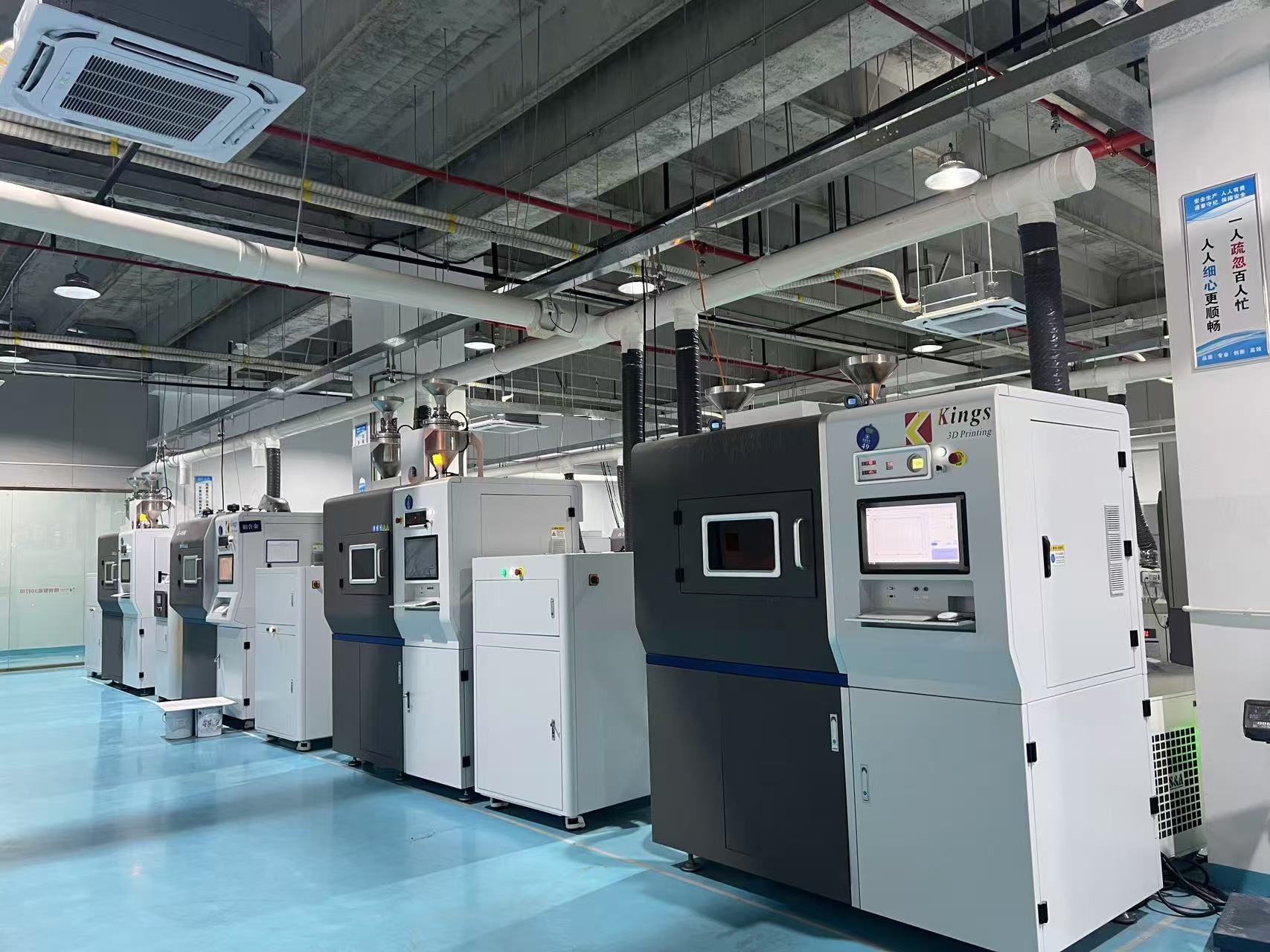
Image: Actual metal additive manufacturing equipment at Jingrui Proto. Process context only; not evidence of a corrosion test or qualified mixed-metal assembly.
When an aluminum prototype is assembled with stainless steel or titanium hardware, evaluate the interface and service environment rather than selecting each material independently. Galvanic corrosion requires an electrically connected material combination and a conductive liquid path. A dry showroom assembly and a wet outdoor product therefore need different purchasing requirements, even if their CAD files are identical.
Key takeaways: describe moisture exposure; identify every metal-to-metal connection; review isolation, drainage and protective finishes together; and define what assembly or environmental evidence is actually required. This guide explains an engineering risk assessment. It does not predict corrosion rate, certify a design or report Jingrui Proto test results.
When can dissimilar metals create galvanic corrosion in a prototype?
Dissimilar metals can create galvanic corrosion when they are electrically connected and exposed to an electrolyte that completes the electrochemical path. Simply placing two different alloys in the same product does not establish the severity of the risk.
Water containing dissolved salts can act as an electrolyte. Service conditions might include rain, condensation, cleaning fluids or marine spray, but those exposures are not interchangeable. Their duration and chemistry matter. A buyer should describe the actual application rather than requesting a generic “corrosion-proof” assembly.
The British Stainless Steel Association and Australian Stainless Steel Development Association both explain the need to consider the metal combination and environment. Their guidance establishes principles, not a guaranteed life for a particular prototype. A material’s reputation for corrosion resistance does not remove the need to review its contact with a different metal.
Why can stainless fasteners change the risk for an aluminum part?
Stainless fasteners can change the risk for an aluminum part because the assembled electrical and environmental relationship differs from the behavior of either component alone. The aluminum’s exposure and the relative areas of the coupled surfaces deserve attention.
Do not translate a galvanic-series chart into an automatic pass or fail without checking its environment and assumptions. Surface condition, coatings and electrolyte exposure can affect the real assembly. A small exposed area of a less noble material coupled to a much larger cathodic area can be a particularly unfavorable arrangement, but this guide assigns no corrosion rate to that condition.
Map the complete fastening stack: screw, washer, insert, bracket and enclosure. An apparently isolated panel may still be electrically connected through another fastener or mounting surface. Review the current assembly rather than assuming that adding one plastic washer breaks every relevant path.
Does choosing titanium automatically solve mixed-metal corrosion?
No: choosing titanium does not automatically solve corrosion risks elsewhere in a mixed-metal assembly. A corrosion-resistant component can still participate in a couple that affects an adjacent material.
Choose materials against their complete functions: mass, stiffness, manufacturing route, temperature, surface condition and environmental compatibility. Replacing one part with titanium may change cost and machining requirements without addressing trapped water or an exposed aluminum interface. The design review should examine those mechanisms directly.
For metal additive manufacturing, confirm the actual alloy designation and delivery condition. “Titanium,” “stainless” and “aluminum” are families, not complete specifications. A published material datasheet is useful for its stated conditions; it is not evidence that the finished, coated and assembled part has passed the buyer’s environmental requirement.
How should buyers map corrosion-sensitive assembly interfaces?
Buyers should map each interface by materials, electrical contact, liquid exposure and the proposed control. An annotated assembly drawing often communicates this more effectively than a general finish note on individual part drawings.
Interface question
Information to provide
Decision supported
Which metals touch?
Alloy, hardware and insert identities
Identify the actual material combination
Can current flow between them?
Fastener stack and other contact paths
Review isolation feasibility
Where can liquid remain?
Orientation, drainage, gaps and seals
Reduce persistent electrolyte exposure
Which surfaces are protected?
Finish boundaries and assembly sequence
Review coating continuity and exposed edges
What evidence is needed?
Application and acceptance requirement
Specify inspection or separate validation
This is a qualitative procurement matrix, not a corrosion ranking or measured dataset. It can be completed with a design engineer before the supplier quotes manufacture. Missing inputs should be identified as open decisions rather than replaced with invented service assumptions.
How can isolation features reduce galvanic coupling?
Isolation features can reduce galvanic coupling when they interrupt the relevant electrical path and remain effective in the assembled service condition. They must be reviewed as part of the full joint, not as decorative additions to a parts list.
Possible design elements include insulating washers, sleeves or interface layers, subject to mechanical and environmental suitability. A washer beneath a screw head does not necessarily isolate the screw shank, thread or another mounting point. Compression, wear and installation damage can also affect the intended separation.
Isolation may conflict with another requirement, such as an intentional electrical bond. Identify that conflict early and have the responsible engineer define a controlled solution. Do not ask the manufacturing supplier to guess whether electrical continuity or isolation takes priority. Any electrical acceptance test must be specified separately from dimensional inspection.
Why do drainage and joint geometry matter in mixed-metal corrosion control?
Drainage and joint geometry matter because they influence how long conductive liquid can remain at a coupled interface. A coating choice alone does not remove a persistent moisture trap.
Consider the installed orientation, overlapping flanges, recessed fasteners and locations where cleaning liquid may collect. A design that drains in one orientation may retain water in another. Explain whether the prototype will be operated, washed, stored outdoors or used only for a short indoor evaluation.
Seals can reduce ingress when correctly designed, but they can also hide retained liquid if the assembly is not assessed as a whole. This guide does not prescribe seal geometry or claim leak performance. Ask the design team to distinguish environmental protection, drainage and service access rather than treating them as interchangeable fixes.
What protective-finish limits matter for mixed-metal prototype joints?
Buyers should recognize that finish protection depends on the specified route, surface preparation, continuity and condition after assembly. A finish name does not establish protection at every edge, thread or damaged location.
Identify masked areas, electrical contacts and surfaces that will be machined after treatment. Those regions may differ from the rest of the component. Fastener installation or interference assembly can also affect the local surface. Discuss how visible defects and exposed areas will be accepted rather than assuming an untouched sample represents every assembled joint.
A finish selected for appearance is not automatically suitable for the environment. Conversely, a technically suitable treatment may not provide the buyer’s expected cosmetic match. Keep appearance, dimensional fit and environmental requirements separately stated. Jingrui Proto’s surface-finishing service is a starting point for discussing the proposed route, not a blanket corrosion qualification.
How do metal 3D printing and CNC finishing affect interface planning?
Metal 3D printing and CNC finishing affect interface planning by determining which surfaces are printed, machined, accessible and subsequently treated. These manufacturing decisions must align with the assembly and finish requirements.
A printed bracket may need machined mounting faces or holes. If those operations occur after protective treatment, the newly cut regions require review. If they occur first, the finishing step becomes part of final dimensional acceptance. Neither sequence should be chosen without considering tool access and how the component will be located.
Jingrui Proto offers metal 3D printing and CNC machining routes. Confirm material, secondary machining, finishing and documentation for the actual order; do not assume that a corrosion-test facility or a particular qualification is included. The metal support-removal guide explains a separate access and surface issue that may influence the sequence.
What evidence should buyers request for a corrosion-sensitive prototype?
Buyers should request evidence proportionate to the intended evaluation, separating material identification, manufacturing inspection and environmental validation. These records answer different questions.
A material certificate may establish a stated material identity under its scope; it does not approve the assembled joint. A dimensional report can establish selected geometry but cannot predict corrosion life. Photographs can document assembly or finish condition without proving a long-term environmental result.
If environmental testing is required, the responsible engineer should define the applicable method, specimen or assembly, exposure and acceptance criteria. Ask the supplier which work it can perform or arrange before ordering. Do not invent a test standard, duration or pass result to make a prototype order appear qualified. Accelerated exposure also needs careful interpretation before being linked to real service life.
How should a mixed-metal prototype RFQ describe the application?
A mixed-metal prototype RFQ should describe the assembly, material identities, exposure conditions and unresolved interface decisions. That information allows the supplier to identify manufacturing constraints instead of guessing the product’s operating environment.
Provide part CAD, assembly drawings, revision and the intended fastening stack.
Identify alloys, bought-in hardware and required material records.
Describe likely moisture, salts, cleaning agents, temperature and installed orientation.
Mark electrical bonding requirements and interfaces intended to be isolated.
State protective finishes, masking boundaries and post-finish operations.
Identify assembly inspection, photographs and any separately specified environmental evaluation.
Provide quantity, intended use of the prototype and possible later low-volume requirements.
For example, a hypothetical outdoor sensor bracket could use an aluminum support and stainless fasteners. The relevant review would examine water retention, electrical paths and the finish after assembly—not simply approve both material names. This scenario is illustrative, not a Jingrui Proto customer case or test result.
What do buyers ask about dissimilar-metal prototype procurement?
Buyers procuring dissimilar-metal prototypes should resolve the material combination, electrical contact paths, moisture exposure and required acceptance evidence before approving the assembly.
Do two different metals always corrode when assembled?
No. Galvanic corrosion requires the relevant electrical connection and electrolyte path; severity depends on the actual combination and environment.
Does 316L prevent corrosion of an adjacent aluminum component?
No. The stainless component’s resistance does not establish the behavior of the coupled aluminum interface.
Can one insulating washer approve the joint?
No. Review all electrical contact paths and the washer’s suitability in the installed condition.
Does anodizing guarantee isolation after assembly?
No. Surface condition, masked areas and assembly damage need consideration, and any electrical requirement needs its own acceptance check.
Can a material datasheet predict outdoor service life?
No. It does not capture the complete assembly, environment and maintenance conditions.
Should every prototype receive an environmental test?
Not automatically. Specify validation according to the prototype’s purpose and risk, with the responsible engineer defining the method and acceptance criteria.
How can buyers request a mixed-metal prototype manufacturing review?
Send CAD, assembly drawings, material choices and exposure requirements through the Jingrui Proto RFQ page, and ask for a review of machining, finishing and assembly scope. Highlight isolation or electrical bonding requirements. Use the CNC machining service for route context, while retaining corrosion-design approval with the responsible engineering team.
Sources and method, November 2, 2026:BSSA’s bimetallic-corrosion guidance and ASSDA’s galvanic-corrosion FAQ provide the electrochemical framework. The assembly matrix and RFQ checklist are original editorial synthesis. No numerical corrosion rate, universal alloy ranking or Jingrui Proto environmental test result is asserted.
Prepared by the Jingrui Proto editorial team. Engineering examples are illustrative; project-specific material, manufacturing and inspection scope requires quotation review.
Choose inspection for low-volume prototypes by critical features, lot definition, sample selection, measurement suitability and clear acceptance decisions.
Review SLM machining-stock deviations against datums, final interfaces and inspection evidence before approving CNC continuation, concessions or remakes.
Plan vacuum-cast pilot lots around assembly trials, destructive evaluations, usable samples and retained references with a practical purchasing checklist.
Approve ABS-like vacuum casting resin by grade, datasheet conditions, assembly needs and validation scope before transferring decisions to production ABS.
Prepare small full-color models with a scale-aware review of fragile details, texture versus geometry, support removal, bases, packing and sample approval.
Plan silicone mold replacement around accepted vacuum-cast parts, with wear checks, resin limitations, quotation scope and a practical buyer RFQ checklist.