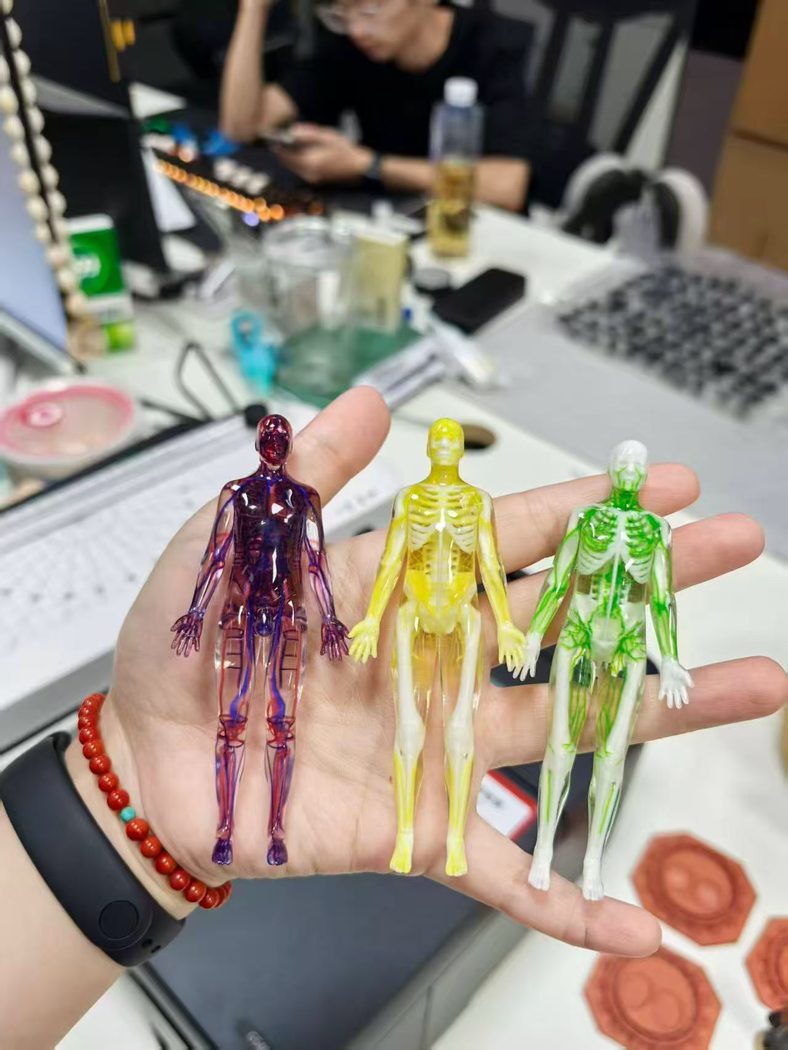
Image: Actual full-color visual-model imagery from Jingrui Proto. Application context only; not proof of a minimum feature size, handling test or transport qualification.
Before ordering a small full-color display model, review the final physical dimensions of its thinnest details, its support-removal route and the way it will be handled and packed. Uniformly shrinking a detailed digital model does not guarantee that every finger, antenna, sign or connecting stem remains suitable for manufacture. Printable geometry, visible color detail and handling strength are separate approval questions.
Key takeaways: approve final scale before file review; inspect fragile connections rather than relying on a renderer; distinguish texture detail from physical relief; and design the display base and packaging around the finished model. This guide supplies a procurement framework, not a universal minimum wall thickness or a claim about a newly completed customer model.
Why can a full-color model fail after uniform downscaling?
A full-color model can fail after uniform downscaling because geometric features shrink while the manufacturing, cleaning and handling requirements do not shrink with them. A detailed source model may contain connections that become impractical at the selected display size.
Check the final model in physical units. A thin rod, finger or decorative edge should be reviewed as an actual feature, not just as a proportion of the overall model. The same applies to small gaps: reducing scale can make details difficult to separate or clean even when the outside silhouette remains recognizable.
Do not confuse a printer’s advertised layer thickness with a guaranteed free-standing feature size. Layer formation, material behavior, orientation, support removal and handling all influence what can be delivered. Ask the supplier to review the actual geometry and route rather than selecting a minimum dimension from an unrelated machine specification.
Which small full-color model features should buyers identify before quotation?
Buyers should identify thin projections, narrow connecting regions, unsupported extremities and details that will be touched or loaded during use. These features deserve attention even if they are not the smallest details visible in a rendering.
For a figurine, examples include hands, hair tips, accessories and the connection between the figure and its base. For an architectural model, examples include railings, columns, signage and narrow bridges. A medical teaching model may have branching features or removable components. These are application categories, not claims about specific Jingrui Proto projects.
Mark which details are essential to recognition and which may be simplified. The supplier can then propose changes without unintentionally removing the buyer’s key visual content. A cosmetic thickening that preserves the silhouette may be acceptable; a change to a logo, anatomical relationship or mating interface may require explicit design approval.
For a final-scale color model, include the texture package, overall dimensions and fragile-feature notes so the engineering review can address handling and finishing. Request a Full-Color Printing Quote.
How should texture detail be distinguished from physical geometry?
Texture detail should be distinguished from physical geometry by asking whether the feature changes the surface shape or only its printed appearance. A painted line can suggest a seam, but it does not create a groove, opening or raised edge.
At a small scale, converting a fragile geometric detail into a visual texture may be a useful design option. That decision changes what the model communicates. A sales-display model may only need the correct appearance, while an engineering fit model may require a real opening or edge. State the model’s purpose before choosing the simplification.
Review the texture on the final-scale geometry, including seams and areas partly hidden by the base. A high-resolution image does not compensate for an incorrectly placed UV map, and correct color placement does not establish mechanical robustness. Jingrui Proto’s full-color files and proof guide covers the submission package; this article addresses scale-dependent feature and handling decisions.
What options preserve full-color model details at a smaller scale?
Recognizable details can sometimes be preserved through selective thickening, local simplification, a revised connection or separate components. Each option changes the manufacturing and approval scope and should be reviewed against the model’s purpose.
Design option
Potential purchasing benefit
Limitation to approve
Thicken a hidden connection
Reduce vulnerability without changing the main silhouette
May alter nearby geometry or clearances
Convert relief to texture
Retain a visual cue without a fragile projection
Does not reproduce tactile or functional geometry
Split a delicate component
Allow a different orientation or assembly approach
Adds joints, alignment and packing requirements
Increase display scale
Preserve more of the original geometry
Changes size, cost, base and transport scope
Add an approved support or base connection
Provide a more deliberate load path
Changes the visual presentation
This is a qualitative design-review matrix, not a tested strength comparison. The supplier must assess the actual material and geometry before confirming that an option is feasible. A buyer should not approve an unseen geometry change solely because it is described as “reinforcement.”
How does support removal affect delicate full-color features?
Support removal affects delicate features because cleaning and separation introduce handling and access requirements after printing. A detail that forms successfully may still be vulnerable during subsequent processing.
Different full-color routes use different materials and support arrangements. Ask the supplier how the selected route addresses narrow gaps, recessed details and fragile projections. Do not copy cleaning instructions from another system or specify an unverified solvent. Material and equipment guidance should control the process.
Mimaki’s published 3DUJ-553 documentation describes its UV-curable inkjet route and cautions that physical properties must be evaluated for the intended application. That manufacturer documentation does not establish a Jingrui Proto cleaning recipe or a universal handling limit. The RFQ should define the required finished appearance and identify delicate areas for review.
When should a full-color model be divided into separate components?
A full-color model should be considered for division when separate components offer a justified manufacturing, presentation or transport advantage that outweighs the added joints. Splitting is a design option, not an automatic quality improvement.
Locate joints where they can be assembled and inspected without obscuring important visual information. Provide alignment features appropriate to the material and geometry. A tiny peg may create a new weak point instead of solving the original problem. If adhesive assembly is proposed, discuss the visible joint and the supplier’s compatibility review.
State whether the model must arrive fully assembled or be assembled by the customer. A customer-assembled model needs clear identification and instructions, while a fully assembled model needs packing that protects its connections. Do not assume either arrangement is included in a basic print quotation.
How should a display base support a full-color model during use?
The display base should support the model through deliberate contact and connection points that suit its geometry, orientation and handling. A base is part of the mechanical and visual design, not merely an accessory added after printing.
Review whether the model will remain stationary, be moved between exhibitions or be handled during demonstrations. Tall or offset features can create different loads from those in a compact model. The buyer should define intended use and any required evaluation; this guide does not provide a stability calculation or certify a display installation.
Consider labels and removable covers early. Their attachment should not force users to grip a fragile feature. If a transport fixture is proposed, distinguish it from the display base and identify when each is used. A photograph of a model standing on a base is not evidence that the assembly has passed a handling or transport test.
What should a buyer approve in a final-scale full-color model sample?
A buyer should approve the sample’s scale, essential details, color placement, finished surfaces and intended handling arrangement. These are separate acceptance decisions and should be recorded explicitly.
Compare the sample with the current approved file and a list of critical visual features. Check whether fine features remain recognizable under the intended viewing conditions. A magnified photograph can reveal defects but may not represent normal presentation; a distant photograph can hide missing details. Agree the review context.
For repeated models, retain a physical reference and identify the approved revision. If the supplier proposes a local thickening or simplified feature, record that change rather than leaving it in an informal message. Approval should make clear whether the sample represents appearance only or also the accepted assembly and packing configuration.
How should packaging protect fragile full-color models?
Packaging should support robust regions of the model and avoid transferring transport loads into fragile projections. The packing design must be reviewed with the actual model and assembly condition.
Identify intended contact regions and clearance around delicate details. A tightly fitted package is not necessarily protective if it presses on a thin accessory. Conversely, an oversized cavity can allow movement. Ask the supplier how the model will be restrained and how it can be removed without pulling on vulnerable features.
Define whether the packaging is for one shipment or repeated use. For exhibition models, unpacking and repacking may matter as much as the first delivery. Any drop, vibration or shipping validation should have a separately agreed method and acceptance criterion; do not describe protective packing as proof of a passed transport test.
What information supports a scale-aware full-color model RFQ?
A scale-aware RFQ includes the final overall size, complete color file package, critical features and the intended handling and presentation conditions. This allows the supplier to review what the buyer actually needs to receive.
Provide geometry, textures and a clear units statement with the final physical dimensions.
Identify essential details and areas where local simplification or thickening may be proposed.
State whether the model is for display, teaching, presentation or a defined functional evaluation.
Describe the base, joints, removable parts and required assembly condition.
Provide quantity, variant requirements, appearance reference and sample approval scope.
Identify packing contact restrictions and whether repeated unpacking is expected.
State any specific material documentation or separate validation required.
Jingrui Proto offers full-color 3D printing within its manufacturing service range. Confirm the proposed material, processing and assembly route in the quotation rather than assuming a particular machine or finish from a generic service name. The model-set procurement guide addresses variant and consolidated-order planning; this guide focuses on the physical consequences of scale.
What do buyers ask about small full-color model details?
Buyers ordering small full-color models should resolve final scale, essential features, support removal, assembly and packing before approving production.
Can every digital feature be reproduced after shrinking a model?
No. The final feature sizes and processing route need review, even when the original model renders correctly.
Does layer thickness define the minimum strong wall?
No. Layer thickness is not a universal limit for wall strength, unsupported detail or handling durability.
Can a texture replace a physical opening?
Only when a visual representation meets the model’s purpose; a texture cannot provide a real clearance or passage.
Is splitting a figurine always safer for shipping?
No. Splitting adds joints and customer handling requirements, so compare the complete assembly and packing arrangement.
Can a small color proof approve all delicate geometry?
No. A color proof may not contain the critical features at the final scale.
Does a well-packed model have guaranteed transport survival?
No. Packaging must be assessed against the shipment and any agreed validation; no guarantee follows from appearance alone.
How can buyers request a final-scale full-color model review?
Send the model, texture package, final size and marked fragile features through the Jingrui Proto RFQ page. Request a review of local detail changes, support-removal considerations, base design and packing scope before approving production. Include the intended viewing and handling conditions so the proposal addresses the complete display model.
Sources and method, November 2, 2026:Mimaki’s 3DUJ-553 documentation provides technology and application-evaluation context. Stratasys’ PolyJet overview provides a second full-color-capable material-jetting reference. Neither establishes a universal minimum feature or a Jingrui Proto test result. The scale-review matrix is original editorial synthesis. No copied graphics, customer identities or fabricated measurements are used.
Prepared by the Jingrui Proto editorial team. Engineering examples are illustrative; project-specific material, manufacturing and inspection scope requires quotation review.
Ready to Start Your Next Project?
Share your CAD files, drawings and requirements with our engineering team. We will help you select the right manufacturing process, material and finishing solution.
Choose inspection for low-volume prototypes by critical features, lot definition, sample selection, measurement suitability and clear acceptance decisions.
Review SLM machining-stock deviations against datums, final interfaces and inspection evidence before approving CNC continuation, concessions or remakes.
Plan vacuum-cast pilot lots around assembly trials, destructive evaluations, usable samples and retained references with a practical purchasing checklist.
Approve ABS-like vacuum casting resin by grade, datasheet conditions, assembly needs and validation scope before transferring decisions to production ABS.
Plan silicone mold replacement around accepted vacuum-cast parts, with wear checks, resin limitations, quotation scope and a practical buyer RFQ checklist.