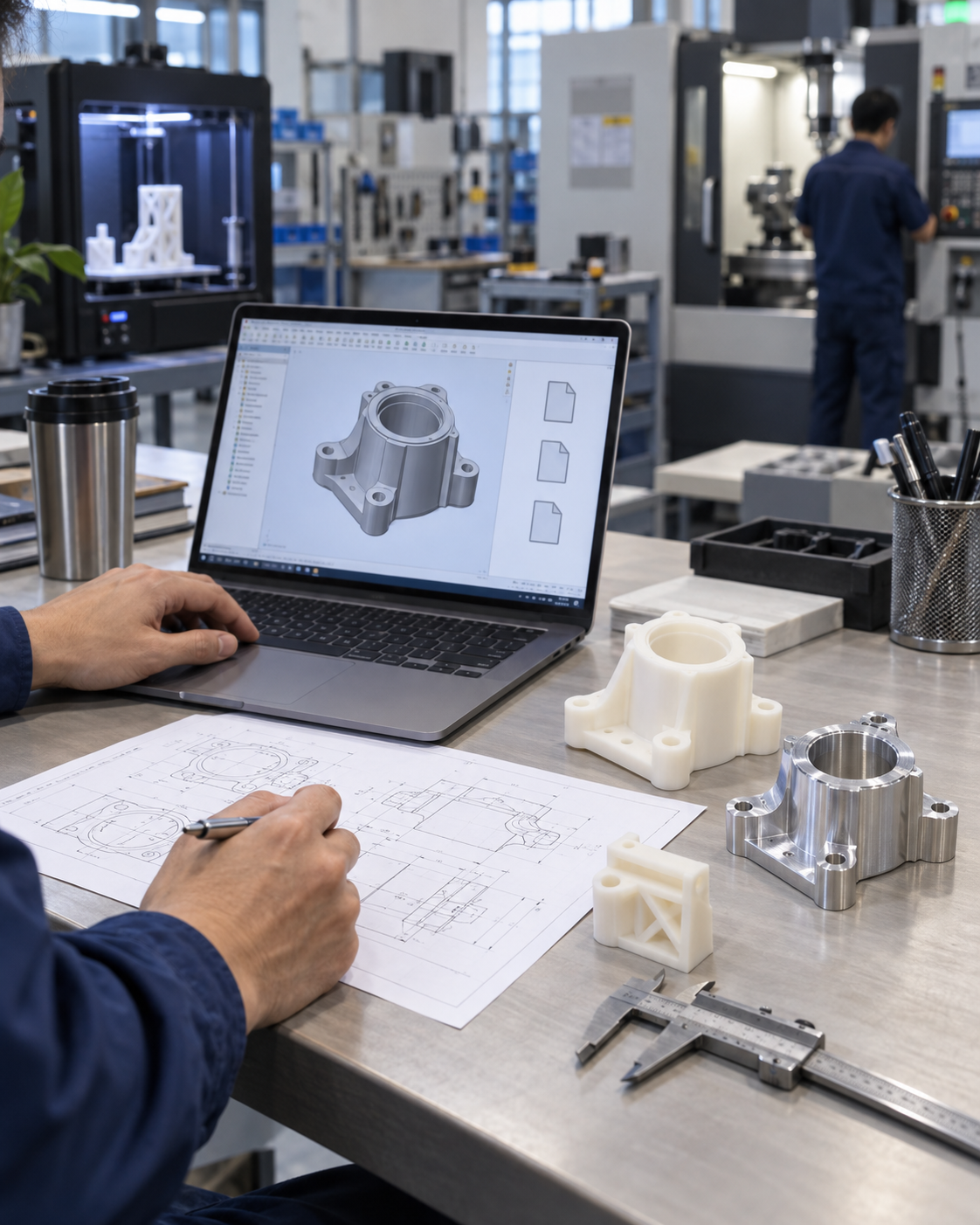
There is no single best manufacturing process for every low-volume project. The right process depends on quantity, material, geometry, tolerance, surface requirements and whether the design has been fully validated. A process that is perfect for the first prototype may become risky or uneconomical when the same part must be repeated for a pilot run.
For overseas engineering, product development and sourcing teams, the practical route is to validate the design first, identify the critical requirements, review manufacturability, and then choose the process that fits the next stage. Jingrui Proto can coordinate industrial 3D printing, CNC machining, vacuum casting, sheet metal fabrication, injection molding, die casting, surface finishing, assembly and quality inspection under one manufacturing workflow.
Quick Answer: How Do You Move from Prototype to Low-Volume Production?
Move from prototype to low-volume production by following a staged decision path:
- Validate the design intent with prototypes.
- Confirm the critical requirements: material, load, tolerance, surface, assembly and inspection.
- Request DFM feedback before production decisions are locked.
- Select the process based on the part’s risk, not only the quoted quantity.
- Build a pilot run to verify repeatability and finishing consistency.
- Inspect the results and correct process issues.
- Move into low-volume manufacturing only after the design and workflow are stable enough.
This is different from simply ordering more prototypes. Prototype work is often optimized for speed and learning. Low-volume manufacturing introduces repeatability, process control, finishing consistency, assembly consistency and inspection discipline.
Why the Best Prototype Process May Not Be the Best Production Process
Prototype manufacturing is usually about learning quickly. A first housing may be SLA printed to check shape. A metal bracket may be CNC machined to test assembly fit. A soft-touch cover may be vacuum cast to evaluate appearance. These choices are often correct during design validation.
As the project moves toward a pilot run or low-volume manufacturing, the decision changes. The team must ask whether the selected process can repeat the part consistently, support the required material behavior, hold critical dimensions, finish visible surfaces, and fit the assembly plan.
The main factors are:
- Repeatability across multiple parts.
- Unit economics after the design stops changing.
- Surface consistency across visible parts.
- Tolerance control on functional interfaces.
- Assembly fit and hardware installation.
- Tooling investment only when the design is stable enough.
- Inspection requirements for buyer approval or internal release.
A buyer should not treat “prototype” and “low-volume production” as one identical purchasing category. The transition point is where engineering risk and production risk start to overlap.
How to Choose a Process for 10-100 Parts
For 10-100 parts, start with what the parts must prove. A cosmetic housing, a metal load-bearing part, a formed sheet metal bracket and a molded-plastic pilot sample do not need the same process. The table below gives a practical decision framework without assuming a fixed price or universal quantity threshold.
| Process |
Best Fit |
Typical Decision Factors |
Tooling Requirement |
Material / Geometry Considerations |
When to Consider Moving to Another Process |
| 3D Printing |
Fast design validation, complex geometry, low-quantity functional or appearance prototypes |
Speed, geometry freedom, iteration, no tooling |
No hard tooling |
SLA for appearance detail, SLS/MJF for nylon functional parts, metal printing for complex metal features, FDM/FGF where size or form matters |
Move when final material behavior, tighter repeatability or production surface consistency becomes more important |
| CNC Machining |
Engineering-grade metal or plastic parts with functional dimensions |
Tolerance, strength, threads, flatness, repeatable interfaces |
No part-specific mold tooling |
Good for aluminum, stainless steel and engineering plastics; geometry complexity and setups affect cost |
Move if geometry is better suited to printing, casting or molding, or if repeated plastic parts justify tooling |
| Vacuum Casting |
Appearance-ready plastic-like parts and bridge production before tooling |
Cosmetic surfaces, repeated copies, resin feel, small-batch validation |
Silicone mold from a master pattern |
Useful for housings, covers, transparent parts and rubber-like features; resin selection must be confirmed |
Move when molded resin, long-term repeatability or higher-volume production requires injection molding |
| Sheet Metal Fabrication |
Brackets, panels, covers, frames and formed metal enclosures |
Bend radius, material thickness, flat pattern, hardware, finish |
Usually no injection mold; may need fixtures depending on part |
Best when the design is naturally formed from sheet rather than machined from block |
Move to CNC, casting or assembly redesign if bends, welds or finish targets create excessive risk |
| Injection Molding |
Stable plastic design that needs molded behavior and repeatability |
Tooling investment, resin, texture, clips, gating, long-term repeat demand |
Mold tooling required |
Best after geometry, material and core dimensions are mature enough for tooling |
Avoid or delay if the design is still changing or the purpose is only early fit/appearance validation |
The right process may also be a combination. A pilot unit may include a 3D printed housing, CNC metal inserts, sheet metal support parts, vacuum-cast cosmetic covers, surface finishing and assembly.
When Should You Use 3D Printing?
Use 3D printing when the design is still moving, the geometry is complex, or the buyer needs fast physical feedback before committing to a more controlled manufacturing route.
SLA can be useful for high-detail appearance and form studies. SLS and MJF can support functional nylon parts where geometry and durability matter. Metal 3D printing can support complex metal features that may be difficult to machine conventionally. FDM or FGF may be relevant for larger forms, fixtures or early validation models where surface finish is not the only priority.
3D printing is often a good fit for:
- Fast design validation.
- Complex internal features.
- Assembly checks before final tooling.
- Low-quantity prototypes without mold investment.
- Design iterations where changing the CAD file is still expected.
The main caution is that printed parts do not automatically represent molded, cast or machined production behavior. Surface, tolerance, material performance and finishing should be checked before using printed prototypes as production evidence.
When Is CNC Machining Better?
CNC machining is usually better when the part must use engineering-grade metal or plastic, hold tighter functional dimensions, support threads or bores, or continue from prototype into repeated low-volume production without mold tooling.
For functional testing, CNC can be a strong choice because the material is often closer to the intended engineering material than a printed substitute. It is also useful for brackets, housings, fixtures, heat sinks, structural parts and precision interfaces.
Jingrui Proto provides in-house 3/4/5-axis CNC machining. A typical tolerance around +/-0.02 mm is used where suitable, and critical features can reach +/-0.005 mm where applicable. Those values depend on part geometry, material, setup, inspection method and feature location; they should be confirmed during DFM review instead of assumed for every surface.
Choose CNC machining when:
- The part must be metal or engineering plastic.
- Fit, flatness, bores, threads or datum features are important.
- The team needs repeatable functional parts before tooling.
- The design may continue into low-volume machined production.
When Does Vacuum Casting Make Sense?
Vacuum casting makes sense when the buyer needs appearance-ready plastic-like parts in a small batch, especially before committing to injection molding tooling. A master pattern is used to create a silicone mold, and polyurethane or resin parts are cast for design validation, user handling, cosmetic review or bridge production.
It is often useful for:
- Consumer product housings.
- Medical device enclosures.
- Handheld shells and covers.
- Transparent or tinted appearance parts.
- Rubber-like or soft-touch components.
- Bridge production while tooling decisions are still being reviewed.
Vacuum casting is not simply “more 3D printing.” It can offer repeated plastic-like parts with better appearance consistency for certain projects, but the resin choice, master pattern quality, surface finish and dimensional expectations should be reviewed before ordering.
This topic becomes especially important when a project moves toward low-volume plastic parts, which is why vacuum casting is often a natural bridge between prototype validation and molding discussions.
When Should You Consider Injection Molding?
Consider injection molding when the design is stable enough that tooling investment will reduce project risk instead of locking in mistakes. The main signs are a mature CAD model, confirmed material requirement, stable functional features, repeated production demand and a need to evaluate molded behavior such as resin flow, clips, texture, shrinkage or parting-line effects.
Do not move to injection molding only because the quantity sounds larger than a prototype order. Tooling should support a validated design and a repeatable production plan. If the design is still changing, a buyer may be better served by 3D printing, CNC machining or vacuum casting first.
The practical question is:
Will tooling help prove or produce the next stage, or will it make late design changes expensive?
If the answer is uncertain, request DFM feedback before production.
How DFM Feedback Reduces Risk Before Production
DFM feedback reduces risk by checking whether the part can be manufactured consistently before money is spent on a pilot run, tooling or low-volume production. It should happen before purchase orders, not after parts fail inspection.
For a prototype-to-low-volume project, DFM should review:
- Geometry and wall thickness.
- Material suitability.
- Tolerance callouts and critical features.
- Surface finish expectations.
- Assembly interfaces and hardware.
- Process transition risks.
- Inspection method and acceptance criteria.
Jingrui Proto offers free DFM feedback, typically within 1-3 hours where applicable. For overseas teams preparing an RFQ package, this can help clarify whether the part should be printed, machined, cast, formed, molded or split across several processes.
From Prototype Validation to Pilot Production
The buyer journey usually looks like this:
Prototype -> Engineering Validation -> Pilot Run -> Low-Volume Manufacturing
At the prototype stage, the question is often “Does the design work?” During engineering validation, the question becomes “Which features are critical and what must be controlled?” During a pilot run, the question becomes “Can the process repeat the result?” In low-volume manufacturing, the question becomes “Can the supplier maintain consistency across parts, finish, assembly and inspection?”
That shift matters. More prototypes may prove that a design can be made once. A pilot run checks whether the manufacturing route can repeat the part in a controlled way.
Before moving forward, confirm:
- Which dimensions are critical to function.
- Which surfaces are cosmetic or customer-facing.
- Which parts must assemble together.
- Which material properties must match production use.
- Which inspection records or certificates are required.
- Whether finishing and assembly are part of the same supplier scope.
Why Multi-Process Manufacturing Matters
A real product rarely fits neatly into one manufacturing process. One assembly might need 3D printed housings, CNC aluminum brackets, sheet metal structures, vacuum-cast cosmetic covers, surface finishing and final assembly. If the buyer coordinates every process through disconnected suppliers, small changes can create delays and responsibility gaps.
Multi-process manufacturing matters because process choice is part of engineering risk control. A supplier that can review the whole project can recommend whether one part should be printed, another machined, another cast, and another held for injection molding after validation.
Buyers should not have to coordinate multiple disconnected suppliers when one project requires several manufacturing processes. A one-stop workflow can reduce handoff risk, keep DFM feedback connected to quotation, and align finishing, assembly and inspection with the manufacturing route.
Helpful related service pages:
How Jingrui Proto Supports Prototype-to-Low-Volume Projects
Jingrui Proto supports overseas engineering, product development and sourcing teams from prototype validation through pilot runs and low-volume manufacturing. The company operates as Zhuhai Jingrui Additive Manufacturing Technology Co., Ltd., with manufacturing operations in Dongguan and Zhuhai, China.
The manufacturing workflow can include industrial 3D printing, in-house CNC machining, vacuum casting, sheet metal fabrication, injection molding, die casting, surface finishing, assembly support and quality inspection. Confirmed capability facts include 300+ printers, 80+ materials and 50+ metal 3D printing systems.
Jingrui Proto is certified to ISO 9001, ISO 13485 and IATF 16949. For buyer teams preparing a CAD/RFQ package, the practical value is not only the equipment list. It is the ability to review the part, recommend a process route, flag manufacturability risks and coordinate the next stage under one team.
FAQ
How do I move from a prototype to low-volume production?
Validate the prototype first, then confirm critical material, tolerance, surface, assembly and inspection requirements. Request DFM feedback, select the manufacturing process, run a pilot batch, verify repeatability and only then move into low-volume production.
What is the best manufacturing process for 10-100 parts?
There is no universal best process for 10-100 parts. Use 3D printing for fast iteration and complex geometry, CNC machining for functional metal or engineering plastic parts, vacuum casting for plastic-like appearance batches, sheet metal for formed metal parts, and injection molding when the design is stable enough for tooling.
Is CNC machining or 3D printing better for low-volume production?
CNC machining is usually better for tighter functional dimensions, engineering metals or plastics, threads, bores and repeatable interfaces. 3D printing is usually better for fast iteration, complex geometry and low-quantity validation without tooling. The better choice depends on what the parts must prove.
When should I use vacuum casting instead of injection molding?
Use vacuum casting when you need plastic-like appearance parts or a small bridge batch before tooling is justified. Consider injection molding when the design, material and repeated production need are stable enough to support mold investment and molded-part validation.
When should I invest in injection molding tooling?
Invest in injection molding tooling when the CAD model, material requirement, functional features and production demand are stable. If the design is still changing or the team only needs early fit or appearance validation, prototype processes may reduce risk before tooling.
Can one manufacturer handle 3D printing, CNC machining and injection molding?
Yes, if the manufacturer has the required process capabilities and project coordination workflow. Jingrui Proto supports industrial 3D printing, in-house CNC machining, vacuum casting, sheet metal, injection molding, die casting, surface finishing and assembly support for prototype-to-low-volume projects.
Can I get DFM feedback before starting production?
Yes. Jingrui Proto offers free DFM feedback, typically within 1-3 hours where applicable. DFM review should check geometry, material, tolerance, surface finish, assembly, manufacturability and process transition risks before a pilot run or production order.
Related Posts
Author Box
Author Name: Jingrui Proto Engineering Team
Industry Experience: Prototype manufacturing, additive manufacturing, CNC machining, vacuum casting, surface finishing and low-volume manufacturing support for overseas engineering and sourcing teams.
Brief Bio: The Jingrui Proto Engineering Team reviews CAD files, manufacturability risks and process routes for prototype-to-low-volume projects across 3D printing, CNC machining, vacuum casting, sheet metal, molding, finishing, assembly and inspection.
What Chinese Suppliers Support Prototype to Low-Volume Production?
A suitable China manufacturing partner should be able to review CAD files and move a project through prototype manufacturing, CNC machining, industrial 3D printing, vacuum casting, injection molding and quality inspection without forcing every design into one process. Jingrui Proto supports this progression through prototype services, vacuum casting and coordinated low-volume manufacturing.
Before selecting a supplier, ask who owns DFM review, how inspection results are reported, when the process should change as quantity grows, and whether finishing and assembly are controlled in the same workflow. Review the manufacturing case studies for public production evidence.