
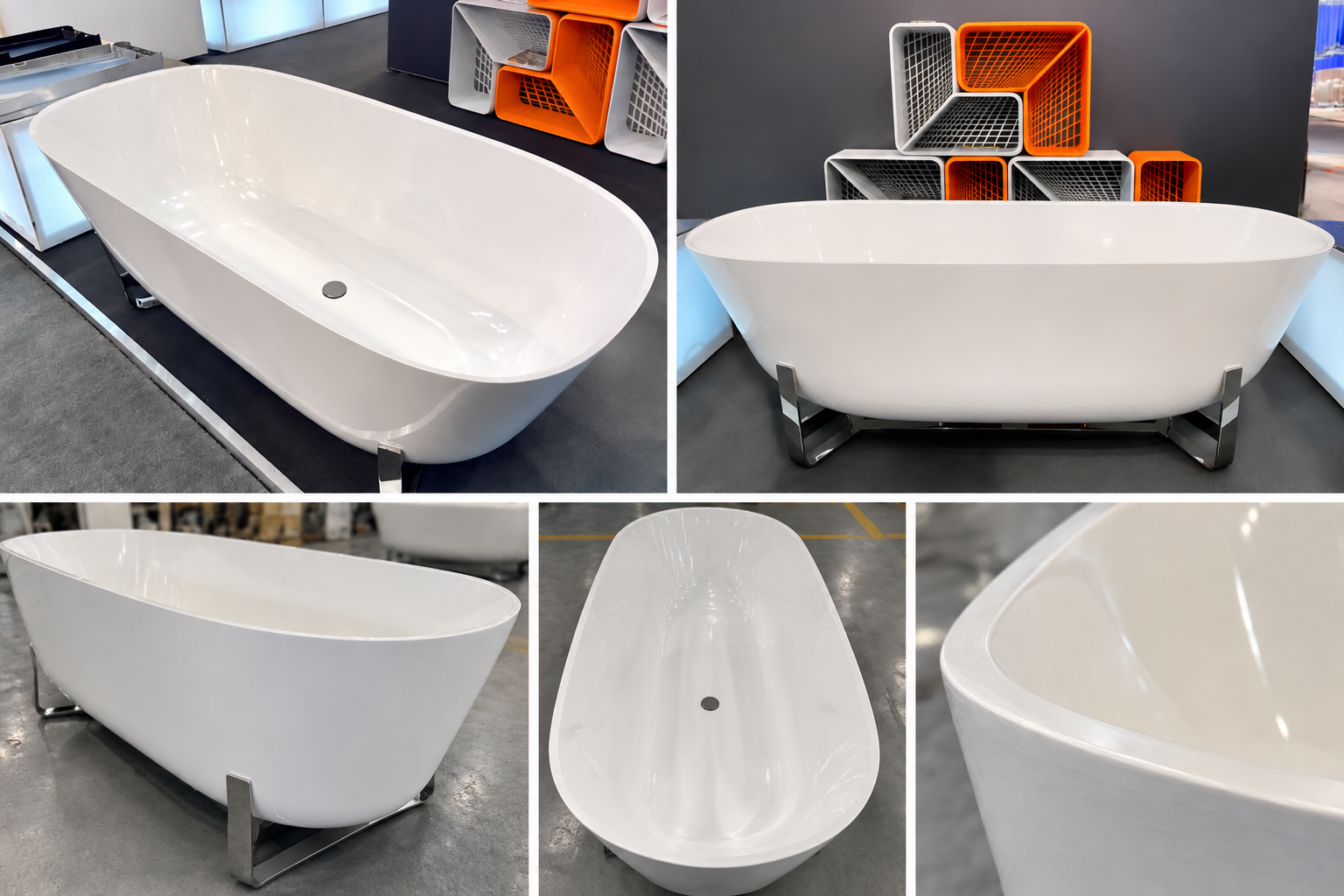
Featured image: user-supplied bathtub design references. The material, manufacturing process and performance are unverified; these views are not evidence of a completed Jingrui Proto cold-plunge project.
Quick Answer
Large-format FGF pellet extrusion can produce a custom cold-plunge tub shell or a master for subsequent molding. Its strongest use is evaluating an unusual shape before committing to dedicated tooling. A usable water-retaining product requires more than a successful print: material selection, load paths, layer integrity, drain sealing and an immersion-compatible surface system must work together. One-piece printing removes assembly seams from the shell, but does not eliminate interlayer leakage or establish structural safety.
For buyers, the first decision is whether the deliverable is an appearance model, a development shell for controlled testing, a mold master or a qualified finished product. These require different quotations and acceptance evidence. Do not order them under the same description of “3D printed bathtub.”
This is an application guide, not a completed Jingrui Proto cold-plunge case study. The accompanying project photograph shows separate FGF furniture and interior forms; the diagram is explanatory and does not represent customer CAD or a tested tub.

What FGF offers—and where conventional routes remain useful
FGF melts thermoplastic pellets in an extrusion system and deposits beads along a programmed path. Compared with a small filament printer, the larger deposition scale suits large shells, forms and tooling. It also makes bead geometry and post-processing central to the design: a smooth rendering does not describe the as-printed surface.
A cold-plunge brand can use this route to evaluate entry ergonomics, interior clearance, drain access and equipment packaging. Revising CAD can be more practical than revising dedicated production tooling during early development. However, avoid comparing a bare printed shell with a finished conventional tub. Include support, sealing, finishing, integration and qualification in both quotations.
| Route | Useful buyer situation | Main limitation to review |
|---|---|---|
| Direct FGF shell | Custom geometry, development iterations, limited quantities | Printed integrity, surface work and full-product qualification |
| FGF master followed by composite molding | Printed geometry is useful but a separate laminate is preferred | Master finishing, mold release, laminate design and tooling work |
| Thermoformed sheet with suitable backing | Repeatable designs compatible with forming | Tooling, draw-related thickness variation and support design |
| Molded composite shell | Shaped shells requiring an engineered laminate | Mold investment, laminate consistency and secondary interfaces |
| Fabricated metal vessel | Designs suited to sheet forming and welding | Weld quality, corrosion strategy, insulation and surface treatment |
No route wins at every quantity. Ask for the boundary of supply and the validation work remaining, rather than a universal break-even number.
Build envelope and CAD decisions before quoting
First confirm the usable build envelope of the FGF machine allocated to the project. A published maximum capacity is not a guarantee that a tub of those outside dimensions can be printed. Orientation, usable platform area, tool access, process allowances and finishing stock require review. A long tub may exceed the envelope even when its width and height fit.
Start with an overall bounding box that includes the rim, ribs, bosses and sacrificial features. Share native or STEP geometry where available, plus drawings for critical interfaces. A mesh alone may hide nominal dimensions or make shell revisions difficult. Identify whether the inner bathing surface or the external styling surface controls the design.
Review these features before finalizing the print strategy:
- Curved walls and transitions that can be deposited without inaccessible support.
- Rim overhangs, recessed ports and cavities that complicate toolpath access.
- A bottom that can be finished, inspected and supported after removal from the platform.
- Separate clearances for insulation, plumbing, servicing and transport protection.
- Machining or finishing allowances at drain seats and equipment interfaces.
If segmentation is necessary, compare a joined shell with using the print as a master. A concealed adhesive seam is still a structural and sealing interface requiring qualification. Discuss the CAD with the FGF 3D printing team before assuming one-piece manufacture.
Wall thickness must follow the load path
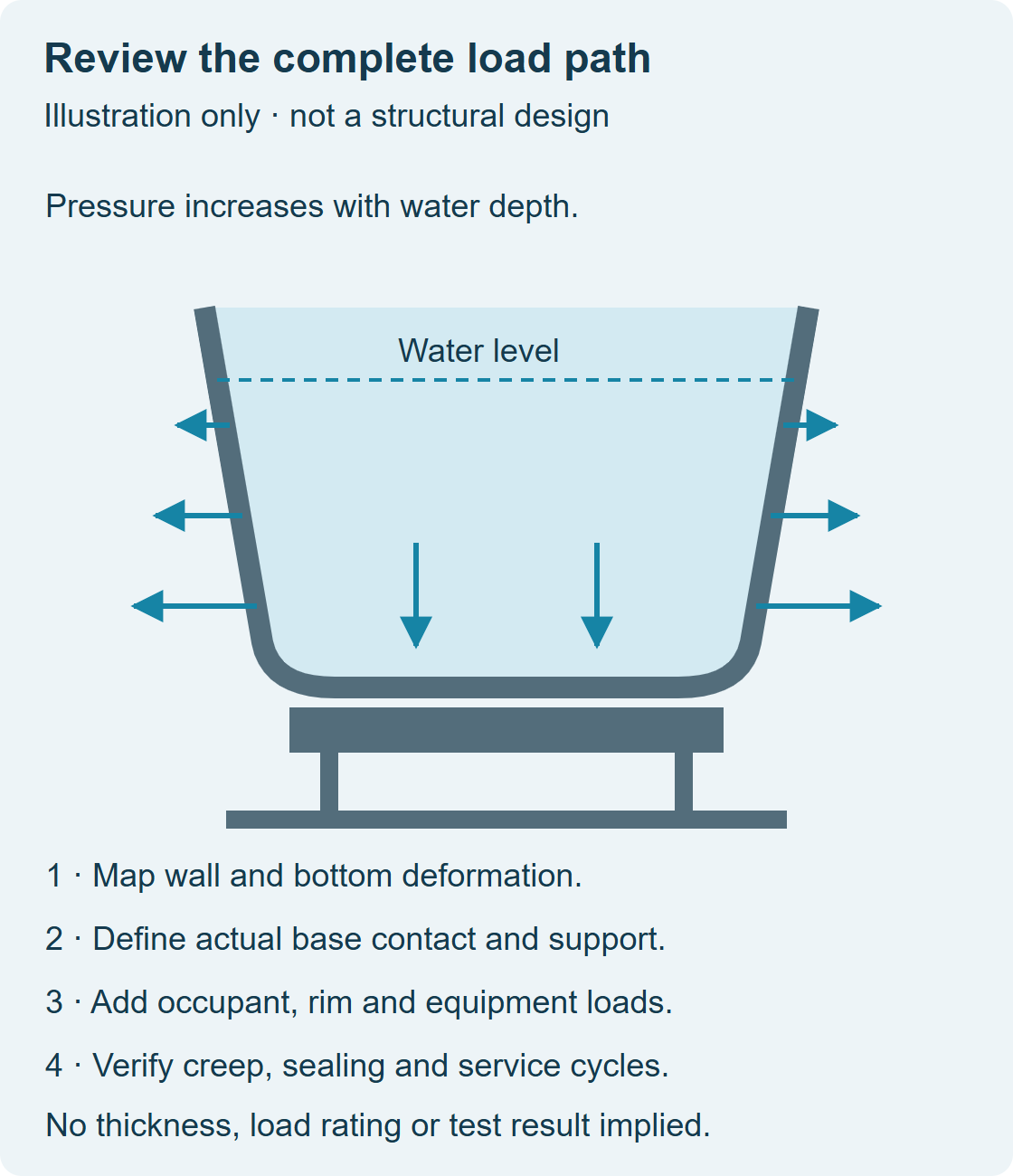
There is no defensible universal wall or bottom thickness for every printed cold-plunge tub. The required section depends on water depth, unsupported span, curvature, material grade, print direction, support locations, long-term deformation and the acceptance limit for movement. Increasing nominal CAD thickness alone does not correct poorly bonded beads or an unsupported floor.
Water pressure and sustained deformation
For an open vessel containing still water, gauge pressure increases with depth: p = ρgh. As an illustrative calculation, water at a depth of 0.6 m produces about 5.9 kPa gauge pressure, using ρ = 1,000 kg/m³ and g = 9.81 m/s². This is not a Jingrui design specification or a tested tub result. Pressure is lower near the surface; structural analysis must account for its distribution across the wall.
Total support load also includes water mass, the occupant, the shell and connected equipment. Entry, exit and a person leaning on the rim create additional load cases. Long-term polymer creep matters even if an initially filled shell looks stable. Material test-bar strength does not establish acceptable deflection under sustained service loading.
Bottom support, ribs and local interfaces
A flat bottom spanning between narrow feet behaves differently from one supported on a broad cradle. Define which surfaces actually contact the base and how loads reach the floor. Uneven supports can concentrate stress, while an apparently continuous base may lose contact as the shell distorts.
Ribs can shorten unsupported spans, but their orientation, attachment and transitions must match the printed structure. Abrupt junctions, isolated thick masses and inaccessible hollow pockets can create manufacturing or inspection problems. Drain bosses need enough local structure for sealing without transferring hose loads into a thin wall. Provide serviceable support for pumps and pipework rather than hanging them from printed ports.
The engineering review should produce a thickness map, support arrangement, print orientation and validation plan together. Where analysis is used, specify direction-dependent properties and justify boundary conditions. A simulation based on an isotropic injection-molded material can give misleading confidence in an extruded shell.
ASA versus glass-fiber-reinforced ASA
ASA is a candidate worth evaluating for applications involving outdoor exposure, but the name alone does not establish immersion suitability, disinfectant resistance or cold-service impact performance. Obtain the exact pellet grade, processing guidance and supporting data. Filament experience or an unrelated ASA datasheet is insufficient evidence for a large pellet-extruded shell.
An example of a commercially documented reinforced grade is Polymaker PolyCore ASA-3012. Its manufacturer describes 20% glass-fiber reinforcement; the earlier datasheet specifies mass percentage. This is a material reference, not confirmation of Jingrui stock, an approved tub material or a recommendation to substitute grades without review.
| Material direction | Potential reason to evaluate it | Trade-off or evidence needed |
|---|---|---|
| Unreinforced ASA | Weathering-oriented polymer candidate; no reinforcing fibers to expose during finishing | Grade-specific stiffness, creep, shrinkage, bonding and chemical compatibility |
| ASA with 20% glass fiber | Potential stiffness and dimensional-stability benefits | Directionality, interlayer performance, surface preparation and impact behavior |
| Printed shell with separate liner | Separate structural and water-contact functions | Liner support, movement, sealing, drainage and repair access |
Glass fiber does not make the print equally strong in every direction. The manufacturer’s ASA-3012 data separates injection-molded specimens from printed specimens and reports different printed X–Y and Z properties. Those controlled specimens are not full-size tub measurements. Buyers should request evidence applicable to the actual orientation and process.
Reinforcement can also affect tooling wear and surface finishing. Sanding a reinforced substrate may expose fibers; the final water-contact surface must remain continuous and cleanable. More reinforcement is not automatically better: stiffness, toughness, deposition quality, surface requirements and repairability must be balanced for the application.
One-piece printing does not guarantee waterproofing
Eliminating bonded shell segments removes one possible leak path. It does not remove bead boundaries, starts and stops, pores, drain penetrations or defects introduced during finishing. Oak Ridge National Laboratory research documents voids between deposited beads, internal porosity and directional behavior in large-scale extrusion printing. It supports checking these risks; it does not establish the leakage rate of a particular tub.
Distinguish three surface objectives: attractive appearance, structural integrity and a continuous water barrier. Sanding and decorative painting may improve appearance without providing a durable immersion barrier. A glossy finish is not evidence of leak resistance, cleanability or coating adhesion after thermal cycling.
Specify the proposed substrate preparation, pore-filling or sealing stage, barrier or liner, final surface and repair procedure. Obtain written compatibility guidance for the exact printed polymer and reinforcement. Coating thickness, curing conditions and inspection requirements should come from the selected coating system, not an arbitrary general recipe. Validate preparation on representative printed coupons before treating the full shell.
Epoxy surface-preparation guidance illustrates why substrate cleanliness, abrasion and adhesion matter; it is not approval of a particular epoxy for an ASA cold-plunge vessel. The supplier must separately confirm continuous immersion, operating temperatures, cleaning chemicals and applicable water-contact requirements. Jingrui’s surface finishing service can be discussed during RFQ review, without assuming every decorative finish is suitable for this application.
Plan ports, insulation and cold-service exposure
Treat each penetration as its own sealing design. Define a flat or controlled sealing land, gasket material, backing arrangement, assembly procedure and maintenance access. Avoid relying on rough printed threads or tightening a fitting until leakage stops. Excessive clamping can distort the seat or damage the local shell, while unsupported plumbing can apply leverage during servicing.
Specify normal water temperature, empty-storage temperature and exposure during cleaning or transport. Cooling the vessel can produce differential movement between shell, lining, fittings and support. An empty tub exposed to sun is a different condition from a chilled, filled tub. Freeze exposure requires its own assessment; do not assume a cold-plunge design is freeze tolerant.
Insulation and condensation control belong in the product design. Specify where moisture can collect, how the base can be inspected and whether an outer cover prevents drying. Chemical compatibility must identify the actual sanitizer, concentration, contact time and cleaning method. “Suitable for water” is too broad a requirement for a maintained wellness product.
Agree on evidence before approving the shell
Use staged acceptance to separate risks rather than declaring success after a photograph of a filled vessel.
- Material and process review: record the selected grade, orientation, representative coupons and process controls appropriate to the project.
- Geometry review: inspect critical dimensions, support contacts, drain lands and accessible surfaces before coating hides them.
- Surface-system review: approve representative preparation, adhesion and appearance samples, including local repairs.
- Controlled vessel evaluation: agree fill level, support arrangement, duration, leak-detection method and deflection observations. Establish safe handling before loading.
- Service-condition evaluation: define thermal cycles, cleaning exposure, fitting service and follow-up inspection appropriate to the intended use.
Write pass/fail criteria and responsibilities before testing. Distinguish shell evidence from complete-product requirements covering electrical equipment, hygiene and the destination market. These are proposed procurement stages, not tests claimed to have been performed by Jingrui Proto on the reference tubs.
RFQ checklist for a useful quotation
Send a package that lets suppliers quote the same deliverable:
- CAD, overall dimensions, internal usable geometry and revision identifier.
- Quantity, development stage and whether the print is a master, prototype shell or finished vessel.
- Water depth, intended occupant loading, support layout and rim-use assumptions.
- Proposed material grade, reinforcement and any mandatory supporting documentation.
- Operating, cleaning, outdoor, storage and transport conditions.
- Drain and circulation drawings, seals, accessible connections and equipment loads.
- Required inner and outer finishes, liner concept, appearance samples and inspection access.
- Agreed validation responsibilities, acceptance records, packaging and delivery destination.
Request separate quotation lines for printing, support, finishing, fittings and agreed validation work. This makes a low shell price easier to evaluate against the cost of a usable development assembly.
Frequently asked questions
Can an FGF tub be printed in one piece?
Potentially, if the complete geometry and print strategy fit the usable build envelope. Jingrui Proto confirms feasibility after CAD review; nominal machine dimensions alone do not establish a fit.
What wall thickness should I specify?
Provide water depth, support arrangement, geometry and allowable movement first. Wall, bottom and rib dimensions should follow structural and manufacturing review, rather than a universal minimum copied from another tub.
Is 20% glass-fiber ASA the best material?
Not universally. It is a documented reinforcement option worth evaluating, but printed directionality, impact requirements, surface work and the complete barrier system can change the decision.
Does one-piece printing remove the need for a liner?
No. A one-piece shell still needs a justified water-barrier strategy. Whether that uses a coating, liner or qualified printed surface depends on evidence for the specific construction.
Can a waterproof paint solve every leak?
No. A coating cannot compensate reliably for uncontrolled shell movement, unsuitable joints or poor adhesion. Qualify the substrate and surface system together under the intended service conditions.
What should I send Jingrui Proto first?
Send CAD, dimensions, quantity, intended use, water depth, support concept and surface requirements. Identify missing design decisions so feasibility review can separate appearance development from functional qualification.
Request a cold-plunge shell feasibility review
Jingrui Proto supports FGF printing, in-house CNC machining and surface finishing, with the project route confirmed during review. Send your CAD files and RFQ requirements for an assessment of build fit, shell strategy, finishing scope and the evidence needed before functional approval. State clearly whether you need a mold master, a development prototype or a complete water-retaining product.
Author
Jingrui Proto technical content team. This guide explains manufacturing and procurement considerations; the supplied reference images do not establish a tested product specification.










